
Remove Cat Urine From Laminate Floor
:max_bytes(150000):strip_icc()/remove-cat-urine-odor-from-wood-floors-1821892-03-55a5bd3ed3e541418772b7d327ea3f53.jpg)
There is a specific, chilling silence that follows the unmistakable sound of a cat retching near the baseboards, but the real horror begins when you stand up from scrubbing and catch a whiff of that ammonia-laced phantom. Cat urine is not just a stain; it is a chemical event, a biological weapon deployed with casual indifference by an animal that rules our homes. Unlike wine or coffee, which merely stain fibers, feline urine is a concentrated solution of urea, uric acid, and bacteria that crystallizes on contact with air, creating a salt-like residue that rehydrates with every rise in humidity. Modern laminate flooring, with its photographic paper layer and fiberboard core, acts like a wick, drawing this cocktail deep into its seams, where standard cleaning solutions—and even many "pet-specific" enzyme cleaners—fail to penetrate.
The history of this domestic battle is as old as domestication itself. Ancient Egyptians worshipped cats and likely ignored the smell of stale urine on their mud-brick floors, but we, in our era of open-plan living and bleached oak aesthetics, demand more. Laminate flooring, introduced in the late 1970s as a cheaper, harder-wearing alternative to hardwood, has become the great equalizer of modern housing—yet it is uniquely vulnerable to moisture. The irony is poetic: we chose a floor that resists scratches but crumbles internally at the first sign of liquid. Today, with remote work keeping us close to our pets and pet ownership at an all-time high, knowing how to decontaminate laminate is not just a chore; it is an act of psychological survival.
The Alchemy of Ammonia: Why Your Floor is Crying Out for Chemistry
The lesser-known truth about cat urine is that it is not actually the urine that smells the worst—it is the bacteria that feed on it. Fresh urine is mostly water and urea, which has a mild, earthy smell. However, within 24 hours, naturally occurring bacteria break down the urea into ammonia, and then, over several days, the ammonia is further converted into mercaptans—the same sulfur compounds that make skunk spray horrific. This chemical cascade means that waiting even one day to clean turns a minor spill into a permanently etched odor. On laminate, this is catastrophic because the protective wear layer is porous on a microscopic level, allowing the uric acid crystals to bond with the finish. Standard vinegar or bleach solutions are useless; they either neutralize the smell temporarily or, in bleach's case, risk a toxic chloramine gas reaction with the ammonia.
Psychologically, the smell of cat urine triggers a primal fight-or-flight response in humans. Our olfactory receptors are hyper-tuned to detect ammonia because it signals decay and unsanitary conditions. This is why you can "smell it even after cleaning"— your brain is detecting microscopic traces that your nose perceives as a threat, causing you to obsessively sniff the area. The cultural impact is significant; a home with pet odors is often the subject of whispered judgment, and many renters have lost security deposits over this exact issue. In Japan, where laminate is ubiquitous, a "pet clause" in rental agreements often includes a non-refundable "odor decontamination fee" equivalent to two months' rent—a testament to how deeply this problem affects real estate value.
The chemical solution lies in oxidation, not neutralization. Enzymatic cleaners break down urea, but for laminate, you need a two-step process: an alkaline degreaser to remove fatty acids, followed by an oxidizing agent like hydrogen peroxide to break the uric acid crystals. However, the most underrated tool is unfragranced, 99% pure isopropyl alcohol. Alcohol evaporates quickly, lifting the urine from the laminate's pores without soaking into the fiberboard core. Many professionals swear by a mix of 1 part rubbing alcohol, 1 part water, and a drop of dish soap—not because it kills bacteria, but because it literally dissolves the crystalline salts that have embedded in the wear layer.
The Protocol: From Crisis to Cure in Four Movements
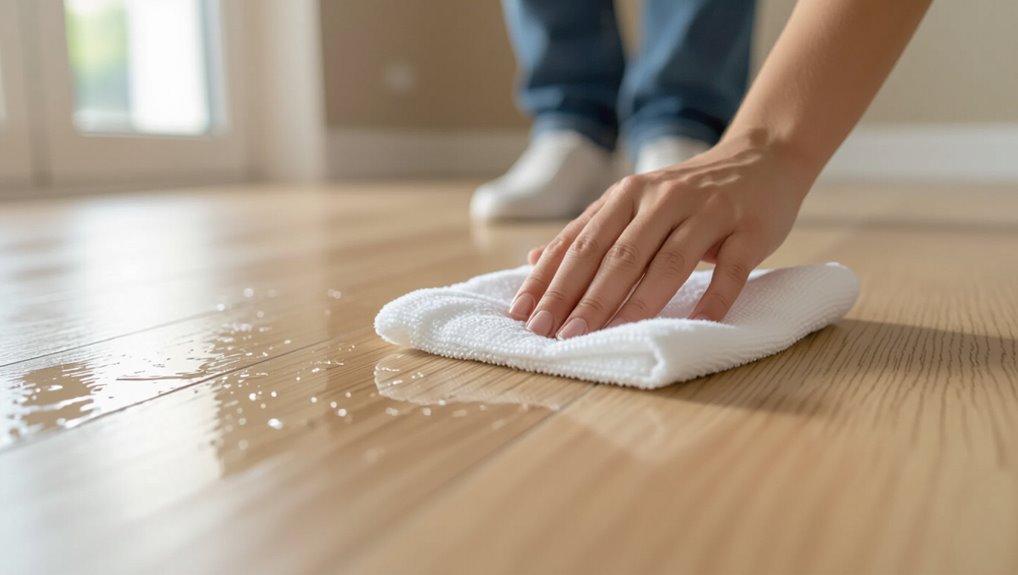
Imagine the scenario: you return from work to find a large, suspicious puddle by the cat's food bowl, now dried to a yellow-ish sheen. Panic sets in. Stop. Do not pour water on it. Adding water to dried urine on laminate is like adding water to a dried soup mix; it rehydrates the crystals and pushes them deeper into the seams. Instead, start by removing the dry matter with a vacuum using a crevice tool. Then, mix your degreasing solution: ¼ cup of white vinegar, 1 tablespoon of baking soda, and 2 cups of lukewarm water. Apply this sparingly—never soak—using a soft microfiber cloth. Work in small circles, applying pressure to lift residue, not spread it. Then, immediately follow with a dry cloth to absorb any moisture.
For the second stage, you must target the underlying core. If the urine has seeped into the seam between planks, you need to introduce the alcohol solution. But here is the professional secret: use a syringe or a needle-nose bottle to inject the alcohol directly into the seam.
:max_bytes(150000):strip_icc()/remove-cat-urine-odor-from-wood-floors-1821892-07-ef43bdd1586f44679b81be7fffea560e.jpg)
This capillary action pulls the alcohol into the joint, dissolving the uric acid without swelling the fiberboard. Let it sit for five minutes, then blow-dry on a cool setting to evaporate the liquid and lift the odor. For deeply set cases, a paste of hydrogen peroxide and baking soda applied thinly over the seam and covered with plastic wrap for two hours will bubble the odor out of the substrate.
Consider the case of Maya, a graphic designer with a beloved, elderly Siamese cat who suffered from chronic kidney disease, producing painfully strong urine. She had already replaced one laminate floor before consulting a flooring specialist. Her mistake? Using a steam mop. The heat activated the dried urine, baking it into a permanent bond. The specialist's advice was to use a UV blacklight to locate every spot—cat urine fluoresces under UV light—and then treat each with a small, hand-held steamer set to 200°F, followed by immediate vacuum extraction. It took three hours, but the floor was saved. The takeaway? Do not use a standard steam mop on laminate with pet accidents; it will ruin the floor.
Actionable takeaway for you: Buy a small UV flashlight (under $15) and check your home at night. You will likely find spots you never knew existed. For each spot, perform the following ritual: vacuum the dry crystals, apply a diluted vinegar solution, inject alcohol into seams using a syringe, and then use a hair dryer on low heat to finish. Mark your calendar—if the smell returns in 35 days, you have uric acid crystals deep in the core that require professional extraction, not just surface cleaning.
The Rite of Purification: Five FAQs on Banishing the Olfactory Ghost
1. Can I use bleach to remove cat urine from laminate?
Absolutely not. Bleach reacts with the ammonia in cat urine to form chloramine gas, which is a severe respiratory irritant and can cause coughing, wheezing, and in confined spaces, serious damage to your lungs. Furthermore, bleach is a strong oxidizer that will permanently discolor or degrade the melamine wear layer on your laminate, leaving a dull, whitish haze that is worse than the stain. The smell of bleach may dominate temporarily, but the urine salts remain intact and will re-emerge once the chlorine odor fades.

Instead, opt for neutral pH cleaners specifically designed for laminate or a diluted isopropyl alcohol solution. These will lift the organic compounds without chemically reacting with them. If you must sanitize, use a commercial pet enzyme cleaner that lists "no chlorine" on the label, and always test it on an inconspicuous corner of the floor first to check for fading or warping.
2. Why does my laminate floor still smell even after I cleaned it thoroughly?
The smell persists because the urine has penetrated the joints where your planks meet. Laminate planks are not sealed individually; they are locked together with a tongue-and-groove mechanism that leaves microscopic gaps. When you clean the surface, you remove the surface residue, but the liquid has wicked into the high-density fiberboard (HDF) core, which acts like a sponge. The uric acid crystals in the core are impervious to most cleaners because they are not water-soluble—they require an acid or alcohol solvent to break the crystalline bond.
Furthermore, humidity plays a role. The crystals are hygroscopic, meaning they attract moisture from the air. When indoor humidity rises (e.g., after a shower or during a rainstorm), the crystals absorb that moisture, rehydrating and releasing the ammonia odor. To address this, you must capillary-inject a solvent into the seams as described above. If the smell persists after three treatments, the core is likely compromised, and you may need to lift that specific plank (modern flooring often allows single-plank replacement) and replace the underlayment.
3. Is it safe to use a steam mop on laminate after a cat accident?
No, and this is a common, costly mistake. Steam mops force hot water vapor into the seams and micro-pores of the laminate. While this is excellent for sanitizing sealed surfaces, it is devastating for laminate because the moisture expands the HDF core, causing it to swell, warp, and permanently buckle. With urine, the heat also bonds the proteins to the wear layer, essentially baking the odor in and making it impossible to remove with any subsequent cleaning.

If you have used a steam mop already, inspect the floor for swollen edges or a slight ripple. If you see this, the floor's structural integrity is compromised. For future accidents, use a cold, damp microfiber mop with the lowest amount of water possible, and immediately follow with a dry mop to wick away all residual moisture. Never soak the floor; remember that laminate is 90% wood product and 10% plastic, and it hates water.
4. What is the most effective commercial product for laminate floors?
There is no single "silver bullet," but the most effective category is enzymatic cleaners with a low pH (below 7) and no volatile organic compounds (VOCs). Products like "Nature's Miracle Urine Destroyer" or "Rocco & Roxie" are good, but you must check the label for the enzyme count and ensure it contains protease (an enzyme that breaks down proteins specifically). However, for laminate, you need a cheaper, DIY prep step first. Spray the area with a 10% solution of rubbing alcohol to dissolve the uric acid salts, then apply your enzyme cleaner and cover with plastic wrap for 24 hours to keep it wet, allowing the enzymes to digest the residue.
Baking soda and vinegar are excellent home remedies, but they are not enzymes. They neutralize freshness but do not digest the proteins. For the best commercial results, look for a "peroxide-based" oxygenating cleaner that is safe for wood. These create a bubbling oxidation reaction that physically lifts the crystals out of the pores. Always avoid ammonia-based glass cleaners—they mimic the smell of cat urine and, ironically, encourage your cat to re-mark the spot.
5. How do I stop my cat from peeing on the same spot on the laminate floor?
This is a behavioral and olfactory problem combined. Once the area smells like a toilet, even if you can't smell it, your cat can. Cats have up to 200 million olfactory receptors, so they detect traces that are invisible to us. First, biologically, you must clean with an enzyme. Then, you must break the chemical marker. Rubbing the area with lemon or orange essential oil mixed with water can deter them because citrus is offensive to most felines. However, be careful—essential oils like phenol are toxic to cats, so use only a micro-drop and ensure they do not lick the area.
:max_bytes(150000):strip_icc()/remove-cat-urine-odor-from-wood-floors-1821892-04-d14f0b01b9ca4cb0b89d48c387978311.jpg)
Second, change the floor's texture. Cats prefer smooth surfaces for urination when they have a urinary tract infection, but they also prefer a surface that "feels" absorbent. Laying down a plastic placemat or a temporary scrap of vinyl tile with a textured surface can break the habit. Finally, consider the psychological angle. If your cat is stressed or their litter box is dirty, they will seek out a low-travel, low-light area like the corner of a laminate floor. Provide multiple litter boxes, place them in the area of the accident (temporarily), and clean the litter box twice daily. The cat is not being malicious; they are communicating that their environment is too sterile or too stressful.
In the end, removing cat urine from a laminate floor is a meditation on impermanence. We spend thousands of dollars and hours choosing floors that reflect our ideals of cleanliness and order, only to have a small, furry creature remind us that our homes are shared ecosystems, not museums. The struggle against the smell is a daily negotiation between our desire for control and the wild, bodily reality of the animals we love. It is humbling to realize that a chemical compound can outsmart our cleaning supplies, and there is a strange beauty in that biological tenacity.
Yet, this chore connects us to generations of pet owners who have faced the same damp cloth and aching back. It is a rite of passage, a badge of honor in the secret society of those who care for creatures. We mop, we sniff the air like suspicious detectives, we curse, and then we do it again, because the companionship is worth the chemistry. This mundane act of purification is a proof of love—a love that is stubborn, practical, and slightly smelly, but real.
Ultimately, our floors are not perfect, and neither are we. The faint, lingering trace of our cat's rebellion is a reminder that perfection is overrated and that a home is alive. We fight the crystals, we win the battle, and we welcome the cat back onto the freshly cleaned surface, knowing that deep down, the stain is a story. And stories, unlike uric acid, are meant to be shared.
:max_bytes(150000):strip_icc()/remove-cat-urine-odor-from-wood-floors-1821892-01-509ce62c9eda424b9db4602eaf62eba9.jpg)
:max_bytes(150000):strip_icc()/remove-cat-urine-odor-from-wood-floors-1821892-05-978db028dbb6458a923e654bd9802d7e.jpg)
