Nyu International Relations Major
So there I was, a sophomore, huddled in a Washington Square Park corner with a coffee that was 90% milk, trying to decode the argument two of my friends were having. One was a Stern finance bro explaining how the Greek debt crisis was a "liquidity problem," while the other, a Gallatin performance studies major, insisted it was a "symptom of neoliberal performativity." Neither of them was making sense to me, and I just wanted to know if my favorite ramen spot was going to hike prices again. That’s when I realized—I needed a framework that could handle both the spreadsheets and the street protests.
That, my friends, is the magic of the International Relations (IR) major at NYU. It’s not just about memorizing treaties or pointing at maps; it’s about learning to speak two completely different languages—the language of power and the language of people—simultaneously. And you get to do it in one of the only cities on Earth that feels like a permanent United Nations general assembly, minus the boring suits.
It’s Not Your High School’s Model UN
Let’s get one thing straight: this major is not about staging fake debates about the South China Sea in a stuffy classroom (though, okay, you might do that once, and it’s kind of fun). The real deal is about analyzing why the South China Sea matters in the first place—economically, environmentally, and historically—and then figuring out who has the leverage to do what about it. You’re not just asking “what happens next?”; you’re asking “whose definition of ‘next’ are we even using?”
Must Read
The core curriculum is a beautiful, brutal workout for your brain. You’ll take a politics course that’s heavy on theory—think Hobbes, Locke, and a lot of people with three names who wrote in German. Then, you’ll pivot to an economics class where you’ll learn why your favorite foreign brand of chocolate is suddenly twice as expensive. It’s a constant back-and-forth between the idealistic “how the world should be” and the cynical “how the world actually works,” and you’ll be expected to hold both in your head at once.
The Five Boroughs Are Your Textbooks
Here’s the part that makes NYU genuinely different from, say, a campus in rural Ohio (no shade, Ohio, you have corn mazes). Your classroom extends to the UN headquarters, which is a 20-minute subway ride away, but more importantly, to the neighborhoods. The IR major pushes you to treat the city as a living lab. You’ll find yourself doing fieldwork in Flushing for a paper on Chinese soft power, or grabbing a bodega coffee while interviewing a diplomat’s kid about their transnational upbringing.
I remember an assignment where we had to trace the supply chain of a single item—I chose my sneakers—and it ended up involving a dusty factory in Vietnam, a shipping route through the Suez, and a trade policy dispute in Washington. It wasn’t just a paper; it was a scavenger hunt through the global economy, and every storefront in SoHo was a clue. That’s when I stopped seeing the city as just a backdrop and started seeing it as a complex, breathing organism of deals and frictions.
The “What Are You Going to Do With That?” Question
Oh, you’ll get this one at every family dinner. And honestly, the answer is: anything you want, because you’ll learn how to think. The truly ironic part is that a lot of IR grads don’t go into diplomacy at all. You’ll find them in tech policy, at NGOs, in journalism, or working for consulting firms that tell governments how to greenwash. (Yeah, we train the people you love to hate, too. Sorry about that.)
The skills are ridiculously transferable: you learn to parse dense jargon (great for AI startup pitches), negotiate with difficult people (great for group projects), and write convincingly under pressure (great for, well, almost everything). You also get a crash course in being humbled—because every time you think you’ve nailed a geopolitical prediction, the world laughs and does a coup d'état just to spite you.
A Tribe of Global Nerds
What I love most is your people. The IR major attracts a specific breed: the kid who watched Borgen in high school, the girl who argued with her parents about foreign aid at age 12, the person who has three passports and a constant identity crisis. You’ll form study groups that feel like a mini security council, complete with shouting matches over who gets to explain realpolitik first.
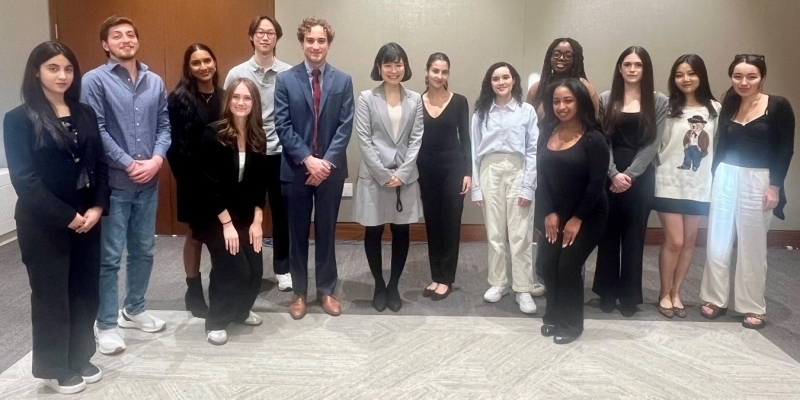
The professors are a mixed bag—some are brilliant academics who’ve never left the ivory tower, and others are ex-diplomats who will drop war stories that make your Netflix true-crime queue look tame. They all have one thing in common: they expect you to come to class with an opinion, but a well-sourced opinion. "Because I feel like it" is not a thesis, my friend.
So, is it hard? Yes. Will you feel overwhelmed by the sheer scale of human misery and geopolitical complexity? Absolutely. But will you also learn to see the world as a place where change is possible, where small actions ripple across borders, and where your ramen place’s price hike is actually a fascinating story of tariffs and weather patterns? That’s the gift. You’ll never read a headline the same way again, and that’s a curse I wouldn’t trade for anything. Now, go schedule that coffee chat with an advisor—and bring a notebook, because you’ll need it.