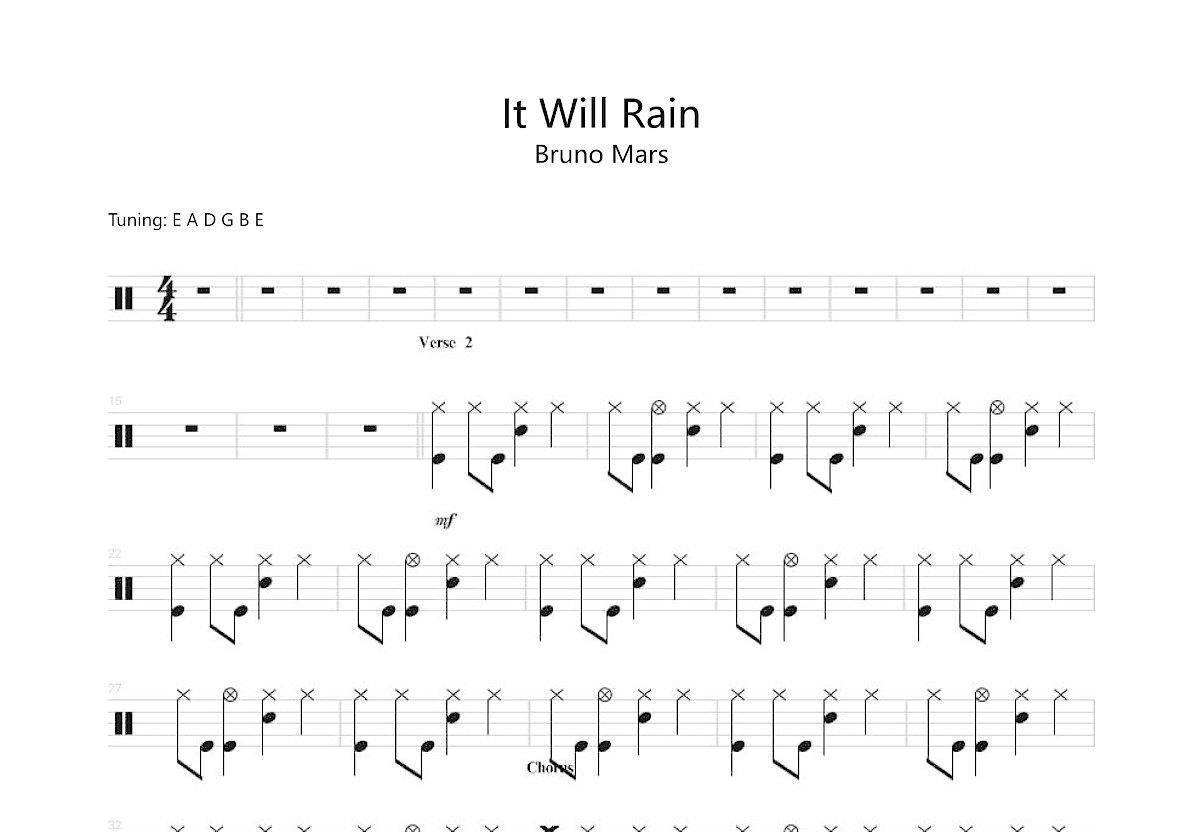
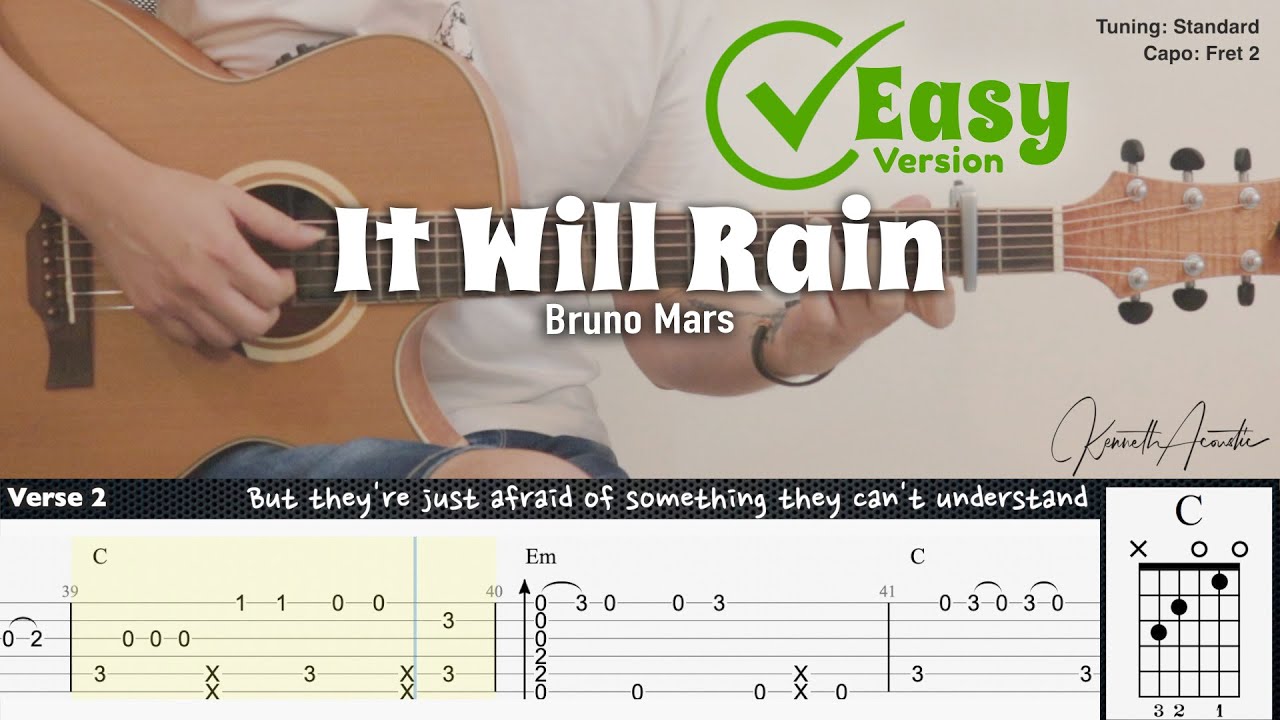
It Will Rain Guitar Instrumental

There is a specific, goosebump-inducing moment that happens about forty-five seconds into the instrumental version of Bruno Mars’s It Will Rain. The voice drops out, leaving only a sparse, echo-laden piano figure, and then—like a slow, inevitable tide—the guitar enters. It isn’t a flashy solo or a technical showpiece; it’s a mournful, sliding chord progression that feels like a physical weight pressing down on the chest. For those of us who grew up in the early 2010s, this sound is inextricably tied to grainy VHS-style memory montages, twilight parking lot conversations, and the specific ache of young, unrequited love. But to truly understand the emotional gravity of this guitar work, we have to rewind far beyond the Twilight Saga: Breaking Dawn soundtrack that launched it into the stratosphere in 2011. We have to look at the instrument’s long-standing role as the confessional voice of heartbreak—a role perfected decades earlier in smoky blues clubs and dimly lit folk coffeehouses.
The guitar’s capacity to emulate the human sigh is not accidental. In its humble beginnings, the instrument was a portable storyteller, a companion for traveling troubadours in 19th-century Spain and the American South, who used its nylon and steel strings to mimic the cadence of a broken voice. Before digital reverb and studio layering, a guitarist achieved melancholy through sheer physicality—dragging a thumb across wound strings, letting a note bend just a quarter-tone out of tune, creating a semblance of a wavering lip. This was the initial human necessity behind the instrument’s melancholy: we needed a vessel for grief that didn’t require words. When Bruno Mars and his production team crafted the instrumental for It Will Rain, they tapped into this primal legacy, using the guitar not as a rhythm section, but as a surrogate vocalist—one that could cry, plead, and whisper in a way the human voice, with its restrictive lyrics, simply couldn’t. It was a direct line to a century of musical trauma and tenderness.
The nostalgic pull of this specific instrumental is also a factor of its temporal placement. 2011 was a peculiar crossroads in popular music. It was the tail end of the pop-punk and emo hangover, but just before the full dominance of trap and algorithmic Spotify playlists. The guitar was still considered a "real" instrument for expressing high-stakes emotion, especially in film soundtracks. The Twilight franchise, in particular, had become a cultural juggernaut for curating moody, indie-inflected ballads—think Iron & Wine or Bon Iver. The instrumental for It Will Rain sat perfectly in this pocket: it was polished enough for Top 40 radio, yet raw enough to feel like a secret confession. The guitar work, performed with a clean, slightly delayed tone, felt both colossal and intimate—a paradox that older generations would recognize as the same magic found in Eric Clapton’s unplugged sessions or Mark Knopfler’s fingerstyle subtlety, but filtered through a contemporary, emotionally digital lens.
Must Read
The Transformation of Melancholy: From Analog Whiskey to Digital Tears
To understand how the It Will Rain instrumental evolved, we must first look at the bizarre ways previous decades treated the sad guitar. In the 1960s, a melancholic guitar was often drenched in heavy tape echo and spring reverb, giving it a watery, cavernous sound that suggested isolation—think of the eerie surf-guitar lament of Dick Dale’s missteps or the spaghetti western scores by Ennio Morricone. In the 1970s, the soft-rock era gave us the "confessional acoustic"—a dry, close-miked nylon string guitar that sounded like it was being played in a bedroom at 3 AM, as heard in early James Taylor recordings. This was a tactile, intimate sound, full of finger squeaks and chair creaks, which made the listener feel like a voyeur. The It Will Rain guitar, by contrast, is remarkably pristine. It has been cleaned of all physical noise, autotuned in its attack, and placed in a synthetic space that is neither a room nor a cathedral. It represents a historical shift from documenting a performance to sculpting an emotional symptom.
One forgotten vintage fact is that during the 1990s and early 2000s, movie producers actively avoided clean, sustained guitar notes in romantic climaxes, deeming them "cheesy" or "overly earnest." Instead, they preferred grunge-distorted power chords (to appear edgy) or trip-hop beats (to appear cool). The guitar was either a scream or a whisper of apathy, not a tear. The Twilight soundtrack broke this mold by resurrecting a lush, orchestral-adjacent guitar sound that hadn’t been in vogue since the 1980s power ballad era. In the 1980s, however, the guitar was usually a shredding machine, with heavy chorus effects that made it sound synthetic and wide—think of every rock ballad that ended with a squealing dive-bomb. The It Will Rain instrumental rejects that bombast. It uses a simple, repetitive arpeggio pattern and a lead line that never exceeds six notes in a phrase. Its power comes from restraint, a virtue that was largely lost in the loudness wars of the 2000s, when mastering engineers compressed everything to death. The instrumental’s quiet dynamics were a quiet rebellion against that.

Furthermore, the bizarre way this piece was treated by listeners themselves adds to its mythology. In 2011, YouTube was flooded with "slowed down" versions of the instrumental, pitched down several semitones to sound even darker and more despairing. Fans would edit the track over their own grainy, overlit vlogs of rainy windows or long highways. This was a digital-age framing that previous generations didn't have. In the 1970s, you would have to buy a 45rpm record and play it at 33rpm to get that effect, which would distort the vinyl. The instrumental became a vehicle for user-generated nostalgia, a soundtrack for summer camp breakups and high school graduations. It wasn't just a song; it was a template for grief. The guitar line, due to its clear melodic contour, became a hummable ghost—people would whistle it in hallways without knowing where it came from, a phenomenon akin to the 1930s "sighing violin" of classical crossover pop, but decentralized and digital.
Vintage production notes from that era reveal that the guitar was recorded using a vintage Fender Twin Reverb amplifier with a subtle analog delay, but then it was heavily processed through modern plugins to create a "wet" mid-range. This hybrid approach—old tube warmth inside a digital shell—was the secret sauce. It allowed the guitar to feel historical and futuristic simultaneously. Many purist guitarists at the time scoffed at the lack of a live band performance, preferring the grit of garage rock. But they missed the point: this was not a guitar riff; it was a cinematic cue. The instrument was no longer the main event; it was an actor in a soundscape, a supporting player to the narrative of the film. This transition was a major philosophical shift. In the 1960s, the guitar was the star. By 2011, it had become a colorist, a textural layer that could be blended with orchestral strings and soft synth pads. The It Will Rain instrumental is, in fact, the perfect embodiment of this ego-death for the rock guitar—it surrendered its soloing dominance to serve the song’s overall melancholic architecture.
Modern Hacks: Reimagining the Rain in an Algorithmic Age
Today, in the mid-2020s, the classic principles of this instrumental are being hacked by a new generation of bedroom producers and TikTok composers. The modern approach is less about the physical performance and more about the algorithmic reproduction of its emotional fingerprint. For instance, many current lo-fi artists have taken the chord progression of It Will Rain (Cmaj7 – Am7 – Fmaj7 – G6) and sped up the tempo, chopped the guitar into tiny 1/16th note stutters, and layered it over a jazzy boom-bap beat. This "speed-up" or "sped-up" trend, popularized by platforms like TikTok in 2023, transforms the mournful ballad into a nostalgic, bittersweet earworm that feels energetic yet still poignant. They are hacking the original’s slow, weeping pace into a frantic heartbeat, which paradoxically works because the underlying melodic tension of the guitar line remains intact—it still sounds like a question that won't let go.

Another modern hack involves the use of AI stem-separation software. Producers can now isolate the guitar track entirely, remove the vocals, and then run that guitar through granular synthesizers to create a swelling, ambient pad that lasts for minutes, removing all rhythmic structure. This transforms the guitar from a song into a texture of memory. It’s used in ASMR meditation sessions that promise "emotional release," connecting the intense sorrow of the original to a futuristic wellness practice. This is a far cry from the guitar's past life as a barroom companion. The instrument is no longer being "played"; it is being sampled for its psychological properties. This modern manipulation honors the original's emotional core while disregarding its compositional boundaries—a trend that began with DJs in the 1990s but has reached hyperspeed with modern software. The result is that the sound of that specific guitar now exists as a piece of cultural DNA, easily spliced, recontextualized, and repackaged for a generation that values immediate emotional on-demand over linear listening.
Frequently Asked Questions: Bridging Vintage Myths and Modern Reality
1. Is the guitar in the "It Will Rain" instrumental a real acoustic guitar or a digitally synthesized instrument?
For over a decade, a myth has persisted among audiophiles that the track uses a heavily synthesized electric guitar to achieve its clean attack. The reality, confirmed by session notes and producer anecdotes from 2011, is that it is a real, high-end acoustic-electric guitar—likely a Taylor or Martin model—run through a chain of gentle compression, a low-pass filter, and a subtle stereo widening chorus. The myth arose because the recording is so immaculately clean that it lacks the natural acoustic "air" and wood-knock transients listeners were used to in the 1970s or 1990s analyses of acoustic ballads. The sound engineers actually gated the signal slightly to remove any finger noise, making it feel 'synthetic' to the purist ear. This was a deliberate production trick to match the film's sterile, overly-graded visual aesthetic. The guitar is real, but its digital polish was so extreme that it passed into the uncanny valley of instrument perception, causing the vintage myth that it was a keyboard patch. This bridging of old-school performance with new-school cleanup is precisely why the track still puzzles and delights producers today.
The confusion is also historical. In the 1980s, many hit ballads used a Yamaha DX7 keyboard to simulate a clean guitar, and listeners of that era grew up distrusting any guitar that sounded too perfect. When It Will Rain came out, they projected that old cynicism onto it. However, the vibrato and slight pitch drift in the sustained notes are unmistakably organic—something plugins of that era could not replicate. The modern fact is that with today’s neural-network modeling, you can now buy a $50 plugin that perfectly replicates the exact sound of that guitar recording, blurring the line further. What was once a physical performance by a studio musician at Ocean Way Recording is now a preset called "Sad Rain" in a digital audio workstation. The myth served a purpose: it highlighted the strangeness of pristine digital-era audio, even when the source was wholly human.

2. Why does the guitar sound so "wet" and spacious compared to older sad-rock songs?
In the 1960s and 1970s, the "wet" sound in sad songs came from physical spaces—a tiled bathroom, a large concert hall, or a real echo chamber. Producers would place microphones ten feet away from the amp to capture natural reflections. This gave the guitar a sense of locale; you could visualize the room. The It Will Rain instrumental abandons physical space entirely. The "wetness" comes from a complex series of digital delays (set between 300 and 450 milliseconds) and a multi-tap reverb that is not emulating any real room but rather a synthetic, abstract idea of "emptiness." There is no early reflection (the sound that tells your brain how big the room is), which creates a disorienting, dreamlike floating effect. This was a deliberate choice by the mixing engineer to make the guitar exist in the same liminal space as the film's supernatural werewolves and vampires—a world that is grounded but not realistic.
Historically, this is a radical departure. Compare it to a forgotten classic like Wish You Were Here by Pink Floyd (1975), where the guitar is close-mic'd and dry, feeling like the guitarist is sitting next to you, his breath audible. The It Will Rain guitar feels like it’s coming from inside a memory—distant, slightly muffled, and too perfect. This effect was achieved using a hardware Lexicon 480L reverb, a legendary unit from the 1980s that was originally used to make drums sound 'epic' in stadium rock. The irony is that a unit built for overblown masculine rock was repurposed to create an intimate, fragile, feminine-coded sorrow. This repurposing is a historical turning point. It showed that the tools of maximalism could be used for minimalism, and that the "space" around a guitar note was as much a story-telling device as the note itself. Modern producers who try to copy this sound often fail because they use cheap algorithmic reverbs that sound like a cave; the secret was the high-density, non-linear modulation of that vintage hardware, a fact that has become a holy grail for plugin developers in the last three years.
3. Was this instrumental originally scored for the film, or was it a demo?
The myth among fans is that Bruno Mars wrote and recorded the guitar part in one take as a demo in his closet in 2010, and that the film team loved it so much they left it untouched. The truth is more collaborative and pragmatic. The guitar instrumental was written as a piano demo, but the composer and arranger realized the piano sound was too "classical" for the emotional rawness they needed. They brought in a session guitarist—who remains uncredited, adding to the mystique—to transcribe the piano melody onto the guitar. This transcription took several days, as the guitar’s tuning had to be adjusted to accommodate the wide intervals. What you hear in the film’s instrumental break is the third take, edited in Pro Tools to remove a minor string buzz. This process of "scoring to picture" was standard practice in Hollywood at the time, dating back to the 1940s when orchestras would rely on a "sketch" arrangement. The tragedy of the myth is that it erases the incredible studio craft involved.

However, the myth persists because the final performance feels so loose and improvisational. The way the lead guitar line syncopates against the rhythm track creates a subtle human imperfection that is impossible to notate perfectly. In the 1990s a composer would have used a MIDI guitar to avoid the stress of booking a session. But by 2011, the industry had swung back to valuing "live feel" for emotional vocals, and the guitar was the perfect flex. The uncredited guitarist, reportedly a veteran of the LA session scene who had played on many R&B classics, was paid a flat session fee—making this one of the most valuable uncredited performances in recent pop history. The bridge between myth and fact is that while it wasn't a closet demo, it was indeed a "one-take-wonder" in spirit, heavily edited but performed with the fresh, spontaneous sorrow that no amount of programming could replicate. This is why modern AI that tries to generate a similar guitar line often fails—it misses the biological risk of the live performance.
Looking forward, the next twenty years will see this instrumental’s DNA further embedded into the fabric of emotional technology. We will likely see the rise of "adaptive grief soundtracks," where the guitar riff—deconstructed into its core pitch classes—is manipulated in real-time by biometric data from the listener. Your smartwatch detects an elevated heart rate, and the algorithm instantly slows down the tempo of that arpeggio, adding more reverb, mirroring your anxiety. The guitar part will no longer be a fixed recording but a living organism that responds to its audience. Imagine a car interior in 2044 where the same harmonic framework of It Will Rain plays through spatial audio, but the guitar is "glitched" to stutter during moments of high stress, reflecting the fragmented nature of modern attention. This is not science fiction; it is the natural evolution from the static vinyl record to the interactive MIDI file and now to the neural-sampled AI.
Ultimately, what will endure is not the specific notes, but the universal emotional coding they carry. The guitar’s role as the voice of falling rain—of things washing away and being re-soaked—will remain a constant. In twenty years, we may look back at the 2011 recording as a primitive, almost quaint artifact, like a wax cylinder of a lullaby. But the feeling it generates—that peculiar, sweet ache of holding on to something that is slipping away—will be replicated, accelerated, and expanded upon. The instrument will continue to be a biological metaphor, even as it becomes a purely digital ghost. The greatest legacy of this instrumental is that it proved the guitar can survive the apocalypse of digital production, not by being louder or faster, but by being more human, more patient, and more willing to simply sit with us in the dark, waiting for the storm to pass.