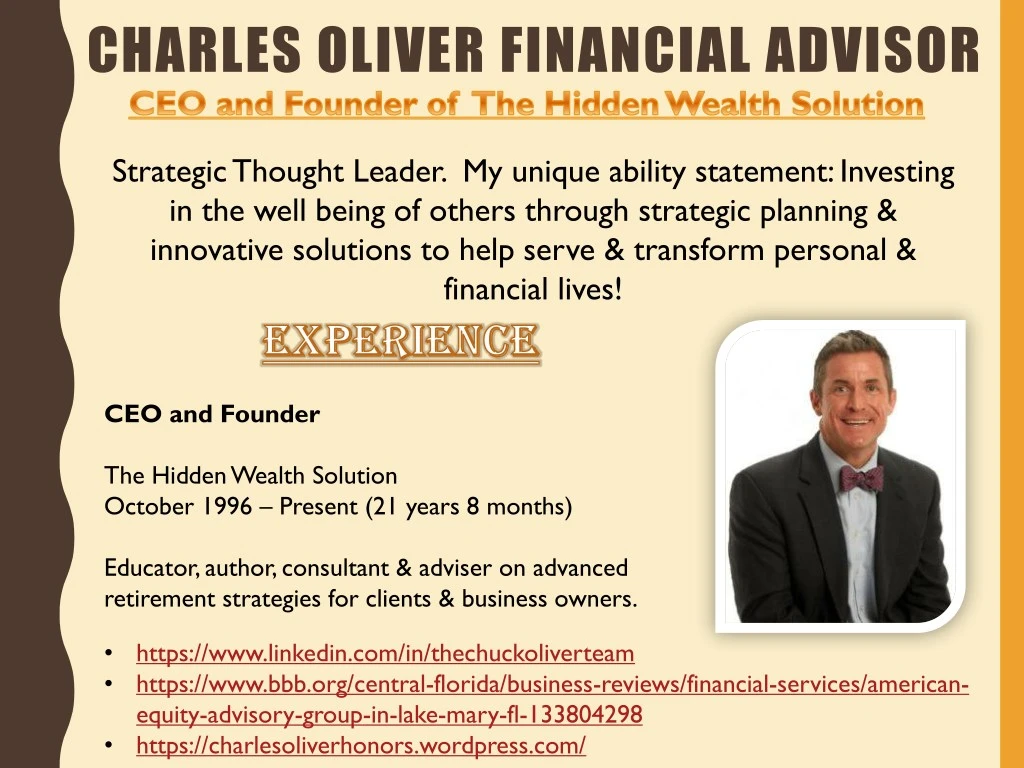
Chuck Oliver Hidden Wealth Solutions

So, last Tuesday, I found myself down a YouTube rabbit hole at 11 p.m., watching a man in a cowboy hat explain how the federal reserve is basically a giant, legalized poker game, and the house always wins. I wasn’t even looking for financial advice—I was just trying to avoid folding laundry. But there he was, Chuck Oliver, talking about “hidden” money with the casual confidence of a guy who’s just found a twenty in his winter coat.
And honestly? He made a weird kind of sense. It got me thinking about all the money we think we have, sitting in 401(k)s and bank accounts, that isn’t really ours in the way we believe it is. That’s the hook, right? That feeling that the financial system is a maze, and someone secretly moved the cheese.
That’s where Chuck Oliver and his “Hidden Wealth Solutions” come in. He’s not selling get-rich-quick schemes or crypto moonshots. No, he’s selling something far more radical in today’s world: permission to ask uncomfortable questions about where your money actually lives.
Must Read
The “Hidden” Part Isn’t a Conspiracy, It’s a Structure
Here’s the thing that struck me after watching a few more of his videos (and, okay, maybe ordering one of his free reports, which is a whole other story involving my inbox). The “hidden” wealth isn’t about offshore accounts or buried treasure. It’s about tax-advantaged structures, insurance vehicles, and legal loopholes that the rich have used for generations.
You know, the stuff that isn’t taught in school, unless you go to a fancy private school where the curriculum includes “How to Not Pay the Estate Tax.” Chuck’s whole pitch is that these tools are available to everyone, not just the top 1%. He just shows you where the doors are; you still have to walk through them.

And let’s be real—the financial industry loves to keep you confused. If you understand how money works, you might stop buying their overpriced mutual funds with a 1.5% expense ratio. Chuck’s approach is basically the financial equivalent of a friend whispering, “Psst, look at this health insurance policy that also acts as a retirement account.”
Why It Feels Different (and Why That Scares People)
What I appreciate about the “Hidden Wealth Solutions” philosophy is that it’s not about predicting the stock market. It’s about control. It’s about shifting your mindset from “how much can I accumulate” to “how much can I retain and control without the government or a bank taking a cut.”

He often talks about the “infinite banking” concept—using whole life insurance as your own personal bank. I know, I know. You just rolled your eyes. Whole life insurance has a bad rap. But hear me out: the idea of borrowing against your own cash value to buy a car or invest, while your policy keeps growing, is… well, it’s clever.
It flips the script. You become the lender, not the borrower. And you’re not paying interest to a megabank; you’re paying it back to yourself. It’s the financial equivalent of stealing second base while the pitcher isn’t looking—totally legal, but you feel a little sneaky doing it.
But here’s my ironic side comment: you need to have some cash to fund that policy in the first place. So, don’t quit your day job just yet. The “hidden” part doesn’t work if you have zero dollars to hide.

The Real Takeaway (Isn’t the Product)
I’m not here to tell you to go buy a specific insurance product or to sign up for Chuck’s $5,000 coaching program (I haven’t). But what I am saying is that the value in “Hidden Wealth Solutions” isn’t the strategy itself—it’s the shift in perspective.
It forces you to realize that your net worth is not your bank balance. Your net worth is your financial freedom—your ability to make choices without being terrified of the next tax bill or market crash. Chuck’s main message is simple: Stop being a passive spectator in your own financial life.

He’s basically a financial philosopher with a southern drawl. He’s saying, “Hey, the rules are written by people who benefit from you not knowing them. So, let’s learn the rules.” And that’s a powerful feeling, even if you just start by reading a boring IRS publication about the internal rate of return on a life insurance policy.
So, do I think Chuck Oliver has a magic key to a hidden vault? No. But I do think he’s holding up a mirror to a system that’s designed to be opaque. And if that makes you angry enough to ask one good question, then he’s done his job.
Now, if you’ll excuse me, I need to go check if my cash-value policy has enough to finally buy that new dishwasher. Just kidding. Mostly. But at 11 p.m., in a dark room, a guy in a cowboy hat can make you believe in a lot of things—especially the power of financial literacy. Just make sure you do your own homework before you sign anything, okay? Consider this your wake-up call, not a sales pitch.