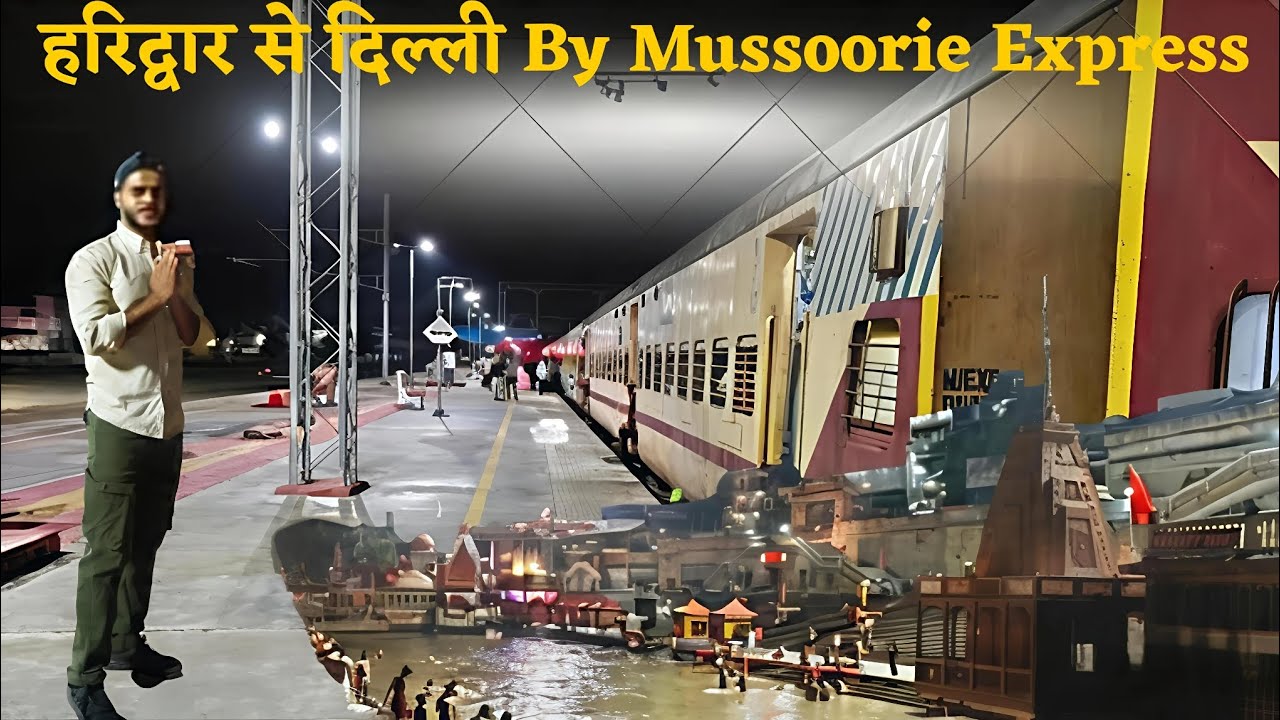
Mussoorie Express Delhi To Haridwar

There is a peculiar romance woven into the steel and steam of the Indian railway, a romance that finds its purest expression not in the bullet trains of the future, but in the clattering, unhurried carriages of the past. The Mussoorie Express, the overnight lifeline from the cacophony of Delhi to the pine-scented foothills of the Himalayas, was never merely a mode of transport; it was a nocturnal ritual, a moving sanctuary for pilgrims, honeymooners, and the weary clerks of the capital seeking a breath of mountain air. Its story begins in the late 19th century, when the British Raj, driven by the imperial necessity to escape the punishing summer heat of the plains, carved a path through the Shivalik range. The train’s genesis was not born of tourism, but of survival—a desperate, colonial-era medical necessity to transport families and officials to the sanatoriums of Landour and Mussoorie, where the thin, cool air promised respite from malaria and dysentery. Back then, the journey was a two-day affair, a grueling trek by narrow-gauge rail to Dehradun, followed by a bone-rattling tonga ride up the winding mountain road. The initial "Express" was a misnomer; it was a deliberate, almost luxurious slowness, a time capsule where one’s life paused at the platform and resumed only upon reaching the misty ridges above Haridwar.
To the uninitiated, the Mussoorie Express was simply a train to Haridwar, the gateway to the Char Dham Yatra. But to the generations who grew up in the shadow of the Yamuna and the Ganges, it was a rolling chronicle of their own lives. The train’s heritage is etched in its rolling stock—the stately, deep maroon and cream coaches that were the standard of the Northern Railway for over half a century. I remember, as a child in the 1980s, the sheer organisational chaos of the Old Delhi Railway Station at 9:45 PM, when the train would depart. The platform was a living tableau: porters in red shirts balancing massive steel trunks on their heads, vendors hawking hot samosas and cold Coca-Cola in glass bottles, and families laying out white sheets on the platform to claim their territory for the long wait. The passengers were a distinct anthropology—the saffron-clad sadhus heading to Rishikesh, the boisterous college groups singing film songs, and the stoic, elderly couples who brought their own bedrolls and steel tiffins filled with homemade parathas. The journey was a sensory overload: the rhythmic thud of the wheels over the points, the hiss of the diesel locomotive, and the acrid smell of coal dust that would settle on your face, a gritty mask that one wore proudly as a badge of arrival.
Yet, the true genius of the Mussoorie Express lay in its democratic hierarchy of sleep. The Sleeper Class, introduced in the 1990s, became the great equalizer. There were no air-conditioned cocoons here; you were part of a communal, horizontal society where strangers shared pillows, secrets, and the collective anxiety of the train’s famous delays. The bathrooms, now a legendary joke, were often flooded, but the spirit of the passengers remained dry. As the train snaked past the haunting ruins of the Tughlaqabad Fort and the dimly lit industrial belts of Ghaziabad, the conversation would inevitably turn to the Ganges. The crew would announce the upcoming stop at Haridwar with a reverence usually reserved for a temple bell. It was not until the train crossed the vast, silt-laden expanse of the Upper Ganges Canal that the air began to change—becoming cooler, damper, and carrying the faint, indescribable aroma of marigolds and incense, a harbinger of the holy city ahead. The train was a time machine, and Haridwar was its destination at the end of history.
Must Read
The Age of Transformation: From Night Mail to Modern Sleeper
The Mussoorie Express underwent its most radical metamorphosis in the 2000s, a period that stripped away much of its nostalgic veneer to make way for brutal efficiency. The iconic maroon coaches were phased out, replaced by the shiny, utilitarian silver and blue LHB (Linke Hofmann Busch) coaches that could cruise at higher speeds. This was a conscious decision by Indian Railways to increase capacity and reduce travel time, cutting the journey from a leisurely 7 hours to a brisk 5.5. The change was a double-edged sword. On one hand, it meant that the 11:30 PM departure from Delhi could now reach Haridwar by 5 AM, in time for the morning aarti at Har Ki Pauri. On the other, it eliminated the cherished tradition of the "chai wallah" who would run alongside the train at Ghaziabad, passing steaming clay cups through the windows. The new, sealed windows and vestibule-style coaches made such transactions impossible, replacing them with a sanitized, pre-ordered catering service that tasted of plastic and automation.
Forgotten vintage facts now seem almost absurdly utopian. For decades, the Mussoorie Express carried a dedicated "postal van" and a "brake van" at the rear, where a guard would manually wave a green flag and, on certain sections, physically crank a handle to lower the level crossing gates. The train’s dining car, a fixture until the 1980s, was a sit-down restaurant on wheels, serving full thalis with unlimited dal and rice, cooked in a coal-fired kitchen. The cooks were legendary figures—men who had apprenticed in the great kitchens of the Raj and who took immense pride in their mutton curry, which was perfected over the jolting flames of a moving stove. Today, that tradition is dead, replaced by a single pantry car that dispenses pre-packaged snacks. Another bizarre tradition was the "flag stop" at the small station of Laksar Junction, where the train would often halt for 20 minutes for no apparent reason. Passengers, aware of this quirk, would jump off, buy freshly roasted corn cobs from vendors on the opposite platform, and climb back on just as the guard blew his whistle. It was a chaotic, unregulated but perfectly choreographed dance of human trust and railway neglect.

The 2010s brought the most profound shock to the train’s ecosystem: the rise of the Shatabdi and Vande Bharat Express, which made the overnight journey seem almost archaic. The Mussoorie Express was rebranded, reformed, and re-timetabled so frequently that its identity became blurred. In a bizarre twist, the train began stopping at the new, sprawling Anand Vihar Terminal, a station that lacked the soul of Old Delhi. The platform at Old Delhi, once a vibrant bazaar of humanity, became a ghost town as the train’s departure shifted. The frequency was reduced, and it was even merged with other trains for a period, causing massive confusion. However, the train’s stubborn ridership revealed a deep psychological need: people did not just want to get to Haridwar; they wanted the experience of the overnight journey. The pilgrims who desired to reach the temple by dawn found the early arrival inconvenient, preferring the old schedule that allowed for a sunrise view of the hills. Indian Railways, in a rare moment of listening to its passengers, restored the later departure, inadvertently proving that nostalgia is a more powerful engine than speed.
Yet, the most overlooked transformation was technological, hidden beneath the chassis. The locomotive changed from the belching WDM-2 diesels to the more environmentally friendly WAP-7 electric engines. The train now runs on 25kV AC overhead lines, powered by grid electricity. This shift, while silent and invisible to the casual passenger, marked the end of an era of diesel fumes and the rhythmic chug that used to lull passengers to sleep. The track itself was upgraded from 100 km/h to 130 km/h sections, and the introduction of the "Kavach" anti-collision system in 2022 brought a level of safety that the old guards with their flags could only dream of. The august history of the train, however, still lingers in the oddest places—the etched "MSR" initials on the old under-frames that were sold for scrap, or the vintage posters in the Dehradun railway museum showing the train in its 1930s avatar, with a separate compartment for servants.

The Hack: Reimagining the Overnight Journey for the Digital Pilgrim
In the age of instant gratification, where Ola Ubers and IndiGo flights dominate, the Mussoorie Express has become a canvas for a new kind of hacking—a digital detox disguised as a train ride. The modern passenger is not just a pilgrim but a remote worker, a content creator, or a spiritual seeker who uses the 5-hour window to disconnect from the 4G grid that dies somewhere near Roorkee. The classic principle of "slow travel" has been repurposed by a new generation that books a third AC berth specifically for the solitude it offers. They are hacking the system by carrying portable Wi-Fi dongles, but ultimately, they are embracing the forced disconnection as a luxury. The train’s modernisation has also birthed a practical hack: the 2023 introduction of dynamic pricing on the route means that booking on a Tuesday versus a Friday can save you 300 rupees, a fact that budget-conscious travelers exploit with ruthless precision through the IRCTC app.
The culinary hack is perhaps the most vital. Knowing that the pantry car’s food is subpar, a subculture of "sabzi smugglers" has emerged. They board the train at Ghaziabad with customised thermos flasks filled with piping hot chole, and insulated roti baskets. They coordinate with the waiting vendors at Haridwar, who have been sent a WhatsApp message with the seat number, to deliver fresh, hot jalebis the moment the train halts. This is a modern update of the old tonga system, but now it’s a seamless digital supply chain. Furthermore, the train’s late-night departure has been hacked by the "night owl" crowd who use the sleeper berths as a budget hotel. Instead of paying for a hotel in Delhi, they board the train, wake up at Haridwar, attend the morning aarti, and take a Shatabdi back the same evening. This "zero-night stay" itinerary is a uniquely modern, cost-effective hack that celebrates the train as infrastructure rather than a journey.
The Eternal Questions: Unravelling the Myth and Machine
Is the Mussoorie Express the same train that originally ran in the 1900s, or is it a different route entirely?
The lineage is more complex than a simple yes or no. The original 1900s train was a narrow-gauge service that ran from Delhi to Dehradun, terminating at the old Dehradun station. The Mussoorie Express was, in fact, a connecting service that ran from Dehradun up the hill to Mussoorie, but the British colonial administration used the name interchangeably for the entire route. The current Mussoorie Express, which terminates at Haridwar, is a broader reincarnation. The route was standardised to broad gauge in the 1970s, and the track to Mussoorie was abandoned due to landslides. Therefore, while the name persists, the physical track and the destination have evolved. The myth that it "goes to Mussoorie" is a historical anachronism kept alive by the locomotive nameplate. Modern evidence shows that the train’s primary traffic is the Haridwar pilgrim, not the Mussoorie tourist, proving that the railway re-purposed the old name for marketing continuity rather than network logic.

Why is the train so often delayed, and has this always been a problem?
Delays are woven into the train’s historical fabric, but the reasons have changed dramatically. In the 1960s, delays were caused by the manual exchange of wooden tokens between stations, a safety system that required the driver to physically collect a token at every single block section. A single missing token could halt the train for hours. Today, in 2024, the delays are caused by a different beast: the enormous freight corridor congestion between Ghaziabad and Meerut. The Mussoorie Express is a "Mail/Express" train, which means it gets lower priority than the Rajdhani and Shatabdi trains on the same track. It is often shunted onto a loop line to let a high-speed passenger train pass. Furthermore, the infamous "Haridwar throat" – the single-track bottleneck just before the station – creates a queue that backs up for 10 kilometers. Historically, the train was allowed to run on "dirty" diesel lines with no such competition. The delay is now a function of the railway’s own success, a technological triumph that has made the old train the underdog in a race it was never meant to win.
Can you still book a berth for the full journey to Mussoorie, or has that service ceased?
This is a frequent point of confusion. You can book a ticket to "Mussoorie" on the Indian Railways booking system, but the train will drop you at Haridwar, not Mussoorie. The physical rail track to Mussoorie was dismantled in the 1990s after a series of devastating landslides made maintenance fiscally impossible. The railway still lists "Mussorie" (with the common misspelling) as a station in their database because the connecting road service is operated by the state transport corporation, but the reservation system now shows it as a meta-station. If you book a full ticket, you will alight at Haridwar and be transferred to a waiting bus, which is part of the railway’s integrated ticketing. This was not always the case. In the 1970s, you could travel in a luxurious first-class coach directly to the Mussoorie station, located at the scenic Library Bazaar, a stop that was the envy of all hill railways. The cessation of that service was a tragic loss for rail enthusiasts, but it has been repurposed. The old railway yard in Mussoorie is now a vibrant vegetable market, with the old tracks still embedded in the asphalt, a quiet memorial to the train that now ends 30 kilometers short.

The delay and its management have become a psychological test for passengers. Many modern travelers now check the "train running status" app, and ironically, a 45-minute delay is now considered "on time" for the Mussoorie Express. The early morning arrival, which was once guaranteed, is now a matter of probability. This has birthed a sub-ritual: passengers who need to catch the 6 AM bus to Rishikesh have learned to not book it, instead waiting for the train to arrive and then taking a shared auto-rickshaw that costs double. The unpredictability is part of the charm, a term of endearment for a machine that stubbornly refuses to be fully disciplined by modernity. The train’s lack of punctuality is not a flaw but a feature, a final bastion of the unpredictable in a world of GPS-tracked fridges and Amazon Prime deliveries.
Looking ahead to the next 20 years, the Mussoorie Express faces an existential fork in the track. The proposed Delhi-Dehradun high-speed rail corridor, which is currently in pre-planning stages, threatens to render the overnight train obsolete. A 100-minute journey would kill the demand for a 5-hour sleeper. However, the very elements that make the train slow—the night sky, the gentle rocking motion, the communal silence—are becoming precious commodities in a hyper-connected world. The future will likely see a bifurcation: one class of travel will become a "retro-luxe" experience, with restored interiors, curated local food, and storytelling guides who narrate the history of the Ganges as the train passes the ghats. It will be marketed as a "heritage sleeper," akin to the Palace on Wheels, but tailored for the domestic voyager seeking authenticity.
Yet, there is a more cynical, pragmatic fate. Indian Railways has recently floated the idea of converting the Mussoorie Express into a fully air-conditioned, high-speed "Intercity Express" that runs during the day. This would strip it of its nocturnal identity, turning it into just another greyhound on the track. But the human heart yearns for the liminal space of the night. The train is a vessel for introspection, a place where the baggage of the city is left behind, and the soul prepares itself for the holy dip at Har Ki Pauri. The next two decades will not be decided by engine technology but by cultural preservation. If we treat the train merely as a utility, it will die. But if we treat it as a moving cultural archive, a rolling museum of our collective pilgrimage, then the Mussoorie Express will not just survive—it will thrive, carrying its passengers not just from Delhi to Haridwar, but from the anxieties of the present to the solace of a remembered, slower past. The tracks are laid; the engine is ready; the only question is whether we are brave enough to keep dreaming at the speed of 60 kilometers per hour.