How Do I Rekindle My Relationship

There is a particular quiet that settles over a home when a relationship loses its voice. It isn’t the silence of comfort, but the heavy, static-filled quiet of two people who have forgotten how to ask each other questions. When we first fall in love, our brains are bathed in dopamine and norepinephrine, creating a neurochemical cocktail that makes our partner feel like the most fascinating puzzle we’ve ever encountered. We are wired for novelty; our reward centers light up with every new story, every shared secret. But as months turn to years, the brain's default mode network kicks in. It categorizes the familiar as safe, and consequently, as boring. The very biological machinery that helped you bond now works against you, encouraging you to glance past your partner rather than into them.
Rekindling a relationship is rarely about grand gestures or dramatic vacations. It is a quiet, introspective rebellion against the brain's efficiency. It is about consciously choosing to disrupt the neural pathway that says, "I already know everything about this person." This process is not just about saving a partnership; it is an act of self-revelation. By looking at your partner with fresh eyes, you are forced to confront the parts of yourself that have grown stagnant, the resentments you have shelved, and the vulnerability you have traded for stability. In our modern world of endless distractions—where scrolling replaces conversation and productivity trumps presence—the act of turning toward your partner is a radical form of mental health care. It is an acknowledgment that the relationship is not a static entity, but a living, breathing ecosystem that requires your attention to survive.
The Emotional Fog: Unpacking the Hidden Hurts and Cognitive Biases
Before you can build a bridge back to intimacy, you must first map the terrain of your own mind. Often, the distance in a relationship is not caused by the absence of love, but by the presence of unexamined cognitive distortions. One of the most destructive is "mind-reading," where you assume your partner’s silence means rejection, or their tiredness means they no longer find you attractive. You react to the story you tell yourself, not to the reality in front of you. For example, when your partner forgets to take out the trash, you might spiral into a narrative that you are invisible, undervalued, and that your efforts are unnoticed. This narrative triggers a defensive wall, and you withdraw, not because of the trash, but because of the meaning you assigned to it.
Must Read
Another hidden hurdle is the negativity bias, a survival mechanism that makes us hyper-vigilant to threats. In a relationship, this translates to remembering the one critical comment during a dinner party while forgetting the years of quiet support. This bias creates a skewed ledger of grievances. When you keep score, you are constantly looking for evidence that your partner is falling short, which, in turn, makes you less likely to offer the very warmth and affection that could break the cycle. It becomes a self-fulfilling prophecy: you expect rejection, so you act cold, which elicits a cold response, confirming your original fear.
Furthermore, we often carry the baggage of "shoulds". We believe our partner should know what we need without asking, or that they should change to fit the person we married ten years ago. This is a rigidity of the ego that suffocates growth. The person you are today is not the person you were when you met, and neither are they. This mismatch creates a sense of betrayal, not because anyone did anything wrong, but because the expectation was for a static, unchanging reality. To rekindle, you must mourn the fantasy of the "perfect partner" and grieve the person you used to be, making space for the complex, evolving humans you are now.
The Art of Re-Acquaintance: Practical Steps for Mental and Emotional Reconnection
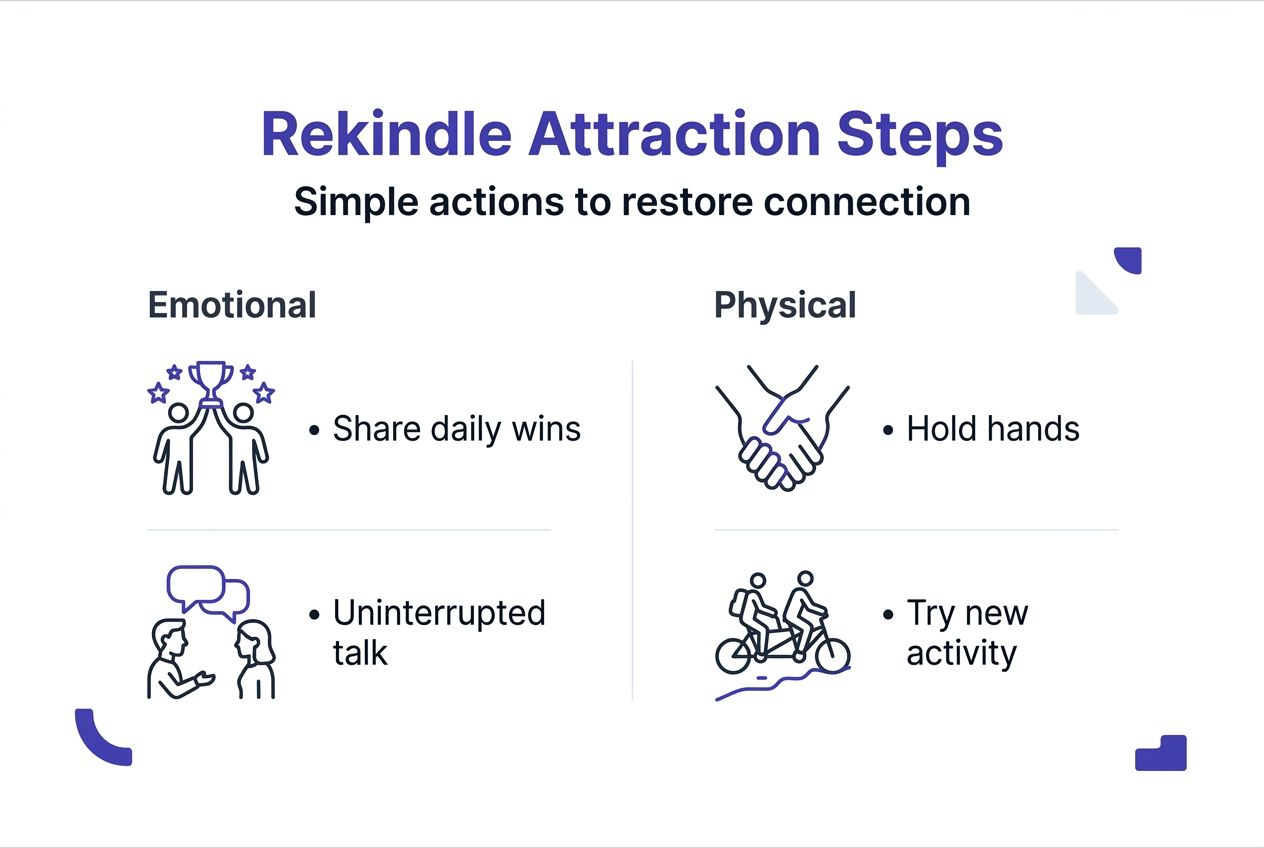
The journey back to each other is not a sprint; it is a deliberate, mindful walk. The first and most crucial step is to lower the stakes of conversation. Often, couples try to "fix" the relationship by discussing the relationship, which triggers the "fight or flight" response. Instead, focus on re-building a foundation of platonic curiosity. Ask questions you don't know the answer to. Not, "Why are you upset?" but, "What was the most challenging part of your day?" or "If you could design a perfect afternoon, what would it look like?" This activates the novelty seeking part of the brain, reminding you that your partner is still a universe of uncharted territory. This is not small talk; this is the antidote to the assumption that you already know them.

Secondly, adopt a practice of "micro-attunement". This involves noticing the small, often ignored cues your partner gives you. It’s the sigh after a phone call, the crinkle of the eyes when they see a dog on the street, the specific way they like their coffee. When you acknowledge these tiny details—by saying "You seem tired, that call was probably stressful," or "I saw that little smile when you saw the puppy"—you are telling their nervous system that they are seen. This builds what psychologist John Gottman calls a "bank account" of positive regard. It is a moment of emotional safety that lowers cortisol levels and increases the likelihood of deeper connection. This mindful presence is a gift you give them, and paradoxically, the focus it requires pulls you out of your own rumination, improving your own mental clarity.
Thirdly, introduce a shared novelty ritual. You don't need a safari; you need a disruption of the routine. This could be taking a cooking class online together, listening to a podcast series and discussing it like a book club, or simply taking a different walking route every Sunday and noting what you see. The key is to create a shared "third thing" that requires cooperation and discovery. When you learn something new together, your brains release dopamine in sync, associating the feeling of learning with the feeling of being with your partner. This bypasses the old, tired arguments. It creates new memories to counter the old, painful ones. This is not about escapism; it is about actively building a new shared history that your mind can access when the old patterns resurface.
Incorporate a daily practice of gratitude articulation—but not the Hallmark kind. Instead of saying "thank you for making dinner," say, "I noticed you remembered I don't like onions, that was really thoughtful." This specific gratitude rewires your attention. It forces you to scan for what is going right, counteracting the negativity bias. It also makes your partner feel individually valued, not just as a functionary. Finally, be prepared for discomfort. You must cultivate the willingness to say, "I feel disconnected," or "I miss you," even when it feels embarrassing. This vulnerability is a strength. It says, "I value this relationship more than I value my pride." The fear of rejection that lingers in the background is just a protective outdated algorithm. Data tells us that the risk of vulnerability is almost always rewarded with a softening in your partner. The risk is not rejection; the risk is staying in the limbo of silent distance.
Navigating the Common Pitfalls: Your Questions Answered
What if we've tried talking, but it always ends in a fight?
This is a clear signal that your "talking" is actually negotiating for survival. You are both in a defensive posture, trying to prove who is more hurt, rather than understanding the hurt of the other. The mental shift here is to stop talking about the problem and start talking beside the problem. Try writing letters to each other. The act of writing forces you to slow down your thinking, to choose words deliberately without the adrenaline rush of a face-to-face altercation. In the letter, focus only on "I feel..." statements, not "You always..." accusations.

When you do speak, institute a rule: "physician, heal thyself." Talk about your own contribution to the dynamic. Instead of saying "You never help me," say, "I feel overwhelmed, and I realize I haven't asked for help clearly; I've just been expecting you to read my mind." This vulnerable admission disarms the other person. They can't fight your truth when you are already acknowledging your weakness. It moves the conflict from a tug-of-war to a shared exploration of the same knot. Remember, the fight is not the enemy; the gridlock is the enemy. A fight showing emotion is better than cold silence.
How do I rekindle the "spark" if I've been feeling numb or indifferent?
Indifference is often a protective shield against deeply buried pain or fear of rejection. Your mind has decided that feeling nothing is safer than feeling the sting of longing. The first step is to forgive your indifference. Do not shame yourself for feeling numb. The body and mind often shut down when they have been carrying too much unspoken load. To rekindle the spark, you must first reignite a relationship with your own feelings.
Spend time alone, deliberately. Ask yourself, "What did I love to do before I met this person?" Engage in that hobby. Rebuild your own inner fire. A person who is passionate about their own life is magnetic. When you bring this new energy back to the partnership, you are not looking to them for entertainment, but as a companion in your own vitality. The spark is not a hidden ember waiting to be blown into flame; it is a capacitor that needs charging. You charge it by giving yourself permission to be excited, curious, and alive without your partner first. Then, you invite them into your world. This creates a dynamic of abundance rather than neediness, which is far more attractive and sustainable.

How do we trust again after a significant betrayal or lie?
Trust after betrayal is not a light switch; it is a muscle. You cannot "decide" to trust them; you must build it through consistent, observable behavior. The first step is radical honesty from the partner who broke the trust, even about small things. They must become a glass house. This is not just about answering questions, but proactively offering information. The hurt partner's brain is in hyper-vigilance mode; they are scanning for danger. The only way to calm that alarm system is to flood it with evidence of safety.
For the person who was hurt, the mental work is to differentiate between reliving the past and observing the present. You must actively ask yourself, "Is this new information a sign of the old betrayal, or is it just a new, ordinary mistake?" This is incredibly hard, as the brain’s amygdala fires indiscriminately. Seek to build a new "trust ledger" starting from zero, rather than trying to rebalance the old one. Acknowledge the small acts of reliability daily. "They left the porch light on," or "They called when they said they would." These moments are the bricks of the new foundation. And crucially, understand that forgiveness is for you; it is the release of carrying the weight of the betrayal. It does not excuse the behavior, but it allows your nervous system to unclench.
Is it normal to love my partner but not like them right now?
Absolutely. This is a common and natural phase. Love is a deep, structural bond—an attachment to the history and the soul of the person. "Liking" is the surface-level appreciation of their day-to-day persona. When you are exhausted, stressed, or have been taking each other for granted, the "liking" part goes dormant. It is a sign of a mature relationship when you can hold both truths: "I love you deeply, and I don't want to have dinner with you tonight." The danger is when you confuse the two and panic, thinking the lack of "like" means the "love" is gone.
To rekindle "liking," you have to treat them as you would a new friend at a party. Would you tell a new friend they are lazy for not doing the dishes? No. You would ask them about their interests. You must create psychological distance from the domestic roles and see the individual again. Go out separately, pursue your own hobbies, and come back with stories. The person who returns to you is a different person than the one who was sitting on the couch. The absence creates a space for longing. You can't miss someone who is always there. By allowing yourselves to be separate, you make the reuniting a moment of genuine curiosity and connection.
What if my partner doesn't want to try? How do I rekindle alone?
This is the most painful scenario, and your mental well-being is the priority. You cannot force a partnership to grow, but you can change the entire dynamic of the system by changing your part in it. The first realization is that your partner's resistance is about them—their own fear, pain, or exhaustion—not about your worth. You must stop pouring energy into the black hole of trying to convince them and start pouring it into your own internal stability. This is easier said than done, but it shifts the pressure.
Focus on "differentiation." Become a secure, complete person within the space of the relationship. You can do this by emotionally disconnecting from the need for a specific outcome. Practice the mantra: "I can be okay, no matter what they do." This doesn't mean you don't care; it means your inner peace is not dependent on their affection. When you stop clinging, you become lighter, and your behavior changes. You become less anxious, less critical, and more independent. This often has a surprising effect—it can be very disarming to the other person, as they no longer have a "fight" to engage in. Your calmness might invite them to lower their defenses. But even if it doesn't, you win. You have reclaimed your own dignity and emotional self-sufficiency, which is the most crucial relationship you will ever have.
Rekindling a relationship is ultimately a pilgrimage back to yourself. It is a rigorous course in humility, patience, and self-forgiveness. As you learn to see your partner without the cataracts of resentment, you learn to see yourself with more compassion. You realize that the love you seek is not a destination, but a continuous practice of showing up—messy, imperfect, but present. The skills you build—active listening, vulnerability, gratitude—do not stay confined to your romantic life; they bleed into how you parent, how you work, and how you treat your own inner voice.
When you master the art of rekindling, you unlock a deeper truth: that all living things require friction, sunlight, and water to bloom. You cannot force a flower to open; you simply provide the conditions. By creating the conditions for connection—emotional safety, curiosity, and mutual respect—you allow the relationship to reveal its next season. You emerge from the fog not just as a better partner, but as a more resilient, awake, and emotionally intelligent human being, holding a hand that you have learned to hold with intention, rather than just habit. The quiet in the home is replaced not noise, but with the soft, profound hum of two people choosing each other, again, in the same room.