Filterless Water Filtration System
There is a certain romance to the idea of water that asks for nothing in return. Before the era of gleaming reverse-osmosis towers and under-sink hydrogen machines, before the very concept of a “filtration system” even entered the domestic lexicon, our great-grandparents simply drank from the earth. They dipped a tin cup into a rain barrel, scooped a palmful from a spring, or drew a bucket from a well, trusting the soil, the sand, and the slow, patient journey of the water itself to do the cleansing. This was the original filterless system—a quiet, ancient covenant between humanity and the geology beneath our feet. The necessity was not for purity in the modern, laboratory-tested sense, but for survival, a primal need to find water that did not carry the sting of typhoid or the creeping malaise of dysentery. The irony is that our ancestors were not naïve; they were pragmatic, selecting “sweet” water over “hard” or “bitter” water based on taste, a sensory science we have largely forgotten in our quest for clinical perfection.
The journey from that muddy, living water to the sterile, plastic-bottled version we know today is a story of increasing intervention. By the mid-19th century, as cities grew and rivers became open sewers, the fear of miasma—the belief that disease was carried by bad air—drove a frantic search for solutions. The slow sand filter, pioneered in places like Paisley, Scotland, in 1804, was a marvel of its time, yet it was still fundamentally a natural process, relying on a biological layer of schmutzdecke to do the work. But as chemistry advanced, so did our distrust of nature’s methods. We began to wrestle with the water, forcing it through screens, membranes, and chemical baths, convinced that only human intervention could make it safe. The filterless approach became a symbol of a lost, simpler age, a nostalgic whisper in a world obsessed with chlorination and carbon-block cartridges that demanded replacement like clockwork, a quiet financial and ecological tax on every household.
Now, in our hyper-connected, micro-plastic-laden era, a strange thing has happened: the hottest trend in hydration is a deliberate retreat. The filterless water filtration system is not a return to the muddy well, but a sophisticated leap forward that mimics the ancient earth using modern physics. It is a philosophical rebellion against the waste of plastic cartridges and the invisible energy costs of boiling or freezing. It is the realization that the best filter might be none at all, but rather a system designed to work with water’s own properties—its memory, its surface tension, and its intricate, swirling dance with dissolved minerals—rather than against them. This is the story of how we are rediscovering the wisdom of the stream in the age of the smart home.
Must Read
The Golden Age of the Ceramic Jar and the Cure-All Stone
To understand the filterless revolution, one must look back at the bizarre and wonderful objects our great-grandparents used to “treat” water before the municipal plant took over. In the 1920s and 1930s, the ceramic water jar, or olla, was a staple in many homes, but it was rarely cleaned with harsh soap. Instead, families believed that the porous clay itself possessed a mystical quality that “sweated” out impurities. The truth was simpler: the evaporation from the clay surface kept the water cool, and the constant, natural seepage prevented the stagnation that breeds bacteria. Yet, the folklore was thick. People would place a copper coin in the bottom of a pitcher, not knowing it acted as a mild algaecide, but believing the copper’s “spirit” would drive away evil humors. The bizarre part is that these practices worked, not through magic, but through a slow, forgotten alchemy of mineral release and biological competition.
Venture further back, to the Victorian era, and you’ll find the “traveler’s purifying stone,” a small piece of porous lava or pumice that was dropped into a glass of dubious well water. Wealthy explorers would carry these stones, believing they could “attract” sediment and heavy particles to the bottom. While they were partly correct—the stone’s surface area did provide a place for particulate matter to settle—the real hero was time and gravity. The forgotten vintage fact is that our ancestors used dilution as a primary strategy. They would mix rainwater (soft and pure) with well water (mineral-rich and often cloudy) to achieve a balance that was palatable and safe. They were, in essence, creating a primitive blending system that relied on the inherent qualities of each source, a concept that modern filterless systems are now using with sophisticated in-line mixers and vortex chambers.
Perhaps the most fascinating contraption was the “filtering” walking stick, popular in 1890s London. It was a hollow cane filled with charcoal, sand, and a layer of natural sponge. A gentleman, caught in a storm, could unscrew the top, fill the stick with rainwater, and drink directly through the handle. It was a triumph of clever engineering, but the maintenance was forgiving, to say the least. The charcoal was rarely changed, and the sponge was often a breeding ground for its own ecosystem. Yet, it worked well enough because the charcoal absorption and the physical straining were incredibly effective for the particulate-heavy urban rain of the industrial revolution. This gadget was a precursor to the modern filterless idea, not because it had no filter, but because its “filter” was a natural, biodegradable, and infinitely replaceable substance—dirt, rock, and plant matter—not a manufactured plastic cartridge.
The mid-20th century, however, drove the filterless concept underground. The post-war boom celebrated the “miracle” of plastic and the authority of the chemical engineer. Pitchers with replaceable filters became status symbols, and the idea of letting water sit in a copper vessel or a clay pot was seen as quaint, even dangerous. The water we drank had to be visibly clear, tasteless, and odorless—a sterile void. This was the era of the “dead water” paradox, where we removed everything, including the beneficial minerals that gave water its vitality, and then spent billions trying to add them back in artificially. The filterless approach was relegated to the dusty corners of homesteader magazines and the domain of survivalists, a forgotten art waiting for its renaissance.
The Vortex and the Stone: Hacking Ancient Wisdom for the Modern Tap
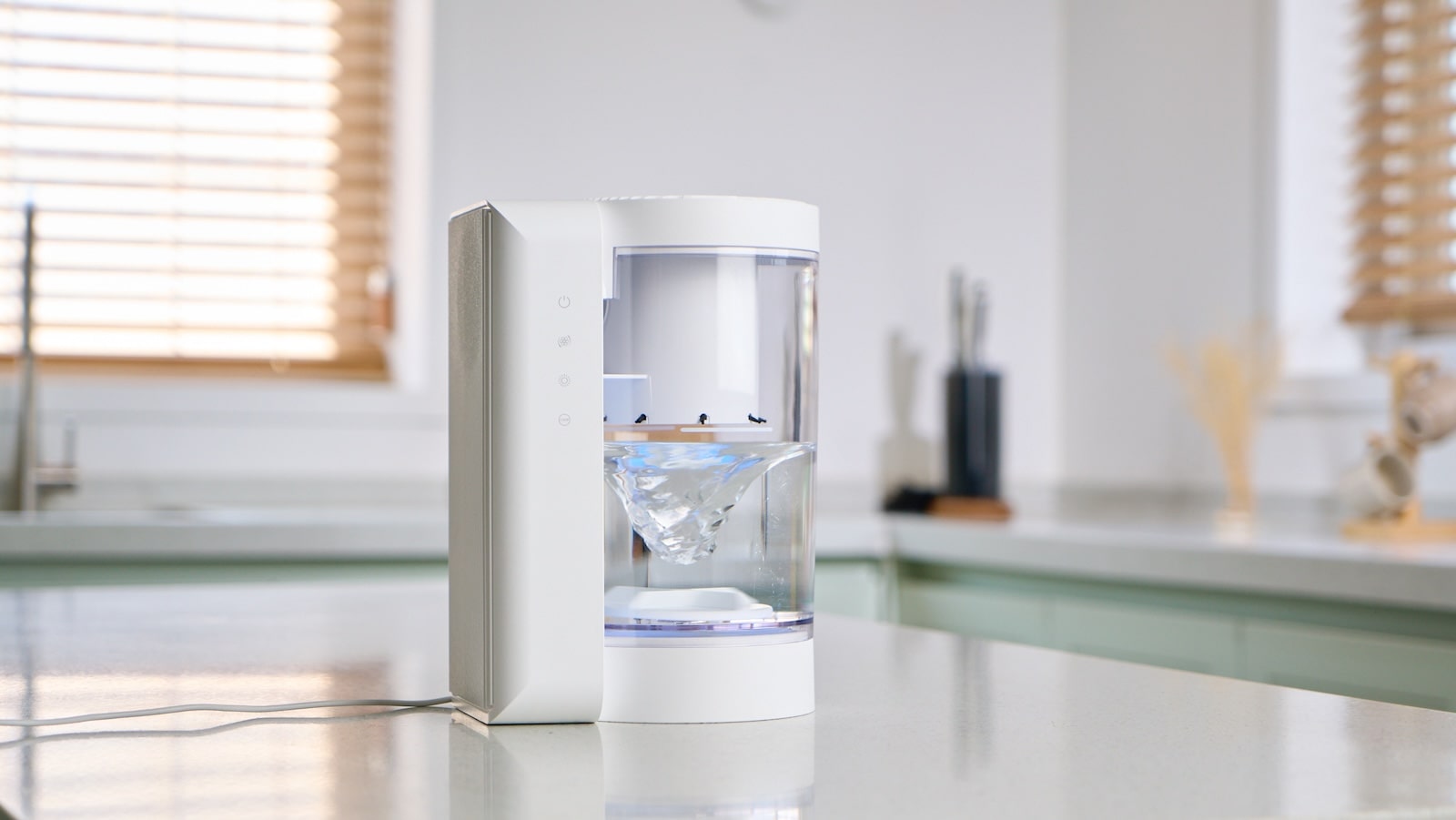
Today’s filterless water filtration system is a brilliant theft from nature’s own playbook, digitally enhanced. The modern devices are not passive jars; they are active, dynamic systems that use fluid dynamics to achieve what cartridges once did. The core principle is the vortex. By forcing water through a series of engineered spirals and chambers at precise velocities, these systems create a centripetal force that flings heavier particles—like sediment, rust, and even some bacteria—outward into a quiescent collection well, while the lighter, cleaner water flows to the center. This is a hack of the ancient river bend, where sediment naturally drops out on the inside curve, but it is now executed in a stainless steel cylinder the size of a coffee mug, with tolerances measured in microns, not feet.

Furthermore, we have rediscovered the power of galvanic action. Modern filterless systems often integrate a carefully calibrated tower of dissimilar metals—typically copper and zinc. This creates a micro-electric field that disrupts the cellular walls of algae and certain pathogens, a process that mimics the natural ionization that occurs when water rushes over mineral deposits in a mountain stream. The key innovation, however, is the absence of consumables. There are no filters to replace. Instead, the metal elements are designed to have a lifespan of decades, slowly dissolving at a rate that is negligible to health but effective for purification. This is the ultimate hack: a system that costs nothing to run, requires no plastic waste, and uses physics as its only consumable. The innovation lies in the precision engineering of the chambers, ensuring the water stays in contact with the metals for the optimal “residence time” to achieve the bacterial kill rate, without overdoing it and leaving a metallic aftertaste.
Frequently Asked Questions: Separating Nostalgia from Modern Science
1. “If it’s filterless, does it actually remove microplastics and heavy metals?”
This is the most common conflation of old and new. Our Victorian ancestors worried about sediment and cholera, but they had no concept of PFAS or microplastics. The modern filterless system using only vortex and metal contact faces a significant challenge here. The vortex is excellent at removing denser particles—sand, rust, and scale—because they have higher specific gravity and get flung out. However, microplastics are often neutrally buoyant and can evade the centripetal force. This is where the history lesson helps. Ancient water treatment relied on settling time—letting water sit undisturbed for days. Modern high-tech filterless systems have reintroduced this via a “timed” settling chamber within the device, where the water is held electronically quiescent for a specific period to allow lighter particles to rise or fall. For heavy metals like lead, they are not removed but rather neutralized by the galvanic reaction, being converted into a less bioavailable compound that sticks to the metal plates. It is an effective but incomplete solution; for absolute removal, a residual carbon block is still often recommended as a supplement, though the core system remains filterless.
The honest answer is that the modern filterless system excels at improving taste, reducing scale, and removing chlorine and biological contaminants. It is a brilliant revival of the “water cellaring” concept, where the water is given the space to be its own filter. But we must not romanticize it as a universal panacea. The technology has adapted to our times by adding a final “polishing” step that uses a catalytic media—often a small mesh of copper alloy—that does not clog but does chemically bind to heavy metals. This is a far cry from the passive stones of the past, and it shows that the evolution is not a return to the past, but a synthesis: the physics of the 1800s married to the materials science of the 21st century.
2. “Is it safe to drink water that hasn’t been forced through a physical membrane?”
The fear of the “unfiltered” is deeply embedded in our modern psyche, a legacy of the chemical engineering boom of the 1950s that taught us to distrust nature. But consider the spring. A natural spring is the ultimate filterless system, yet we deem it the purest water on earth. The safety margin lies in the source water. If your incoming municipal water is already biologically treated, a filterless system is incredibly safe because it is not trying to fight a massive contaminant load; it is simply refining an already potable source. In the past, filterless systems failed because they were treating highly contaminated surface water. Today, they are designed for the relatively clean water of our municipal grids. The vortex and metal contact are not a substitute for a sterilizer; they are a finishing touch, a way to restore the “living” quality of water without the risk.
Moreover, the lack of a physical filter actually eliminates a hidden safety hazard: the “trap” effect. A saturated carbon filter becomes a bacterial breeding ground, releasing more contaminants than it captures. A filterless system avoids this paradox entirely. By using physics (vortex) and electro-chemistry (metal ions) instead of a porous barrier, there is no “hollow” space for biofilm to accumulate. The water is in constant motion, and the surfaces it touches are inherently anti-bacterial (copper, zinc). This is a meaningful historical innovation, addressing a flaw that has existed in filtration technology since the first cloth bag was used to strain river water in the Middle Ages. The answer is a resounding yes—with the caveat that it is a system for competent municipal water, not a wilderness survival tool.
3. “Are these systems just an expensive gimmick, or do they actually change the water’s properties?”
The skeptics will point to the fact that plain tap water is already safe, so what is the point? The answer lies in the difference between “safe” and “structured.” This is where the nostalgia of the clay jar meets quantum physics. Proponents of filterless systems argue that the high-pressure passage through pumps and PVC pipes creates a chaotic, “disorganized” water structure. The vortex and the natural mineral interactions in a filterless system are said to re-cohere the water molecule clusters, a process that, while difficult to measure in a glass on a lab bench, affects the mouthfeel and hydration efficiency. Our ancestors would have called this “vitality,” a concept we have lost. But modern science is exploring it under the guise of “water relaxation” time, which measures how long water molecules stay in a vibratory state. Filterless systems with copper contact have been shown to increase this relaxation time, leading to a smoother, more hydrating taste.
It is a gimmick only if you believe that water is simply H2O molecules. Historical figures, from Hippocrates to Leonardo da Vinci, believed water was a living spirit that could be altered by shape, sound, and motion. The modern filterless system is, in a way, an engineering tribute to those beliefs. The expensive part of these systems is not the fancy housing or the brand name; it’s the precision of the internal geometry. A cheap vortex will just spin the water; a highly engineered one will create a laminar flow that separates particles with the elegance of a river. The taste difference is tangible—many users describe it as “rounder” or “softer,” reminiscent of spring water from a known source. It is not a psychological placebo; it is a physical alteration of the dissolved gas content and ion distribution. The cost is justified not in removing things, but in enhancing the water’s intrinsic structure, a practice as old as the first ritual of drinking from a holy spring.
Looking ahead, the next two decades will see the filterless principle merge with the Internet of Things and smart material science. We will have “intelligent vessels” that use no filters but instead use acoustic frequencies and precise light pulses to manage biological purity, drawing directly from the fact that ancient people left water in the sunlight to “heal” it. These devices will report on their own galvanic health and self-clean their metal cores using reverse electrical pulses, effectively making them immortal. The future of water is not in a plastic cartridge that we throw away every three months; it is in a bespoke, eternally-clad system that is installed once and becomes a part of the home’s architecture, much like the old copper cisterns or the village spring house.
Furthermore, the cultural shift will be profound. As we battle climate change and plastic pollution, the filterless system will become a badge of ecological sophistication, a rejection of the disposable culture that has defined the last half-century. We will look back at the 1990s pitcher filters with a bemused smile, the way we view lead paint or asbestos today. The water will flow from our taps, untouched by plastic, carrying only the minerals it has gathered on its brief journey through a labyrinth of stone and metal, a journey that echoes the long, slow path it took through the earth thousands of years ago. We are not inventing a new way to filter water; we are simply learning how to get out of its way and let it be water again, trusting in the ancient, patient intelligence of the natural world that our ancestors fought to preserve.