Negotiation Mastery Harvard Review

In the grand theatre of human interaction, few skills are as universally applicable—and as universally misunderstood—as negotiation. It’s not the boardroom gladiator match of popular culture, nor is it the slick, fast-talking con artistry of Hollywood’s imagination. Rather, negotiation is the quiet, deliberate architecture of every agreement you’ve ever made, from the salary you earn to the bedtime your toddler negotiates with terrifying precision. The Harvard Negotiation Project, born out of a 1979 book titled Getting to Yes, didn't just invent a framework; it codified a philosophy that has since infiltrated global diplomacy, corporate strategy, and even online dating. The core insight? That we are all, always, negotiating—the only variable is whether we do it with intention or with clumsy instinct.
Why does this matter now more than ever? In an era of hyper-connectivity and algorithmic pricing, where the human touch is often reduced to a transactional click, the ability to navigate conflict and create value has become a rare, almost rebellious form of intelligence. The Harvard Review’s approach isn't about winning; it’s about problem-solving. It shifts the battlefield from a zero-sum game to a collaborative puzzle. This article dives deep into the machinery of that philosophy, peeling back the layers of psychological trickery, cultural nuance, and strategic empathy that separate the amateur from the master. Prepare to have your assumptions challenged—and your next conversation weaponized with intellect.
The Dark Art of the "Yes": Psychology and Unspoken Signals
Beneath the polished veneer of Harvard’s principled negotiation lies a shadowy underbelly of cognitive biases that can derail even the most prepared deal. The most insidious of these is the anchoring effect, a phenomenon where the first number thrown onto the table irreversibly skews the subsequent discussion. Did you know that a real estate agent showing a $1M house will often first show a $1.5M "dump" just to make the target look reasonable? This isn't a coincidence; it's a neurochemical hijack of your reference points. The Harvard framework acknowledges that we are not rational actors—we are emotional, fallible beings running on heuristics that were designed for savannah survival, not quarterly earnings calls.
Must Read
Culturally, the Harvard method has a fascinating and often contradictory relationship with the rest of the world. In high-context cultures like Japan or the Arab Gulf, the direct, "let's split the difference" approach advocated by Western texts can be seen as crass, even hostile. A master negotiator recognizes that silence is a weapon in Tokyo but a sign of weakness in New York. The dark fun fact? The Harvard Project’s own research found that negotiators who used extreme initial demands (even laughably high ones) were perceived as more competent and achieved better outcomes in Western contexts, yet this same tactic in East Asia often led to complete breakdowns of trust. It’s a reminder that the "principles" are merely a starting point for a deeply contextual, anthropological exercise.
Furthermore, the psychological phenomenon of reactive devaluation plays a cruel trick on us. Research from Harvard’s own Kennedy School demonstrated that the value of a concession drops dramatically if the offer comes from an adversary. If your colleague proposes a solution that you were about to suggest yourself, you will suddenly find it flawed. This bias is so powerful that it can sabotage mergers and peace treaties. The mastery lies in reframing. You don't just hear the other side's proposal; you decode the intent behind it, often realizing that the "enemy" is merely the messenger of a mutual constraint. The most successful negotiators are amateur psychologists, reading micro-expressions and vocal pitch to detect a hidden priority that hasn't been verbalized yet.
The Playbook: Scenarios, Case Studies, and Tactical Moves
Let’s move from theory to the trenches. Consider the case of a mid-level marketing executive, Sarah, who was offered a promotion with only a 4% salary increase. The traditional approach would be to push back with a counter-offer of 10%, leading to a tug-of-war. Instead, Sarah applied the Harvard method of BATNA (Best Alternative to a Negotiated Agreement). She realized her BATNA wasn't quitting; it was taking a 6-month sabbatical to freelance, which she valued highly. This shifted her power dynamic. In the meeting, she didn't demand a number; she laid out the market rate for her role, cited the increased scope of work (a criterion-based standard), and offered to delay the start date to align with the company's budget cycle. She didn't fight for money; she problem-solved the flow of money. She got a 12% raise by making the CFO feel like they were solving a logistics puzzle together, not losing a battle.
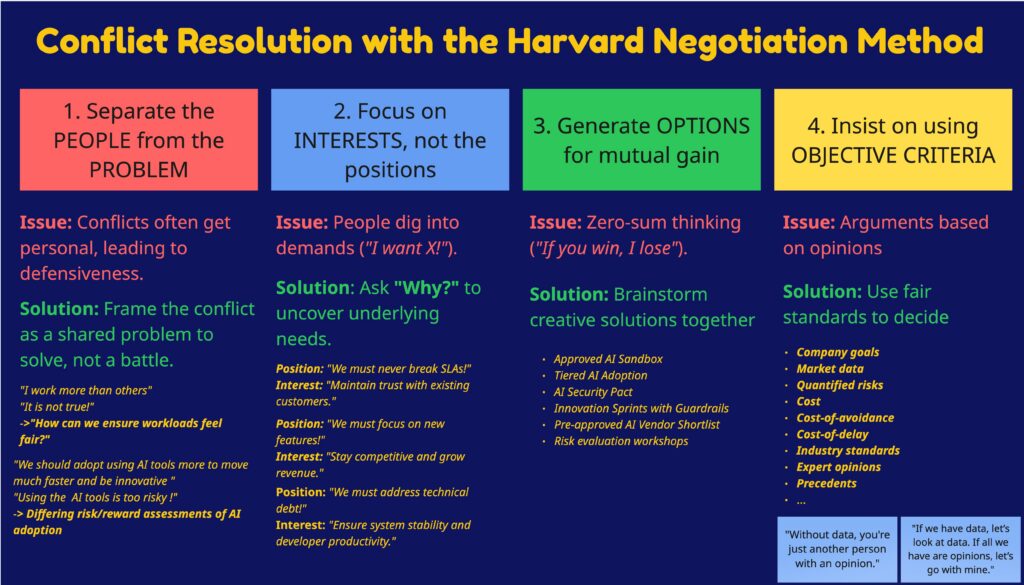
Another scenario involves the classic deadlock: two companies fighting over a single manufacturing contract. Both want the same price point, and neither will budge. An amateur sees a "pie" to be split; a master sees an opportunity to expand the pie. The Harvard approach dictates asking "Why?" instead of "How much?". During a quiet lunch, one negotiator discovered the client was prioritizing speed over cost, while the other side was prioritizing security over speed. By unbundling the contract—offering a 12-month pilot at a higher cost per unit but with a guaranteed service-level agreement—they found a mutually beneficial structure. This is the core of logrolling: trading issues that have low value to you but high value to them. The actionable takeaway? Always list your top three priorities and your bottom three. If they aren't diametrically opposed to your counterpart's list, you have a deal hiding in plain sight.
For the freelancer or the everyday person, the practical insights are even more direct. The first is the power of the flinch. When you hear a lowball offer, physically or verbally showing surprise (a sharp intake of breath, a pause) is not manipulation; it sets a psychological precedent that the offer is offside. The second is the Pareto Principle applied to concessions: never give something away for free. If a client asks for a quicker turnaround, don't say "yes," say "I can do that if we prioritize X over Y." This maintains the reciprocity balance. The third is the implementation of the "No" mindset. Daniel Shapiro, a Harvard affiliate, teaches that hearing "No" often brings relief because it removes the pressure of a false "Yes." Ask questions that invite "No" ("Is this completely unacceptable?") to open dialogue rather than asking for "Yes" which triggers defensiveness.
Finally, consider the digital age's impact. Negotiating over email strips away tone and body language, making the Lymbic system (our gut) untrustworthy. The Harvard Review recommends the "Zone of Possible Agreement" (ZOPA) mapping before you even type a reply. Calculate your walk-away point, their likely walk-away point, and the stretch goal. Put those numbers on a piece of paper. When you write your email, you are not reacting to their last message; you are executing a pre-planned strategy. This removes the emotional volatility of the "reply all" rage. In this sense, mastery is not about being a better talker; it is about being a better system architect of your own emotional responses.
The Negotiation Mastery FAQ: Answers from the Ivory Tower
1. What is the single most important habit of effective negotiators?
The single most important habit is the relentless pursuit of preparation, specifically the over-preparation of your BATNA. Most people walk into a negotiation with a desired outcome, but masters walk in with a fully fleshed-out alternative plan. Your BATNA isn't just a fallback; it's your source of psychological power. If you know you have a lucrative offer elsewhere, you exude confidence. If you know you can walk away from a toxic client, you stop begging for scraps. This preparation involves writing down your BATNA, improving it before you enter the room, and keeping it secret. The paradox of negotiation mastery is that the less you need the deal, the better the deal you will get.

Beyond the BATNA, the habit of "active listening on steroids" is crucial. This means not just waiting for your turn to speak, but summarizing the other party's position back to them until they confirm you've understood it. This lowers their defensiveness and gathers crucial intelligence. In the Harvard framework, this is known as "going to the balcony"—mentally stepping back from the stage of conversation to observe the dynamics objectively. You are studying your opponent's body language while simultaneously monitoring your own triggers. It is a meta-cognitive split that feels unnatural at first but becomes a superpower with practice.
2. Is it ever okay to lie or bluff during a negotiation?
The short, Harvard-endorsed answer is a resounding "No"—but the long answer involves a nuanced definition of "lying." The Project distinguishes between misrepresentation (actively asserting a falsehood) and puffing (exaggerating your position). Saying "I have another offer" when you don't is misrepresentation, and it is a high-risk strategy that can backfire catastrophically if discovered, destroying trust permanently. However, saying "My budget is very tight" is subjective, unprovable, and generally acceptable. The master's approach is to never lie, but also never volunteer information that weakens your position.
The deeper psychological insight is that lying creates a cognitive load that leaks into your body language, making you look guilty even if you're hiding something trivial. More importantly, negotiation is a repeat game. In a world of LinkedIn and industry referral groups, your reputation for integrity is your most valuable negotiating asset. A master negotiator builds a reputation for being firm but fair. They realize that the goal isn't to win the current deal; it is to win the relationship that provides a continuous pipeline of deals. Bluffing might win you a chicken dinner, but honesty wins you the farm.
3. How do you handle a negotiations where the other party is using aggressive, hostile tactics?
This is where the Harvard method truly shines, offering a defense called "Negotiation Jujitsu". The principle is to never push back against the attack. When they attack your proposal, don't defend it. When they attack you personally, don't take the bait. Instead, you reframe their attack into a problem to be solved. For example, if they say, "This price is insulting," you respond with, "I understand the price is a concern for you; what is the specific budget number you are working with?" This throws the ball back into their court while maintaining a calm, collaborative posture.

Another powerful tool is the "Broken Record" technique coupled with silence. If they use aggressive deadlines or ultimatums, you acknowledge their urgency (empathy) but then relentlessly restate your core criteria. You must also recognize that hostility is often a mask for fear or insecurity. By remaining calm, you expose the bluster as a tactic, not a reality. If the aggression becomes abusive, the master knows their BATNA is to walk away—and often, that walking away is the only thing that snaps the aggressor back to reality. Remember, you never lose a negotiation if you can clearly identify when a situation is no longer a negotiation but a hostage situation.
4. How can I negotiate better in personal relationships without making it feel like a business deal?
The transition from business to personal life requires a radical shift in vocabulary. In business, you focus on interests; in personal life, you must focus on emotions and identity. The Harvard Project’s "Four Horsemen" of relational conflict—criticism, contempt, defensiveness, and stonewalling—are the anti-negotiation. To avoid this, replace "What's in it for me?" with "What do we need to feel safe?" When negotiating chores with a partner, don't say "I do more than you," which is a positional attack. Instead, say "I feel overwhelmed when I come home to a messy kitchen; can we find a system that gives us both more evening relaxation?"
Mastery here involves labeling the emotion. A very effective tactic from former FBI hostage negotiator Chris Voss (deeply rooted in Harvard principles) is to say, "It sounds like you’re feeling unappreciated." This doesn't fix the problem, but it validates the underlying feeling, disarming defensiveness. In personal relationships, the ultimate goal isn't an agreement on a spreadsheet; it's an agreement on the narrative of your shared life. You are not trading chores; you are co-writing a story. Every negotiation should end with both parties feeling heard, even if the outcome isn't exactly what they wanted. That emotional equity is the currency of lasting connection.
5. What are the biggest mistakes novice negotiators make?
The most common mistake is the "Reactive Bidding" pattern—walking in and instantly accepting the first offer or countering aimlessly without a strategy. This stems from a lack of preparation and a fear of silence. Novices talk too much because they equate silence with failure. In reality, silence is a vacuum that the other party will feel compelled to fill with concessions or information. The second massive mistake is conflating price with value. They tunnel-vision on the dollar amount and ignore the intangibles: payment terms, delivery schedules, training, warranties, and future partnership opportunities.

Thirdly, and perhaps most critically, novices make the mistake of getting emotionally attached to their position. They see a "No" as a rejection of their worth. This leads to the "escalation of commitment"—throwing good money after bad just to save face. The fix is the Harvard mantra: "Be soft on the people, hard on the problem." Separate your ego from the task. Finally, novices fail to anticipate the other side's negotiation process. They assume everyone is playing by the same rules. A master prepares for the human element by asking themselves, "What pressures are they under? What does their boss expect? How do they like to communicate?" This pre-mortem of the other side's world is the secret sauce of high-level negotiation.
Stepping back from the boardroom and the dinner table, the mastery of negotiation is ultimately a mirror held up to our own humanity. It forces us to confront the uncomfortable truth that we cannot control others, but we can control our reactions and our preparation. It taps into our primal need for fairness—a concept so powerful that brain scans show the amygdala and insula light up in rage when we perceive unfairness, overriding our logical centers. When you learn to negotiate cleanly, you are essentially hacking the primate brain’s justice system, acknowledging the other’s need for dignity while ensuring your own survival. It is a dance between vulnerability and strength, which is, in essence, what it means to be human.
In our daily lives, the Harvard Review’s insight rescues us from the tyranny of the win-lose mentality. That mindset breeds isolation and paranoia. By adopting a collaborative stance, we transform annoying interactions (like arguing with a customer service bot) into moments of clarity. We stop seeing strangers as obstacles and start seeing them as partners in a puzzle. This doesn't make us pushovers; on the contrary, it makes us unshakeable. When you know your BATNA, walk away from toxicity, and focus on interests over positions, you become a calm eye in the storm of modern life.
Ultimately, negotiation mastery is less about the deal and more about the self. It is the practice of listening loudly, thinking clearly, and choosing your battles with surgical precision. Whether you are haggling for a carpet in a Moroccan souk or orchestrating a billion-dollar merger, the laws are the same: respect the process, honor the person, and never stop preparing for the possibility of no deal. The next time you open your mouth to argue, pause and ask yourself—are you trying to win, or are you trying to solve? The answer will tell you everything about where you are on the path from amateur to master.