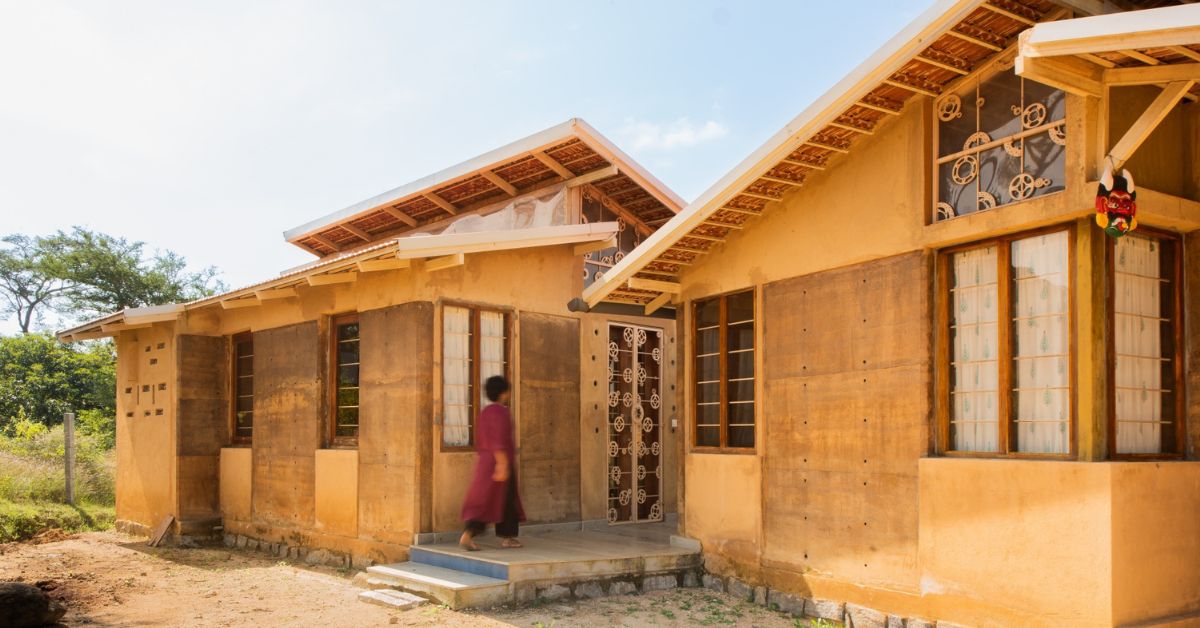
Mud House Construction In Bangalore

There is a particular scent that defines a Bangalore monsoon—the smell of wet earth, of kaccha lime plaster sweating cool against a wall, and the faint, sweet musk of sun-dried mud bricks stacked like golden loaves in a forgotten corner of the city. Long before the glassy IT corridors of Whitefield and the soulless symmetry of gated communities, Bangalore was a city of red soil and granite. In the 1950s and 60s, when the city was still a pensioner’s paradise, the act of building a home was not a transaction; it was a ritual. Families would pool resources, hire a mistri (master mason) from the old town, and spend months trampling earth, mixing it with paddy straw and cow dung, and pressing it into wooden molds. The resultant walls were not merely structural—they were breathing, living membranes that kept the brutal April heat at bay and whispered stories of the land they were born from. This was the humble genesis of mud house construction in Bangalore: a practice born not of aesthetic choice, but of deep, unadulterated necessity, where the earth beneath your feet was both the blueprint and the building material.
But necessity is a cruel master, and as Bangalore began its relentless march towards becoming a tech metropolis in the 1980s, the mud house became a symbol of a past we were desperate to escape. The arrival of Portland cement and hollow red bricks in the 1970s was seen as a technological triumph, a promise of permanence against the perceived fragility of earthen walls. A mud house was suddenly associated with rural poverty, with the cramped gullies of Malleswaram’s older quarters, or with the temporary shelters of migrant workers. The city’s wealthy and upwardly mobile began to encase their red soil homes in a sarcophagus of concrete, plastering over the earthy warmth with grey, unyielding finishes. It was a strange cultural amnesia—a city built on a geological bed of laterite and fertile loam actively renouncing its own foundation. The very women who had perfected the art of tadelakt-like mud polishing, which gave walls a mirror-like sheen, found their skills obsolete. For decades, the narrative was clear: to build with mud was to admit to being left behind. The subtle climate rationality of a 600mm-thick earthen wall, which naturally regulated humidity and cooled the air by up to 8 degrees Celsius, was traded for the insulting thinness of cement blocks that wept condensation in the monsoon.
Yet, buried beneath the rubble of demolition sites and the asphalt of new flyovers, that old knowledge never fully died. It was kept alive by the poorest of the poor, who had no other option, and by a tiny, eccentric cadre of architects who looked at a Rammed Earth wall and saw not a relic, but a radical future. The turning point, however, was not architectural ego, but an energy crisis. When electricity tariffs began to climb in the 1990s and air conditioner usage became a survival necessity rather than a luxury, the economic folly of concrete architecture became starkly visible. Why pay a fortune to cool a box that was designed to trap heat? This question triggered a slow, tentative revival. The city’s engineers, who once scoffed at mud, started peering at soil samples with new eyes, realizing that Bangalore’s distinctive red laterite soil was actually world-class for stabilization. The journey of mud in this city, therefore, is not a linear tale of progress, but a cyclical one—a spiraling return to the source, albeit now armed with soil-cement ratios and mechanical compactors instead of bare feet and wooden mallets.
Must Read
The Great Concrete Hijack and the Bizarre Decades of Denial
The most fascinating—and frankly, bizarre—period in Bangalore’s housing history was the 1980s to the early 2000s, when the city went through what can only be described as a violent aesthetic psychosis. It wasn’t just that builders rejected mud; they actively mocked it. In the booming layouts of Jayanagar and Basaveshwara Nagar, a house was judged by the volume of M-Sand and cement it consumed. Builders would slap a thin layer of "cement plaster" over a mud brick wall just to hide the crime, a superficial shaming that did nothing for the thermal performance. There was a pervasive, irrational fear of "walls sweating" or of termites treating your home as a buffet. I recall a senior civil engineer from the Bangalore Mahanagara Palike (BMP) in the mid-90s stating, with absolute certainty, that a mud house could never withstand the vibrations of a BMTC bus passing by. This was patently false—the old fort walls in the city had survived cannonballs—but it served the narrative of the construction mafia, who made their margins on the sheer tonnage of cement sold.
Digging deeper into the forgotten vintage facts, one discovers that Bangalore’s pre-colonial architecture was heavily dependent on a specific technique called Chunam and rammed earth. The palaces in nearby Mysore and the old cantonment bungalows used a mix of mud, lime, jaggery, and very finely ground eggshells to create a surface that was insect-repellent and, mysteriously, self-healing. Small cracks in the walls would literally close up during the next rain as the clay particles swelled. But the concrete-era culture had no vocabulary for such materials. The bizarre treatment of this topic extended to the way urban planners discussed it. In the Comprehensive Development Plan of 1995, there was no mention of "alternate building materials" except in vague footnotes about "low-cost housing for the poor". The city actively legislated mud out of existence by mandating minimum mortar strengths that a pure mud wall could never meet, forcing any aspiring eco-builder to either bribe inspectors or secretly move under the cover of darkness to raise their walls.

Then, there was the phenomenon of the "hidden mud palace". In the 1990s, in upscale neighborhoods like Indiranagar, it was not uncommon to find 50-year-old mud bungalows that had been hidden behind elaborate compound walls and climbing plants. The owners were often embarrassed of their homes, spending lakhs on interiors to persuade guests that the insides were "modern", while the thick, tawny exterior stood guard. Some even went to the extreme of having the exteriors sprayed with a textured paint that imitated brickwork—a pathological desire to appear concrete. This self-loathing reached its peak with the infamous "Fake Rocks" trend of the 2000s, where homeowners would build concrete retaining walls and paint them to look like natural Karnataka granite, completely ignoring the genuine beauty of the rammed earth just below. It was a city doing a tremendous amount of emotional labor to forget that it lived on a red soil that was the envy of the world.
However, the harshest irony was the structural failure of this new concrete utopia. By the 2005, the city began witnessing a strange epidemic: "sick buildings". The corporate campuses and high-rise apartments, despite being marvels of engineering, suffered from chronic mold issues, respiratory problems among occupants, and a horrifying reliance on 24/7 mechanical ventilation. The very mud that had been banished was capable of absorbing 50% of its weight in moisture, regulating the Bangalore air with an alchemy that no HVAC system could replicate. The act of building with mud was no longer just nostalgic; it had become an act of public health. This realization cracked the concrete monopoly, opening the door for a generation of "Neo-Earth" builders who began hacking the old rules with modern rheology—using 10% cement stabilized soil, polyester fibers, and hydraulic presses to create Compressed Stabilized Earth Blocks (CSEBs) that were stronger than conventional bricks but used 80% less embedded energy.
Modern Hacks: Re-Engineering the Earth for the Bengaluru Velocity
Today’s mud construction is not your grandmother’s rammed earth. It is precision-engineered, data-driven, and shockingly futuristic. The classic principle of "wet soil compacted layer by layer" has been modernized into the world of Rammed Earth. Architects in Bangalore are now using smart sensors embedded inside walls to monitor moisture content and structural integrity in real-time. These walls are hybridized with thin layers of fly-ash insulation and pierced with PVC conduits for smart wiring, making them compatible with the Internet of Things (IoT). For the fast-paced homeowner who wants a rustic look but cannot wait six months for natural curing, companies are pre-fabricating large mud panels in off-site factories. These panels—compressed at 2000 PSI—are trucked to the site and lifted into place within days, a stark contrast to the labor-intensive hand-tamping of yesteryear.
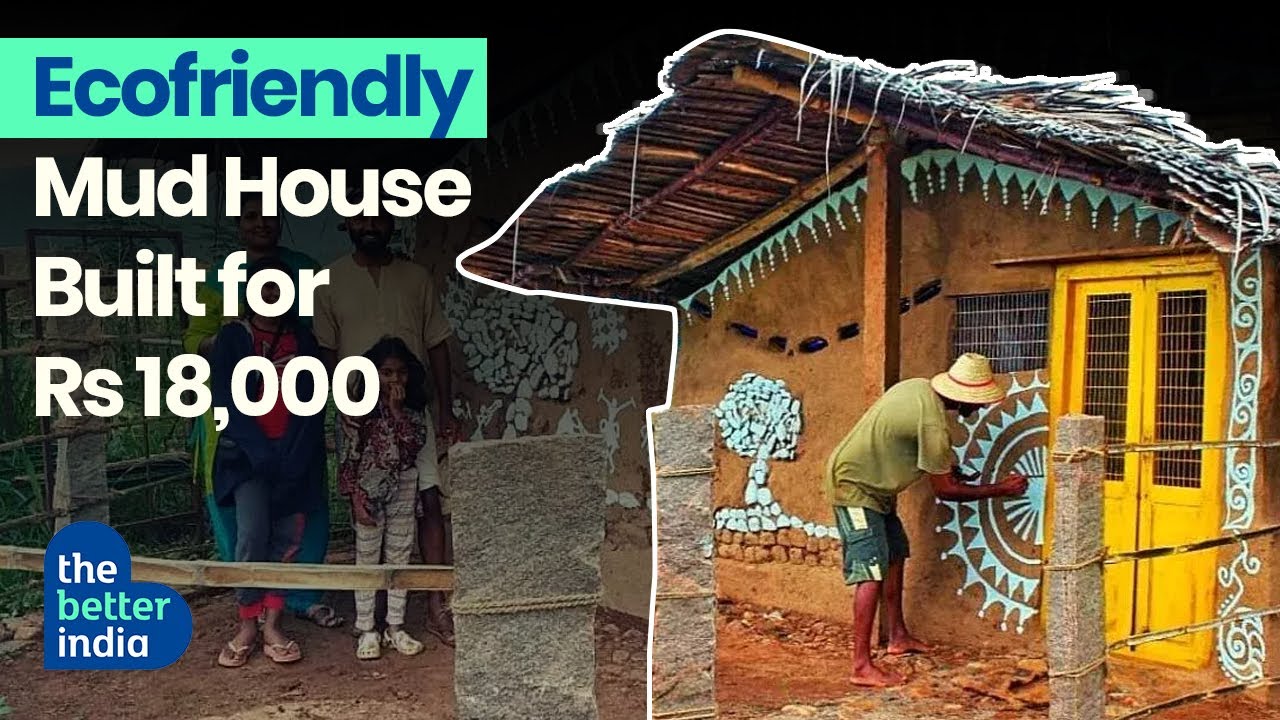
The biggest hack, however, lies in the chemistry. Traditional mud required massive overhanging roofs to protect the walls from rain; modern builders are changing the soil matrix itself. By adding chemical stabilizers like calcium chloride and hydrophobic additives, they are creating a "self-sealing" wall surface that actually gets stronger as it gets wetter. Gone are the days of daily watering and maintenance. Instead, we now have "Living Walls" where mud sections are integrated with vertical hydroponic gardens that not only cool the house but purify the air. Furthermore, the aesthetic has shifted from the "poverty womb" to the "luxury bunker". High-end villas in the new north Bangalore corridor are showcasing polished mud walls that look like brushed caramel, accented with rosewood frames and Italian marble floors. The modern hack is about juxtaposition—taking the ancient coolness and pairing it with the absolute apex of modern finishings to create a statement of conscious wealth, not frantic consumerism.
The Mud Paradox: Clarity Across the Ages
1. Is an old-style mud house safe against Bangalore’s seismic activity and constant rain?
The historical myth, which persisted through the 1960s and 70s, was that mud houses are ticking time bombs, prone to melting in the rain and crumbling at the first tremor. This notion stemmed from observing poorly maintained, pure-clay homes in rural areas where the foundations were non-existent. However, historical records from the 1940s show that well-built Bangalore mud houses with stone basalt foundations actually fared far better during the occasional regional tremors than rigid brick houses. The key was the flexibility of the mud—it could absorb micro-vibrations without cracking, while cement is brittle and snaps. Modern fact: today’s engineered mud houses are tested against seismic loads on shake tables. Because they are monolithic in nature (built as one continuous mass, especially rammed earth), they perform excellently against teardown. For rain, the modern hack is the foundation and the cap. A raised granite plinth and a deep overhanging eaves—features used extensively in the 1990s traditional Malnad homes—protect the vertical walls. Modern builders add a breathable silicone-based sealant that allows internal moisture out but prevents external droplets from entering. So, yes, with proper engineering, a mud house in Bangalore is not just safe; it is arguably safer and more resilient than conventional concrete boxes, particularly against the urban flooding that clogs the concrete city.
The second part of the answer addresses the fear of termites. The misconception that mud attracts insects is a leftover from the colonial era, when British engineers in the 1880s witnessed termite mounds and assumed all earth was corrupted. In reality, termites prefer damp, dark voids—which are common in hollow concrete block walls. They do not typically eat through dense, compacted earth unless there is excessive organic matter (straw) present. Vintage builders used a bizarre but effective trick: they added neem leaves and ash from burnt tamarind pods to the mud mix. This acted as a natural pesticide. Modern engineering replicates this by maintaining a low soil compaction moisture content (below 12%) and using non-organic stabilizers like lime or fly ash, which create a hard, mineral-packed matrix that termite mandibles cannot penetrate. The modern fact is that insurance companies in Bangalore now offer reduced premiums for certified rammed earth homes because of their enhanced fire resistance and pest resistance, debunking the old myths entirely.

2. Does building with mud really save money in Bangalore’s inflated real estate market, or is it a rich person’s vanity project?
This is where nostalgia often blinds us. In the 1970s, mud construction was undoubtedly cheaper—it was the labour of your own hands and the soil from your own plot. The cost of materials was nearly zero. Fast forward to the 2020s, and the equation has inverted violently. The cost of skilled earth artisans has skyrocketed, thanks to the scarcity of trained masons who understand the nuances of soil compaction. A single square foot of high-end rammed earth, with its beautiful striated layers, can cost anywhere between ₹250 to ₹400 per square foot—significantly higher than a standard brick-and-mortar wall at ₹150 per square foot. However, this is where the analysis gets analytical. You are not just paying for walls; you are paying for a passive cooling system. A typical Bangalore homeowner spends ₹5,000-₹8,000 monthly on AC bills. A mud house reduces this energy load by up to 60-70%, meaning the payback period on that initial premium is roughly 4-5 years. Over a 20-year horizon, the total cost of ownership of a mud house is dramatically lower.
Furthermore, the land cost dominates Bangalore’s real estate market, not the structure. Those who argue mud is "for the poor" are ignoring the evolution. The real saving is in the perception of density. Because mud walls can be made exceptionally thick (up to 2 feet), they allow for larger, more open floor plans with fewer structural pillars. This means you can build more usable square footage on a smaller plot without violating setback rules. The novelty factor is also an economic asset; an eco-certified mud villa in a gated community commands a 15-20% higher resale value due to its "boutique" status. For the middle-class aspirant building a single-family home, opting for CSEBs (which are machine-pressed blocks) cuts labour time massively and costs only 10% more than conventional bricks, while offering superior insulation. It is not a vanity project; it is a long-term investment in utility and resilience, which, given Bangalore’s unreliable power grid, is profoundly practical.
3. Are modern mud houses just imitations of ancient architecture, or are they a genuinely new invention?
To see them as mere imitations is to discount two decades of material science. The ancient Vastu-compliant mud homes of the 1800s were essentially giant sun-dried bricks—good at storing heat, but weak in tension. They relied heavily on thick walls for structural integrity. Modern construction, however, has utilized the concept of Geopolymer binders. In the 1990s, a strange science experiment began in Bangalore’s Indian Institute of Science (IISc) where they discovered that by activating the silica and alumina in laterite soil with an alkaline solution (such as sodium hydroxide), you could create a material that cures like concrete but is entirely soil-based. This is the driving force behind modern mud houses. They are not built using the "puddle and press" technique; they are cast using the "Pressure and Flow" technique, treated as a fluid material that can be pumped into complex 3D-printed molds. This is a novel construction method with no direct historical precedent.

Moreover, the modern mud house is armed with a digital nervous system. Sensors embedded in the wall can detect structural fatigue and send alerts to your smartphone. The mixture is not archaic; it is bionic—integrating carbon-fiber rods for tensile strength and recycled plastic fibers to prevent catastrophic shearing. This is the dawn of computational earth architecture, where artificial intelligence optimizes the soil matrix for the specific micro-climate of a Bangalore neighborhood—be it the sandy loam of Electronic City or the red clay of Devanahalli. The goal is no longer to mimic the old fort walls, but to create a living, evolving skin that responds to the city’s unprecedented rain patterns and temperature spikes. It is a bold, new materiality that borrows the aesthetic soul of the past but is thoroughly planted in the future of robotics and geo-chemistry.
As we look two decades into the future, the mud of Bangalore is poised to become the ultimate symbol of technological prestige. We are standing on the precipice of a world where the skyscrapers of the city—currently concrete monoliths—will be gradually retrofitted with "earth exoskeletons". Imagine a future where the cooling load of a 40-story building is handled by an outer shell of hyper-engineered rammed earth, grown using biologically synthesized soil that "cures" via bacterial activity. The photovoltaic-embedded clay tiles of the future will not just shelter us; they will function as micro-energy grids. The city’s identity will shift from the "Silicon Valley of India" to the "Soil Valley of the World", where every major tech campus employs geneticists to breed specific bacteria that turn local waste soil into immediate load-bearing, self-repairing structures. The construction workers of tomorrow will not be masons with trowels, but drone operators guiding bio-reactors that spray structural mud onto 3D-printed lattice frames.
But the most profound change will be psychological. The final act of the mud revival will be the reclaiming of cultural memory. When the concrete blocks that seal our current homes start to crumble after their 60-year lifespan—a lifespan significantly shorter than the 200-year-old mud mansions still standing in Basavanagudi—the city will undergo a catastrophic rerouting of its construction logic. The children of future Bengaluru will do their school projects on the "intelligent earth" of their ancestors, not on binary code alone. They will walk through homes where the walls breathe, where the warmth inside during a November drizzle feels less like a machine output and more like a maternal embrace from the planet itself. The mud house will be normalized not as a rustic exception, but as the default, luxurious standard of human habitation—a full circle that took us four decades to recognize. The red soil of Bangalore, once scraped away to make way for parking lots, will once again be the primary infrastructure of our lives, binding us forever to a truth we briefly denied: that the future of great cities is not built in the air, but nourished from the ground up.