
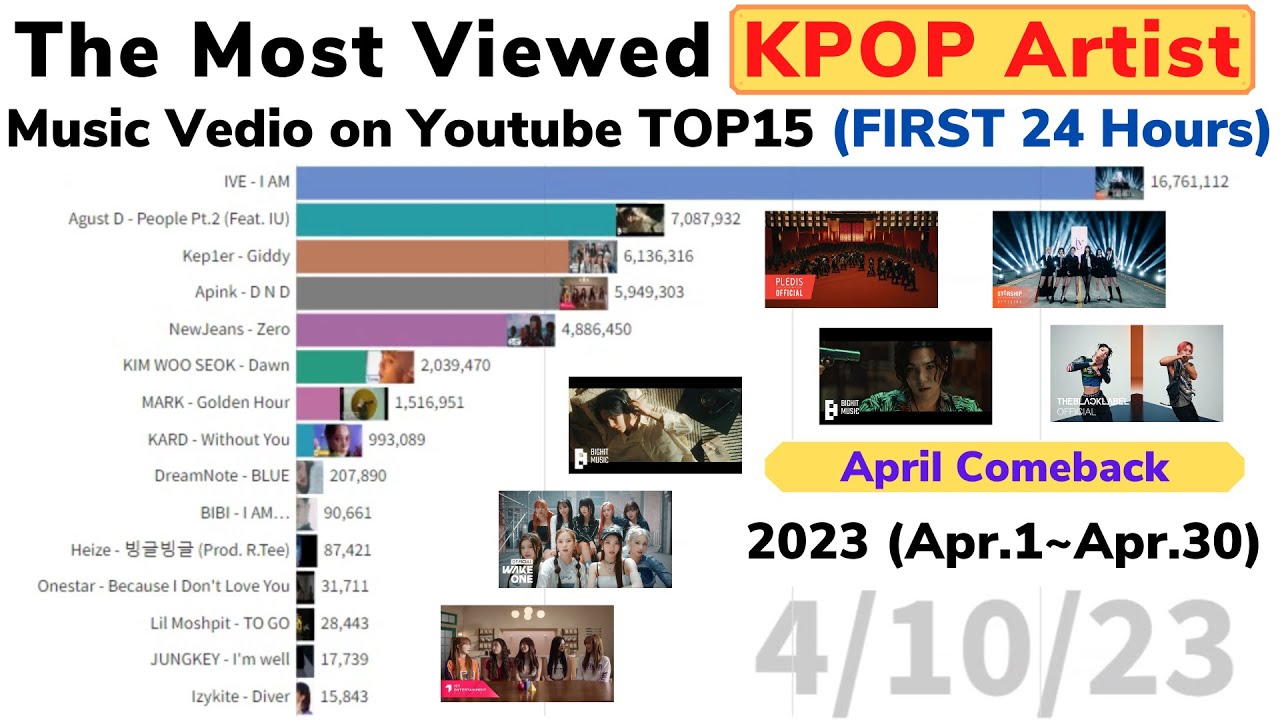
Most Viewed Kpop Solo Mv In 24 Hours

There is a specific, visceral thrill that arrives with a timestamp. It is the cold, digital confirmation of a cultural moment, a number that flickers across a screen and instantly etches itself into the collective memory of millions. For K-pop fans, that number is often the 24-hour view count on YouTube—a brutal, exhilarating sprint that has become the sport of the digital age. To look back at the history of the most-viewed K-pop solo music videos in their first day is not merely to review statistics; it is to witness the evolution of a global fandom from a niche subculture into a hyper-organized, technologically empowered behemoth. The journey begins not with polished, high-budget cinematic productions, but with a raw, desperate need for connection. In the late 2000s and early 2010s, a soloist’s success was measured by physical album sales and broadcast appearances on shows like Music Bank or Inkigayo. The internet was a secondary tool, a place for dedicated fans to share grainy fancams on forums, but the idea of a "world record" for views was a foreign concept, relegated to Western pop stars like Justin Bieber or Adele. The initial human necessity was simple: the desire to see one’s idol succeed, to validate their comeback in a tangible, quantifiable way that transcended linguistic borders. This need for validation, for a shareable proof of love, laid the groundwork for a revolution that would turn streaming into an act of devotion.
The earliest solo records were less about sophisticated algorithms and more about the sheer, brute-force enthusiasm of a nascent online community. When Psy’s "Gangnam Style" shattered the glass ceiling of YouTube in 2012, it was a fluke—a global novelty that felt less like a fandom effort and more like a planetary seizure caused by an earworm. Yet, it primed the pump, teaching Korean entertainment companies that YouTube was not just a distribution channel, but a global billboard. For solo artists specifically, the landscape was sparse. The first true soloist to weaponize the 24-hour metric was often overshadowed by their group counterparts, yet figures like Taeyeon from Girls’ Generation or G-Dragon from BIGBANG began testing the waters. G-Dragon’s "Coup D'Etat" in 2013, while critically lauded, was a time of very different metrics; a million views in a day was considered a monumental victory. The speed of consumption was slower, hindered by buffering videos on 3G networks and the lack of automatic play features. There was a bizarre, almost ritualistic aspect to early streaming: fans would manually click the video, refresh the page after it ended, and meticulously track the view counter with stopwatches. It was a labor of love, but an inefficient one, a stark contrast to today’s seamlessly integrated playlists. Back then, the concept of a "bulldozer" streaming party—where hundreds of thousands of fans coordinate to watch a video simultaneously—was treated with suspicion by YouTube, leading to the infamous "view count freeze" that plagued the platform during massive K-pop releases, a technical glitch that would become a rite of passage for record-breaking comebacks.
As the 2010s progressed, the paradigm shifted from organic virality to strategic planning. The major transformation arrived with the rise of the "fandom think tank"—the birth of massive online armies on platforms like Twitter and Telegram. These groups transformed streaming from a passive activity into a science. They analyzed YouTube’s algorithm, determining that watch time, retention, and repeat views were more critical than just clicking. This led to the development of "blocked streaming," where fans would watch a specific sequence of videos to reset their IP addresses and avoid view-capping. It was during this era that the solo record began to escalate violently. When Kai of EXO released "Mmmh" in November 2020, he captured a then-record that felt monolithically huge. But the true watershed moment for soloists arrived with Lisa of BLACKPINK. Her debut single "LALISA" in September 2021 didn’t just break the solo record; it shattered the perception of what a soloist could achieve. Garnering over 73.6 million views in 24 hours, the video was a visual opulence of Thai culture and hip-hop swagger. It was a knockout blow that proved a soloist could rival—and even surpass—the biggest group comebacks. The reaction was not just excitement; it was a declaration that the solo market had finally matured into a main-event spectacle.
Must Read
Yet, for every triumph, there is a forgotten vintage fact that highlights how strange this era was. While Lisa’s record was awe-inspiring, it was immediately met with a shadow—a reminder of the dark underbelly of the metric. The record for most viewed solo MV previously belonged to BTS’s Jungkook, but for his viral cover of "2U" by The Chainsmokers? No, actually, the true forgotten gem is the tense rivalry between IU and Jessi. In 2021, when IU released "LILAC" and Jessi released "Cold Blooded," fanbases clashed over what constituted a "true" solo debut versus a title track from a regular album. The semantics of the chart became a battlefield, arguing over whether subunit releases or solo sub-singles counted. This bizarre gatekeeping reflects a deeper truth: the 24-hour metric is a volatile, emotional currency, prone to manipulation and heartbreak. We also cannot forget the infamous "freeze" event during Park Jimin’s "Set Me Free Pt.2" release in 2023. As the video was on pace to break Lisa’s record, YouTube’s algorithm detected the spam-like behavior of streaming fanbases and halted the count for over six hours. This resulted in Jimin missing the record by a hair, finishing around 52 million, a devastating loss that sparked global fan outrage. This incident forever changed the rules of the game, forcing fanbases to diversify their IP addresses and slow down their “speed runs” to avoid algorithmic suspicion. It humanized the algorithm, revealing that a robot’s capriciousness could dictate the narrative of a superstar's career.
In today’s fast-paced world, the classic principles of "streaming" have been completely hacked. The modern era, defined by Jungkook’s "Seven" in July 2023—which hit 109.9 million views in 24 hours—is not about fighting the algorithm, but befriending it. Jungkook’s team utilized a "multi-artist" playback strategy, releasing the explicit version, the clean version, and an instrumental soundtrack simultaneously. This created a buffet for the algorithm, offering diverse content that kept users on the platform longer. Modern soloists now rely on "pre-save" campaigns, where fans queue the music video in their "watch later" list hours before the premiere, ensuring a massive simultaneous spike upon release. Furthermore, the rise of TikTok has changed the definition of a successful debut; short-form, addictive choreography clips are released hours before the MV, driving massive traffic to the main video as people seek the full context of the dance move they’ve already learned. This hybrid strategy—combining audio streaming, YouTube views, and TikTok trends—is a hack on the very concept of linear promotion. It treats the "first day" not as a singular event, but as a multi-vector offensive designed to saturate every feed on the internet.

The Sociology of the View Count: From Fandom to Infrastructure
The evolution of this metric is also a story of the infrastructure of devotion. In previous decades, the "bizarre way" this topic was treated involved fan-run radio stations and physical letter-writing campaigns. Today, that infrastructure has been digitized but retains the same obsessive energy. Fanbases now operate like professional media agencies, with dedicated "streaming captains" who use Google Sheets to assign time slots to thousands of fans. They run "Vacation Mode" events, where members take days off work to stream for 24 hours straight. The philosophy has shifted from "watch and enjoy" to "watch and optimize." This is a profound sociological shift—the fandom has become a decentralized workforce, with the idol as the CEO and the views as the quarterly earnings report. This gamification has led to an arms race of engagement, but it also raises questions about the authenticity of consumption. Yet, the narrative is undeniable: the "record" is a co-creation between the artist and the audience. A soloist is no longer a singer; they are a brand manager leading a global digital labor force, and the 24-hour view count is the ultimate KPI.
Looking at the "forgotten vintage facts," we must acknowledge the early pioneers who paid the price for today's comforts. Taemin of SHINee, with "Want" in 2019, experienced constant buffering issues on the V LIVE platform, which was not optimized for global traffic. Fans had to rely on illegal YouTube uploads just to view the content, splitting the traffic and crippling his 24-hour numbers. Similarly, Sunmi’s "Gashina" in 2017 achieved legendary status through word-of-mouth but lacked the streaming infrastructure that later generations enjoyed. These artists represent the "analog era" of the digital metric—their talent was immense, but their timing was slightly early. The audience’s desire for a "safe" viewing experience—one that didn't crash and showed accurate numbers—was a primitive need that drove the tech companies to build better servers. The highs of the 2020s, where videos premiere without a single lag for millions, are built on the scar tissue of those early crashes. The 24-hour view count is not just a badge of honor; it is a testament to the absurd, collaborative advancements in global internet infrastructural stability.
The Great Hacking: Modernizing the Historic Sprint
Today’s artists are hacking the nostalgia of the "music video premiere" itself. In the past, a premiere was a cliffhanger—an event where you waited eagerly to finally see the visual. Now, the premiere is an interactive social event. On YouTube, the "live premiere" chat feature has evolved into a virtual concert. Idols like Chanyeol and Ten now sit in the chat minutes before the MV drops, sending emojis and interacting with fans. This humanizes the process and converts viewers into participants, drastically increasing retention because they are waiting for the artist’s reaction to their own video. The "classic principle" of the video as a finished product has been modernized into a real-time performance. Furthermore, the use of AI-generated thumbnails and A/B testing is now standard. Companies release the video with multiple thumbnails to different demographic segments, ensuring the highest possible click-through rate in the first hour. This is a stark departure from the early 2010s, where the thumbnail was just a fuzzy screenshot. The recording industry has realized that the "first 3 seconds" of a thumbnail are more valuable than the first 3 seconds of the song itself.

Frequently Asked Questions on Solo MV Records
Why did Jungkook’s "Seven" manage to almost double the previous solo record, when his group’s records seem to have plateaued?
The answer lies in the diversification of global time zones and the "lifestyle of the format." When BTS releases a group song, the fandom’s streaming power is massive, but the audience for a solo track is often broader. With "Seven," the infusion of a catchy, Western pop melody featuring Latto, along with the fact that it was an explicit summer anthem, captured a casual demographic that does not typically stream K-pop. The historical myth is that a higher fandom size equals a higher view count; in reality, it is about the depth of the pool, not just the width. The success of "Seven" is also attributed to its release timing on a Friday, which allowed for three days of weekend streaming to be averaged into the "first 24 hours" window from various global regions. It leveraged the weekend's higher leisure-time viewership, a hack that its predecessor, "LALISA," hindered by a mid-week release. The metrics are a ballet of global calendars, and Jungkook’s team choreographed it flawlessly, appealing not just to the existing fandom but to the global nightlife and gym-playlist crowd.
Is the view count still considered a "valid" measure of success, or is it now considered a fake metric due to streaming farms?
This is a crucial bridge between historical myth and modern fact. In the past, labels actively used "ad farms" or click-buying bots to inflate numbers, leading YouTube to crack down and purge millions of views. This created the myth that all high numbers are fake. However, modern YouTube analytics are sophisticated; they track unique viewers, engagement duration, and human-bot CAPTCHA patterns. A fan watching a video 50 times on the same IP is still counted as one "valid" view by strict standards, but an ad farm using compromised Android devices is easily caught and removed. Therefore, while the number is a "soft" metric—it doesn't equate to sales or cultural longevity—it is a valid measure of a fandom’s organizational might and willingness to dedicate man-hours. The shift has been from buying views to "leasing" human attention through sophisticated streaming schedules, which is legal and validated by the platform. The metric is not indicative of artistic quality, but it is a perfectly valid measure of fan engagement and marketing reach. The "fake" nature of the past, where numbers were inflated with bots, has been replaced by a "gym-rat" culture of highly trained, voluntary participation.

How has the 24-hour record impacted the marketing budgets for solo debuts versus group debuts?
Historically, solo debuts were considered a "side project"—a way to keep the brand hot while the group was on hiatus. Budgets were 50% to 70% of a group comeback. However, the 24-hour record has revolutionised this. A soloist is now viewed as an independent revenue stream with the potential for a higher profit margin per unit of investment. Because the soloist carries the video alone, the marketing budget is increasingly allocated to premium cinematography, overseas filming locations, and expensive CGI, as these visual hooks are the primary drivers of the initial stream. The "classic principle" was that the group dynamic carried the charisma; now, the solo debut must be a visual feast because the audience is watching the individual’s gravity. In 2024, solo debuts like Jimin’s "MUSE" and J-Hope’s "HOPE ON THE STREET" have been given budgets rivaling BTS group releases, featuring multiple set changes and documentary-style production. The ROI is calculated not just on album sales but on the advertising revenue from the MV itself, which expectedly surpasses 200 million views. Marketing teams now allocate 30% of the total budget to "pre-release teaser content" designed exclusively to boost the first 24 hours, a stark contrast to the old days where the teaser was an afterthought.
As we peer into the next 20 years, the trajectory of this phenomenon is dizzying. We are heading towards a future where the "Music Video" as a linear 3-minute film may cease to exist. Expect the rise of "chopped and screwed" versions of the MV, where interactive 4D experiences are embedded into the YouTube infrastructure. In the next two decades, the 24-hour record will likely be measured in Virtual Reality views, where users don their haptic suits and "enter" the video to dance alongside a digital avatar of the artist. The record won’t be about how many times it was clicked, but how many concurrent users were inside the virtual world. The record holder will not just have the most views; they will have the highest server capacity, offering a "real-time virtual meet-and-greet" during the first hour. The humble beginning of "clicking play" will evolve into "stepping into the stage."
We will also see a deeper philosophical shift towards the "Authenticity Score." As audiences become more jaded by the arms race of streaming, there is a palpable desire for slower, more genuine connections. The current frantic pace of the 24-hour sprint may eventually collapse under its own weight, leading to a future where YouTube disables the metric entirely, forcing artists to focus on longevity. Perhaps the most beautiful possibility is that the record will become obsolete, replaced by a metric that measures the global cultural footprint in the weeks following a release—like how many covers were made, how many weddings used the song, or how many memes were spawned. But until that introspective era arrives, we will continue to hold our breath. We will refresh the page with shaking hands, watching as the digits tick upward. We are witnessing a digital gladiatorial arena where the prize is not gold, but the collective digital heartbeat of a generation. And as LISA, Jungkook, and the next generation of soloists prove, the hunger for being "seen" in the first day is a deeply human need—one that will never fade, only digitize. The countdown will always be the most thrilling part of the performance.



![[TOP 30] MOST VIEWED MUSIC VIDEOS BY KPOP ARTISTS IN THE LAST 24 HOURS](https://i.ytimg.com/vi/z_EaS_qCkuE/maxresdefault.jpg)