Mole Fraction Definition Class 12

Picture this: it’s Friday night, and you’re making lemonade for a party. You dump in a cup of sugar, a cup of lemon juice, and about three cups of water, stir it like your life depends on it, and take a sip. It’s either genius or a crime against citrus—but here’s the kicker: you just became a chemist, and you didn’t even know it.
Now, imagine your friend asks, “Hey, how much sugar is actually in there?” You could say “one cup,” but that’s like telling someone your age in months—technically true, but weirdly unhelpful. What you really need is a way to talk about proportions, not just amounts. That, my friend, is exactly where mole fraction steps in to save your Friday night.
So, what on Earth is a mole fraction?
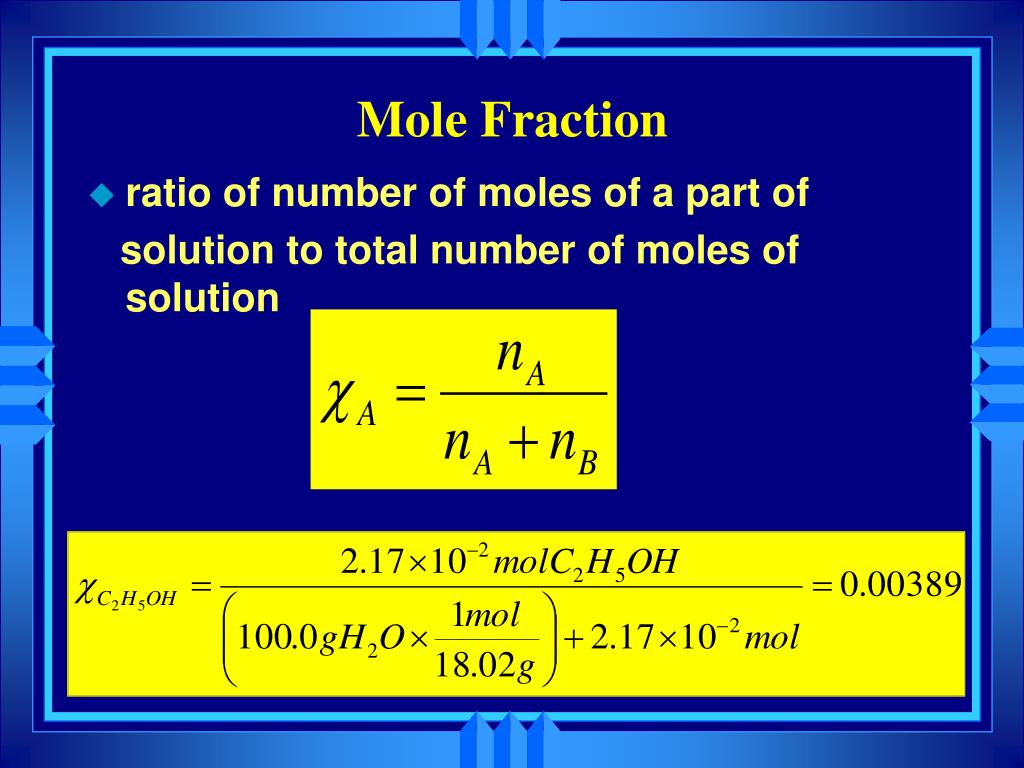
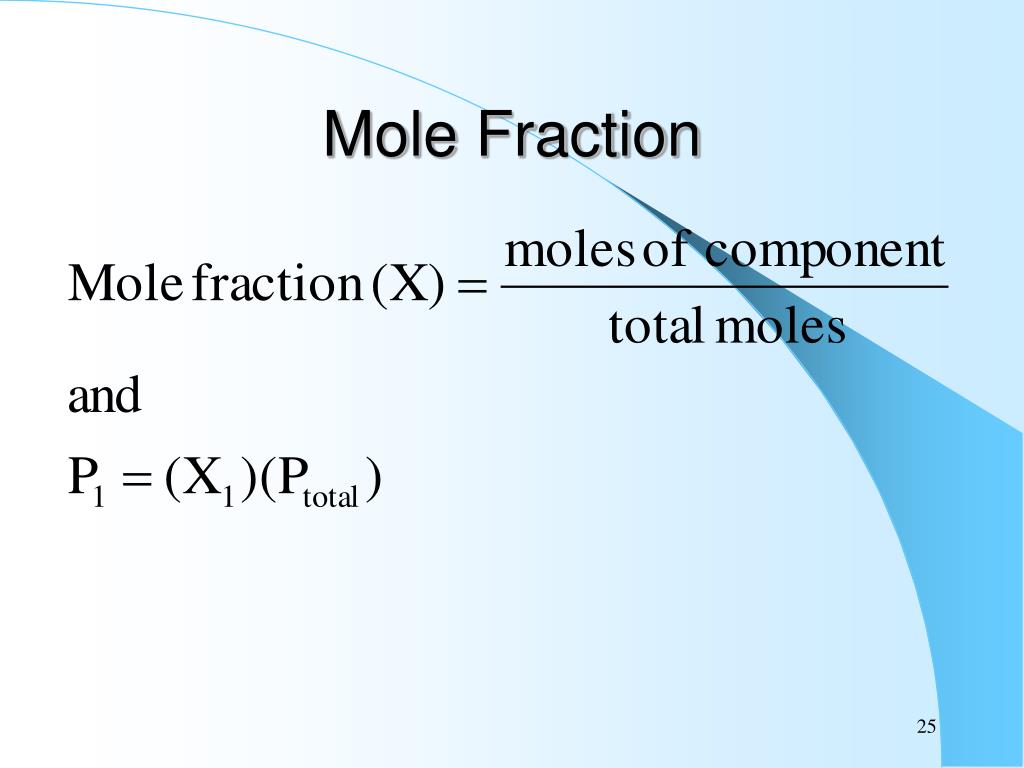
Let’s cut the fluff. Mole fraction (symbol: χ, pronounced “kai”) is a way to express the ratio of one component’s moles to the total moles in a mixture. It’s like asking: “Of every 100 particles in this drink, how many are sugar?”
Must Read
Here’s the formula that will haunt you for the next two years (in a good way):
χA = moles of A / total moles of all components
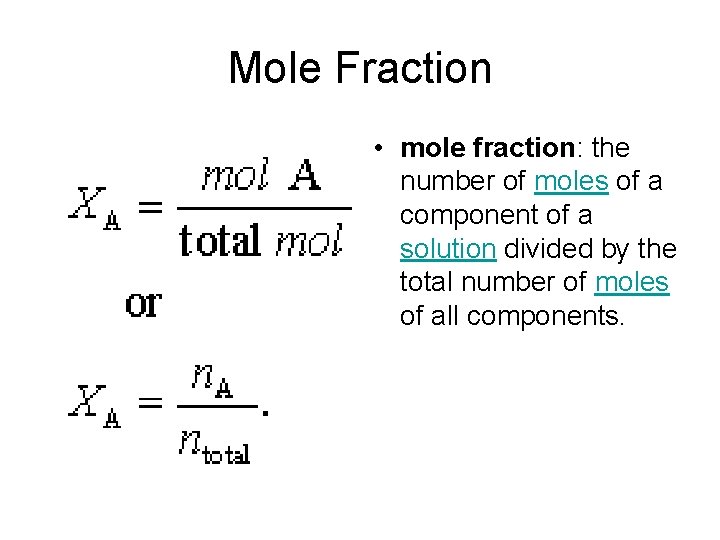
That’s it. No magic, no hidden constants, no “assuming ideal behavior” nonsense—yet. But wait, before you roll your eyes and scroll away, let me tell you why this little ratio is the coolest kid in the solution chemistry playground.
Why not just use molarity? (Or “Why should I care?”)
Great question, and I can hear you asking it because I’ve been there. Molarity changes with temperature—liquids expand, solutions get diluted, and your calculations go sideways. Mole fraction is temperature-independent, which is a fancy way of saying it’s loyal. It doesn’t care if you’re boiling the beaker or freezing it; the ratio stays rock solid.
Also, mole fraction is dimensionless. There are no units attached, which sounds boring but is actually liberating. You can use it for gases, liquids, solids, or even a weird mixture of all three—like a chemistry smoothie where you’ve thrown in everything from the lab sink.

And here’s the secret sauce for Class 12: mole fraction is the foundation for Raoult’s Law, colligative properties (like freezing point depression), and even gas mixtures. You think you’re learning about a simple ratio, but you’re actually building the bridge to every future chapter in physical chemistry. Sneaky, right?
A tiny example (because math with stories is easier)
Let’s go back to your lemonade. Say you have 2 moles of sugar and 8 moles of water. Total moles? 10. Mole fraction of sugar? 2/10 = 0.2. Fraction of water? 8/10 = 0.8. Notice how they add up to 1? That’s not a coincidence—it’s a universal rule. If your fractions don’t sum to 1, you’ve miscounted or you’re lying about the sugar.
Now, here’s where your brain goes, “Okay, but that’s just percentages with extra steps.” And you’re not wrong, but hold on. Percentages are based on 100 parts, while mole fraction is based on 1 entire mole-mix. They’re cousins, not twins. Percentages force you to multiply by 100; mole fraction just is. It’s the “naked” ratio, and sometimes naked is better, especially in gas law problems.

Real talk: the “class 12” twist
In your textbook, you’ll see problems like, “Calculate the mole fraction of HCl in a solution containing 36.5 g of HCl and 54 g of water.” And your first instinct is panic. But stop—convert everything to moles first. Moles are the universal currency in chemistry. Grams are like different countries’ currencies, but moles? That’s the US dollar of atoms.
So: 36.5 g HCl ÷ 36.5 g/mol = 1 mole HCl. Water: 54 g ÷ 18 g/mol = 3 moles. Total = 4. Mole fraction of HCl = 1/4 = 0.25. See? You just did it. Feels good, doesn’t it? But here’s the ironic part—you’ll forget this by Monday because it looks too simple. And then your exam will have a sneaky trick like, “The solution is 20% by mass.” Suddenly you’re not dealing with grams; you’re dealing with assumptions. But that’s a story for another blog post.
Why this matters beyond the exam hall
Chemists use mole fraction to design anesthetic mixtures (yes, the stuff that puts you under for surgery), to calculate how much oxygen you breathe at high altitudes, and even to formulate antifreeze for your car. So the next time your car doesn’t overheat in July, you can thank mole fraction. Or at least pretend you understand it enough to sound smart at a dinner party.

But honestly, here’s what I want you to remember: mole fraction is not a villain. It’s not calculus. It’s a friendly ratio that says, “Hey, out of all the particles in this mix, this portion is yours.” It respects temperature, ignores volume, and plays nice with gases.
So go ahead, make your lemonade, calculate the mole fraction of sugar, and impress yourself. And when your teacher asks, “What’s the definition of mole fraction?”—you won’t recite a textbook line. You’ll say, “It’s the ratio of one part to the whole, minus all the drama.” Then sit back and enjoy the awkward silence.
P.S. If you mix 1 mole of sugar with 0 moles of water, you get χ = 1. That’s called a “meltdown” in chemistry. But also in life, so proceed with caution.