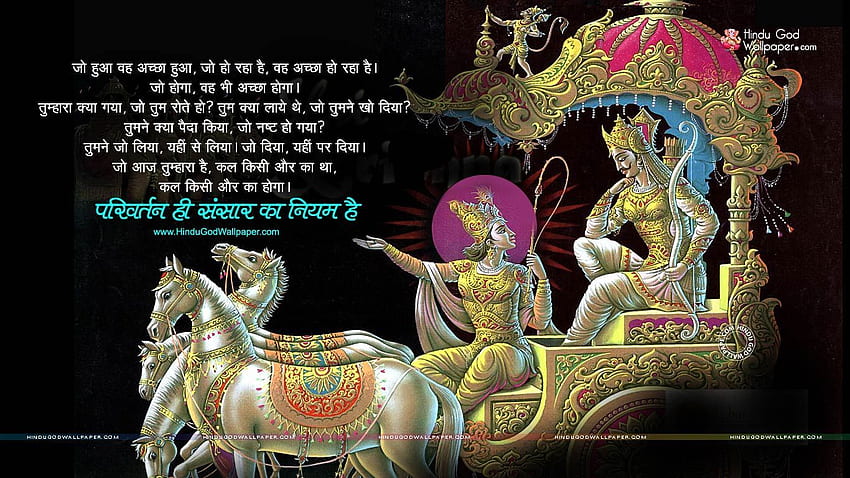
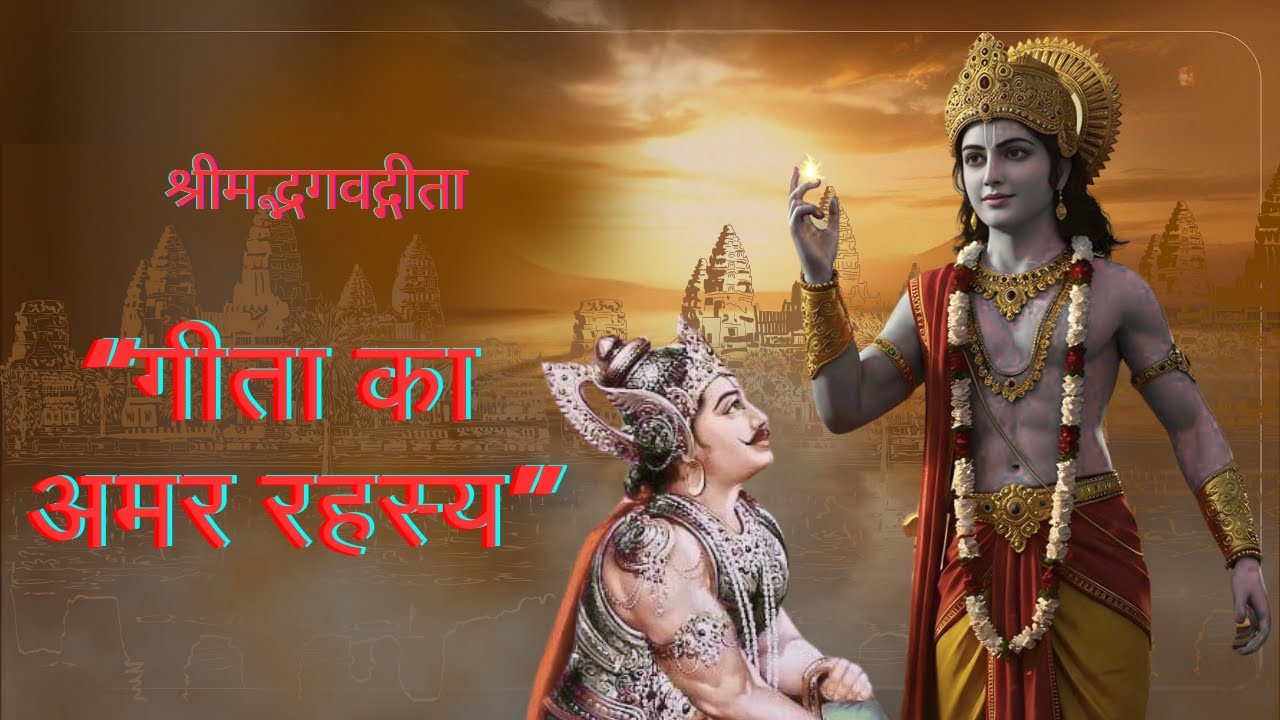
Krishna Knowledge Bhagwat Geeta Saar

Imagine walking onto a battlefield, not with weapons, but with a mind torn between duty and despair. That’s the opening scene of the Bhagavad Geeta, a 700-verse dialogue that is less a religious sermon and more a high-stakes psychological thriller. It’s a conversation between Prince Arjuna, who is having a full-blown existential meltdown, and his charioteer, Krishna, who just happens to be the Supreme Being in disguise. Fast forward a few millennia, and this ancient Sanskrit text has found its way into Silicon Valley boardrooms, modern therapy sessions, and the playlists of your favorite Spotify meditation gurus. The Bhagwat Geeta Saar—or the essence of the Geeta—isn't about escaping the world; it’s about learning how to fight your battles with a composed mind.
Why does this text, written roughly 5,000 years ago, feel so unnervingly relevant today? Because the battlefield of Kurukshetra is a metaphor for the daily war you wage in your own head. It’s the conflict between what you want to do and what you must do, between your ego and your ethics, between the noise of the world and the quiet voice of your intuition. The Geeta Saar strips away the ritualistic baggage and delivers a raw, unfiltered operating system for the human psyche. It doesn’t promise eternal bliss; instead, it offers something far more valuable: a practical manual for staying sane while the world burns around you.
The Dark Side of Detachment: What the Geeta Doesn’t Tell You at First Glance
Most people hear the phrase “Karm Karo, Phal ki Chinta Mat Karo” (Do your duty, don’t worry about the results) and think it’s a passive excuse for mediocrity. But here’s the dark, twisted fun fact: Krishna wasn't telling Arjuna to be lazy. He was telling him to be dangerous. The concept of Nishkama Karma—action without attachment to the outcome—is actually a psychological weapon. When you stop obsessing over the victory trophy, your efficiency skyrockets because you aren't paralyzed by the fear of failure. In modern sports psychology, this is called "process orientation," where an athlete focuses only on the mechanics of the shot, not the scoreboard. The Geeta invented this 5,000 years ago, but with a darker implication: if you remove the ego’s stake in the result, you become unstoppable because there is nothing to lose.
Must Read
There is also a rebellious, almost anarchic thread running through the text that is often sanitized by modern interpreters. Krishna famously states, “I am the gambling of the cheats and the splendor of the splendid.” This is not a metaphor. In the Vibhuti Vibhaga chapter, Krishna claims to be the pillar of immorality as well as morality—He is the force behind the scam artist and the saint. This is a dark, humbling fact: the universe isn't purely "nice." It’s a chaotic equilibrium. The Geeta Saar asks you to accept this duality. It doesn’t ask you to love the chaos, but to recognize its divine origin, which is a far more mature, terrifying, and liberating perspective than the "God is love" bumper sticker philosophy.
Culturally, this text has seeped into the unlikeliest of places. It was a favorite of Aldous Huxley, who referred to it as the best statement of the "Perennial Philosophy." It inspired J. Robert Oppenheimer, who famously quoted the Geeta ("Now I am become Death, the destroyer of worlds") upon the first atomic bomb test. That quote wasn't a boast; it was a haunting admission of the Geeta’s core lesson—that you must perform your role, even if that role brings devastation, without personalizing the fallout. In the West, it influenced the transcendentalist movement of Emerson and Thoreau, and today, you can find its principles embedded in the "stoic" productivity apps that track your deep work. The text is a mirror; it reflects back whatever you need to see, whether it’s a call to action or a warning about the cost of action.
The 3 AM Couch Test: Applying the Geeta Saar to Modern Anxiety
Let’s get practical. You’re not going to war, but you are staring at a blinking cursor at 11 PM, trying to finish a project you hate, for a boss you resent, while your Instagram feed shows your friends on vacation. This is your Kurukshetra. The Geeta Saar offers a three-step protocol here. First, identify your "Krishna"—the calm, detached voice within you that isn't emotionally hijacked. When anxiety spikes, ask yourself: "Who is judging this fear?" The answer is usually a silent witness. The Geeta calls this the Atman, which is distinct from the mind that is screaming. By separating the observer from the thought, you immediately drop your heart rate. You realize you are not the anxiety; you are the one witnessing the anxiety.
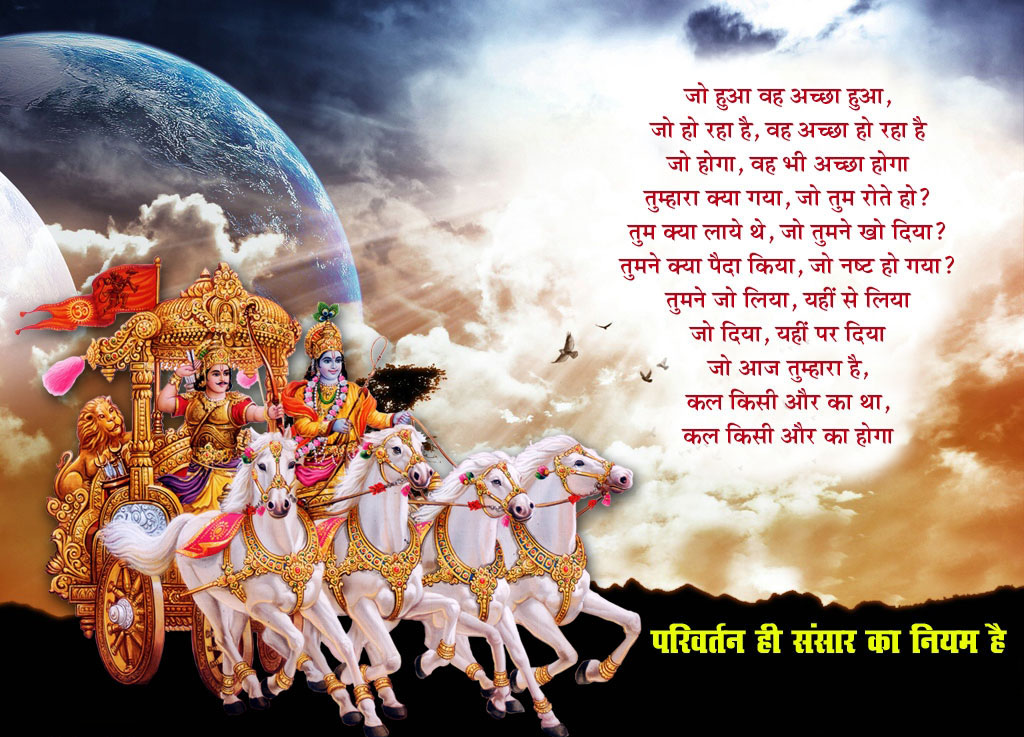
Second, embrace the concept of Swadharma (your unique duty). Society tries to make you a generic template—get the degree, get the mortgage, get the corner office. But the Geeta argues that you must act according to your own nature, not the nature of the person next to you. A case study: imagine a quiet, artistic introvert working as a high-pressure sales executive. They are miserable because they are doing the Dharma of a shark while being a goldfish. The Geeta says it is better to fail at your own duty than to succeed at another’s. This isn't about quitting your job; it’s about recalibrating how you do it. Can you infuse your sales pitch with storytelling? Can you use your empathy to read a client better than the aggressive guy next to you? That is applying Swadharma to modern corporate life—it’s about strategic authenticity, not blind rebellion.
Third, practice the art of “compartmentalized surrender.” Krishna tells Arjuna to fight, but also tells him, "Surrender all actions to me." In practical terms, this is the ability to work with full intensity while maintaining the internal feeling that the universe has your back. It’s the difference between trying to push a river and learning to swim with the current. For a case study, look at high-level athletes like Novak Djokovic or Michael Jordan. They train obsessively—they are fierce competitors—but when the moment of the game arrives, they have a "flow" state where they aren't thinking about the championship trophy. They are just playing. The Geeta calls this Yogah Karmasu Kaushalam—excellence in action is Yoga. Your takeaway is to create a "ritual of release" at the end of each work session. Literally say to yourself, "I have done my part; the rest is up to the divine algorithm." This single shift can prevent burnout and chronic insomnia.
Finally, the Geeta Saar offers a radical solution to FOMO (Fear of Missing Out). Krishna explains that birth and death are just wardrobe changes for the soul. While the metaphysical implications are huge, the immediate psychological benefit is this: the more you identify with the eternal (the soul), the less you cling to the temporary (the status update, the promotion, the car). This doesn't mean you become a monk; it means you engage with the world but stop trying to squeeze infinite pleasure from finite things. You start enjoying the moment—the taste of coffee, the texture of rain—without the feverish need to capture it or show it to anyone. You become a participant in life’s drama rather than a hostage to it.
The Crucible of Doubt: Your Questions Answered
Is the Bhagavad Geeta Saar a religious text or a philosophical one?
It is a brilliant Trojan horse. On the surface, it is a Hindu scripture, complete with divine iconography and theological commands. However, upon deeper inspection—and this is why it attracts atheists and agnostics—it functions as a purely rational system of psychology. The "God" Krishna can be interpreted as the "Higher Self" or the "Cosmic Algorithm." The religion is the candy coating; the medicine inside is a practical guide to decision-making under pressure. You can read it without believing in a personal deity and still extract profound value from its analysis of the mind. It treats the battle of life as a given—it doesn't ask you to pray for a different battlefield, it asks you to engage with the one you have.
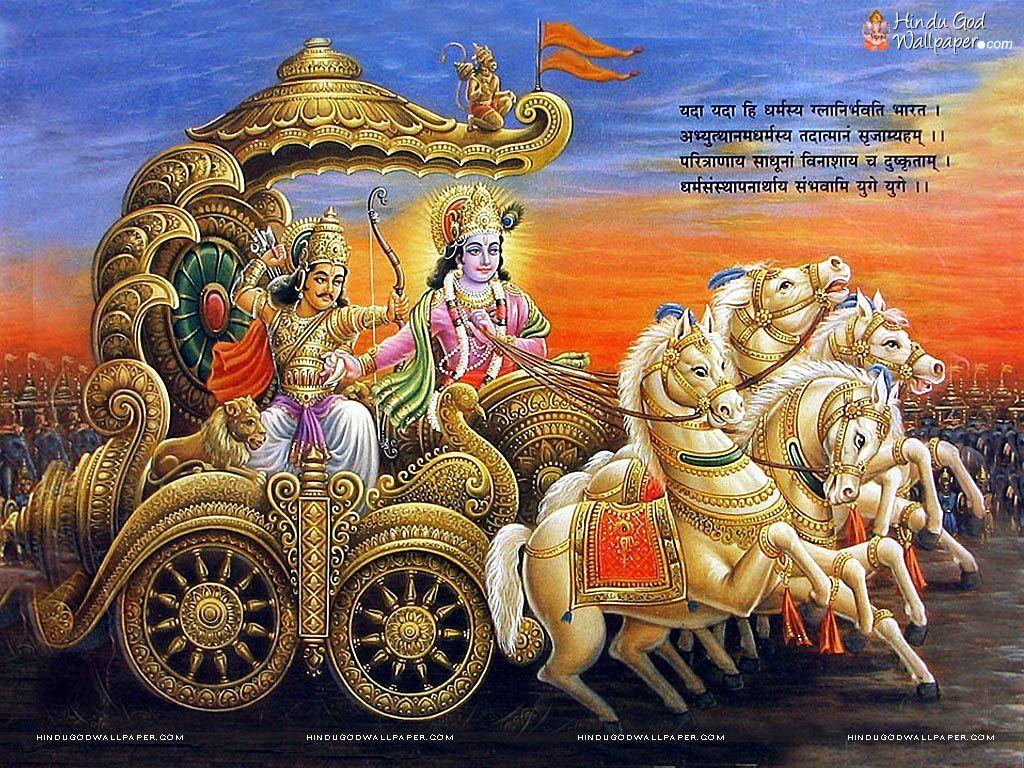
This dual nature is its genius. It allows a scientist to read it as a treatise on quantum mechanics (the observer effect, the field of potentiality) while a devotee reads it as a love letter from God. The Geeta Saar is inclusive because it doesn't demand you choose a lens; it asks you to look through a prism. It argues that truth is multifaceted, and the path to it is not a single road but a network of interconnected trails—action, knowledge, and devotion. So, whether you call it religion or philosophy, you are ultimately dealing with a blueprint for navigating the human condition, which transcends the boundaries of dogma.
Does the Geeta promote violence?
This is the most controversial, dark question. The text literally takes place on a battlefield, and Krishna appears to be goading a reluctant warrior to kill his relatives. This is a scary fact. However, the context is crucial. The Mahabharata war is presented as a last resort. The Kauravas (the villains) had been offered peace five times. Arjuna’s hesitation was driven by emotional attachment—he was willing to sacrifice an entire kingdom for the comfort of his own family’s safety. Krishna’s counsel is to fight for righteousness (Dharma), not for personal vendetta.
In modern application, the "violence" is allegorical. The "war" is the fight against injustice, mental slavery, or societal evil. It is the courage to speak up against a toxic workplace culture. It is the internal ruthlessness to kill your own bad habits—the ego, the greed, the anger—that are standing against your soul's growth. The Geeta advises that if you have exhausted all peaceful options, then standing still is also a form of violence—passive violence against the truth. The violence it condones is the violence of decisive action against internal and external corruption, not the violence of the impulsive. It’s the grim responsibility of a surgeon cutting away a tumor to save the body.
How do I practice "Detachment" when I have bills to pay and people depending on me?
This is the most common modern objection, and the Geeta Saar has a very sharp answer: You have misunderstood the lesson. Detachment in the Geeta does not mean abandoning your family or your bank account. It means detaching from your expectations of how those things should make you feel. Pay your bills meticulously, but don't tie your self-worth to the bank balance. Take care of your family, but don't attempt to control their outcomes. The text uses the metaphor of a lotus leaf in water. The leaf is in the water, but the water does not penetrate it. You have to be in the world, but not allow the world's vibrations to create friction within you.
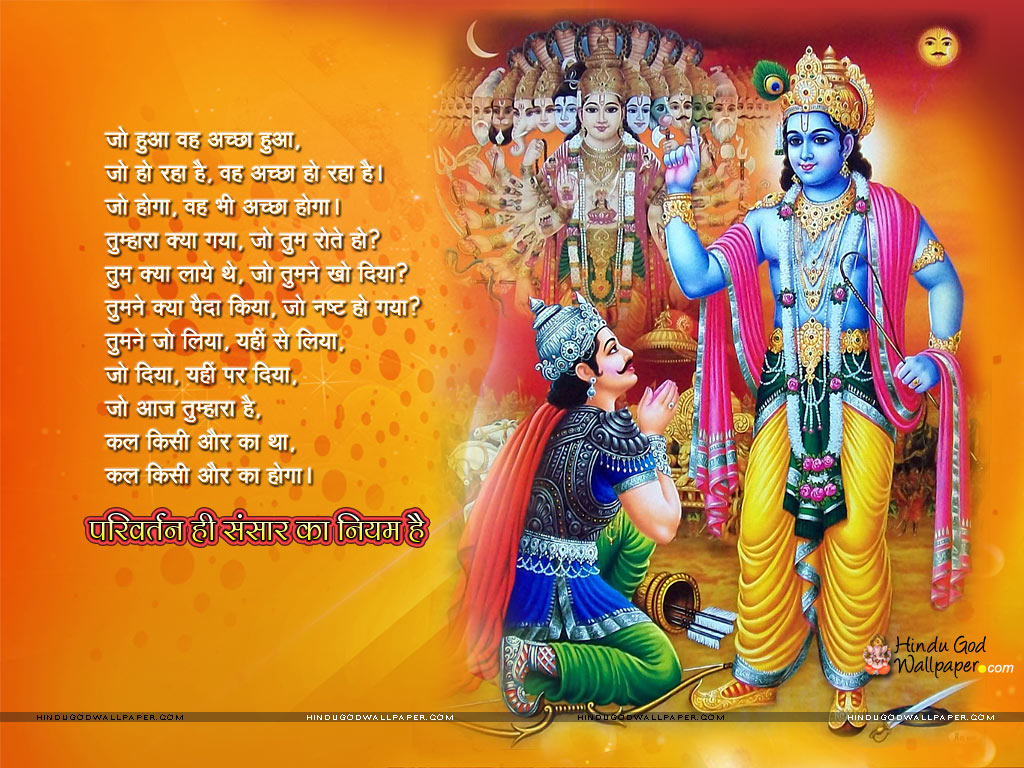
Practically, this translates to "full engagement with emotional sobriety." You work just as hard, you love just as fiercely, but you check the "scoreboard" less frequently. You create a mental firewall: you say, "I will do this to the best of my ability," and then you mentally relinquish the result. The detachment isn't about laziness; it's about reducing the suffering that comes from the uncontrollable. The moment you realize that 50% of the outcome is outside your control (the economy, other people's moods, the weather), you can put your energy solely into the 50% you do control—your effort and your attitude. That is the ultimate form of care, not neglect.
What is the "Saar" (essence) of the Geeta in one sentence?
If you had to squeeze 700 verses into a tweet, it would be: “You are the immortal soul disguised as a fragile body; act relentlessly, live ethically, and surrender the results to a force greater than your ego.” It’s a masterclass in confidence—grounded not in the arrogance of "I will win," but in the certainty of "I am eternal." The Saar is about identity correction. Once you stop identifying with the ego that feels insulted, scared, or inadequate, you naturally shift into a state of peace.
This one-sentence wisdom is a superpower in the digital age, where our identities are constantly bombarded by algorithms feeding our insecurities. The Geeta says, "You are not this profile picture. You are not these likes. You are the one who observes the likes." When you internalize this, you stop seeking external validation because you are already whole. The essence is not a command to do more; it is a revelation that you already are enough. The action then becomes a joyful expression of that completeness, not a desperate attempt to achieve it.
Can I read the Geeta Saar if I am not Hindu?
100% yes. In fact, Western readers, free from the cultural baggage, often extract the most radical and pragmatic insights. The Geeta is a universal text because it deals with the universal problem of choice. Every human faces a "Kurukshetra" at some point—a moment requiring life-altering decisions. The text doesn’t ask you to convert; it asks you to raise your consciousness. It fits seamlessly alongside Stoic philosophy of Marcus Aurelius, the existentialism of Sartre, and the modern science of neuroplasticity.

Many corporate leaders in the US and Europe study it as a manual for strategic management. The famous physicist Erwin Schrödinger used Geeta concepts to formulate his ideas about consciousness. The text is a philosophical Rosetta Stone—it translates Eastern mysticism into Western action. The truths it speaks—about fear, death, and duty—are not proprietary. They are the raw coordinates of the human soul. So, pick up a translation (preferably one by Eknath Easwaran), but read it as a mirror, not a scripture. Read it with the question, "What does this say about my life, my career, and my inner battles?"
In the rhythm of our daily lives—the commuter traffic, the office politics, the family disputes—we often feel like Arjuna, standing at the edge of a war and wishing we could run away. The Geeta Saar shows us that the war is not the obstacle; the war is the path. It taps into our deepest human nature: our desire for security and our fear of the unknown. By teaching us to act with clarity but without desperate attachments, it gives us a way to move through life with a light tread but a firm grip on our values.
It is a strange comfort to know that an ancient prince had the same panic attacks you do. His crisis validates your own. The Geeta normalizes the feeling of being overwhelmed and then offers a ladder out of the pit. It connects to our daily lives because it acknowledges the struggle is real, but it insists the struggle is not permanent. You are the witness, the actor, and the ultimate spectator of your own movie. The final reflection is this: every morning when you wake up, you get to choose which identity you wear—the anxious ego or the serene observer.
As you go back to your inbox, your deadlines, or your dinner table, carry this dark and beautiful truth: You didn't take the trouble of being born to just worry about the results. You are here to experience, to act, and to learn the art of letting go. The Geeta Saar isn't a rulebook; it’s a permission slip—permission to be powerful, to be at peace, and to fight your battles with a smile that says, "I know how this ends, and it ends well for the soul."