How To Prepare Group 1 Exam In Telugu
The air in Andhra Pradesh and Telangana carries a particular kind of electricity—a mixture of aspiration, anxiety, and the aroma of filter coffee. For millions of young graduates, the acronym “Group 1” isn’t just a selection process; it is a cultural rite of passage. The Andhra Pradesh Public Service Commission (APPSC) and its Telangana counterpart (TSPSC) conduct what is arguably the most prestigious civil services examination in the region. It is a gateway to positions like District Collector, Superintendent of Police, and Commercial Tax Officer—roles that carry immense social weight and the power to shape the lives of rural millions. Preparing for this exam in Telugu, your mother tongue, is not merely a linguistic choice; it is a strategic one, yet one that comes with its own set of ghosts and glories.
Historically, the Group 1 exam has been a leverage point for socio-economic mobility. In a state where land records and political dynasties often dictate power, this exam is one of the few democratic arenas where a village boy from a farming family can outrank a city-educated elite. However, the preparation journey is notoriously brutal. With a selection ratio often less than 0.01%, the exam demands not just intelligence, but an almost monastic discipline. The shift to Telugu-medium preparation, specifically, allows candidates to grasp complex constitutional nuances with raw clarity, bypassing the cognitive dissonance of translating English legal jargon. But as we shall see, this path is filled with hidden pitfalls, psychological traps, and a curious blend of folklore and modern strategy.
The Telugu Advantage: Why Your Mother Tongue is a Double-Edged Sword
Let’s debunk a common myth: preparing in Telugu does not make you an inferior candidate. In fact, for the screening and mains exams, your conceptual retention in Telugu is often superior. The human brain is wired to process complex emotional and logical concepts in the primary language learned during childhood. When you read a term like ‘Praja Swamyam’ (Democracy) versus the English ‘Republic’, the Telugu word carries a heavier, more contextual weight. You are not just memorizing; you are internalizing the historical struggle of the Telugu people. However, the double-edged sword appears in the form of translation fatigue and vague terminology. Government reports, economic surveys, and scientific data are primarily published in English. If you rely solely on Telugu material, you risk becoming a parrot, repeating memorized lines without understanding the data behind them.
Must Read
Psychologically, there is a fascinating phenomenon called the “Telugu Trap of Completeness.” Many aspirants feel that because they are studying in their native language, they inherently understand everything. This is a false cognitive bias. The examiners, savvy to this, often use English terms within a Telugu paper to test your applied knowledge. For instance, a question might ask you to discuss the “NITI Aayog” without translating it to Rashtriya Aayog. The cultural impact here is profound; the exam has inadvertently pushed a generation of Telugu students to become bilingual code-switchers, moving fluidly between English economic terms and Telugu political theories. The best preparation strategy is to correlate Telugu content with English source material—not to translate, but to triangulate the truth.
Dark fact time: Did you know that the majority of toppers in the last decade actually wrote their preliums in English and the mains in Telugu? This hybrid strategy is a well-kept secret among coaching institutes in Vijayawada and Hyderabad. They argue that the screening test (Prelims) is about speed and accuracy, where English terminology reduces confusion. But the Mains, which is descriptive, demands narrative depth, which is where Telugu shines. If you are a pure Telugu-medium candidate, your margin for error in Prelims is razor-thin, because the negative marking is calculated to sabotage those who guess. So, while your Telugu is your sword, the shield must be built with English vocabulary for modern administrative terms—terms like “e-governance” which simply don’t have smooth Telugu equivalents that examiners accept.
The Battle Plan: From Comic Books to Case Studies
Let’s move from theory to the gritty, messy reality of a preparation schedule. Imagine you are a candidate from a small town like Guntur, with access to a decent library but no fancy smart classes. Your first challenge is the sheer volume of the syllabus: History, Polity, Economy, Geography, Science, and Current Affairs. The modern Telugu aspirant uses a staircase strategy. For the first three months, you read NCERT textbooks translated in Telugu (available free from the government website) alongside the famous local publication, Vijetha and Suraksha booklets. These are dense, but they are your foundation. Do not jump to Toppers’ notes immediately; that is a classic failure point—you end up reading someone else’s thoughts without forming your own mental map.

Here is a case study of a successful topper, let’s call him Ravi, who cleared the APPSC Group 1 in 2019. Ravi failed twice. The second time, he lost by just 4 marks. His problem? He was brilliant in Telugu essay writing but terrible at numerical reasoning. In his third attempt, he did something unusual: he treated Current Affairs like a soap opera. He subscribed to a daily Telugu news digest, but he forced himself to read the English editorial of The Hindu every evening. He created a “translation journal” where he wrote the Telugu explanation on one side and the English technical term on the other. Every Sunday, he would mock-test himself with 200 questions. His secret weapon was a timeline chart of the Kakatiya and Vijayanagara dynasties—crucial for Telangana and AP history—which he drew on his bedroom wall. He stopped memorizing dates and started visualizing the social impact of those periods on current land reforms.
For the Mains, the focus must be on answer writing in Telugu. This is where most fail. You might know the answer, but if your handwriting is illegible or your Telugu grammar is broken, you lose up to 30% of your marks. A practical scenario: the question asks about “Water Crises in Rayalaseema.” A weak answer lists drought statistics. A topper’s answer starts with a Telugu folk saying (Kadiri to Diguvu varaku) about the region’s thirst, then moves to the 1948 Krishna River Agreement, discusses the present-day encroachments, and then suggests policy fixes. The examiner is human; they feel the cultural resonance. You must prepare 5-6 such “template essays” on hot topics—Jal Shakti, caste census, digital payments—and practice them religiously in Telugu Urdu script style, ensuring crisp paragraphs and sub-headings. Finally, never ignore the descriptive paper on Telugu literature; it is a scoring gift if you know your Kaviraya era poems.
Another actionable takeaway revolves around the dreaded Interview. This is rarely in Telugu—it’s usually a mix of Hindi and English. Yet, they ask you about your native district. Here, your Telugu cultural knowledge is your armor. If you studied in Telugu, own it. Tell the board, “Sir, I studied the Panchayat Raj system in Telugu textbooks, which gave me a deeper understanding of the village dynamics.” This honesty converts a potential linguistic weakness into a strength of authenticity. Do not try to appear more fluent in English than you are; it triggers follow-up questions you cannot sustain. Instead, prepare detailed Telugu-specific data—like the specifics of the DWCRA groups in Telangana—to showcase grassroots sensitivity.
Navigating the Minefield: FAQs for the Telugu Aspirant
1. Is it mandatory to answer the essay paper in Telugu if I chose Telugu medium?
No, it is not strictly mandatory, but it is highly recommended. The APPSC/TSPSC allow you to answer the Mains papers in any language from the prescribed list, regardless of your chosen medium. However, the psychological advantage of writing in Telugu is massive. You can articulate complex socio-political arguments with broader emotional depth, and examiners often appreciate a vernacular perspective that English can sometimes flatten. That said, the risk is that Indian constitutional terms like “Habeas Corpus” or “Judicial Review” must be written in English—you cannot transliterate them into Telugu script. The accepted practice is to write the Telugu explanation and put the English term in brackets. This proves your command over both languages. If you are weak in Telugu grammar, it is better to switch to English fully than to write broken Telugu. The examiner penalizes grammatical errors in Telugu as heavily as they do in English.

Furthermore, your answer quality is judged on the structure, not just the language. A shorthand tip is to use the 4-3-2-1 rule: 4 lines of context, 3 points of argument, 2 implications, and 1 conclusive suggestion, all within a single answer block. If you can do this in Telugu with neat handwriting, you are golden. Practicing this specific format under timed conditions for at least 20 full-length essays is non-negotiable. Keep a separate notebook for “practiced answers” and review them every fortnight to avoid repetition in your phrasing.
2. What are the best free resources available in Telugu for Group 1 preparation?
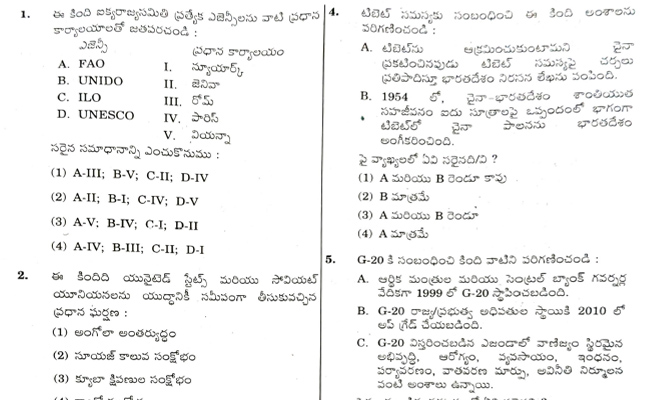
The ecosystem for Telugu resources is surprisingly robust if you know where to look. First, the TSPSC/APPSC official websites publish previous year papers in Telugu PDFs—these are your bible. They show you the exact language and pattern of the examination. Secondly, the state government’s open educational resources (e.g., the digital libraries of Telugu Academy textbooks) are excellent. They offer the entire intermediate degree syllabus in Telugu, which aligns with 60% of the Group 1 syllabus. Thirdly, the YouTube channel “Wisdom IAS” and “RAO’s Academy” offer free weekly current affairs videos in Telugu, which are far better than paid competitors. They simplify complex economics using Telugu analogies—for example, comparing the repo rate to a relay race baton passing between the RBI and commercial banks.
For newspapers, do not neglect Eenadu—but specifically the Sunday edition’s “Career” supplement. It offers a weekly mixed-language quiz. However, relying solely on free resources is a recipe for missing out on analytical depth. You must supplement them with at least one standard English newspaper every day for the editorial page. The free resources give you the “what,” but the English editorials give you the “so what”—the policy implications that elevate your mains answers. Treat free resources as the skeleton and English analysis as the muscle. Do not hoard dozens of PDFs; that is digital hoarding. Stick to three core resources and revise them obsessively.
3. How do I handle the fundamental bias towards English coaching institutes in Hyderabad?
Acknowledge the elephant in the room: the prestigious coaching hubs like Rau’s and Sosin’s are English-centric. However, the top Telugu-medium institutes like Shine India and PDM have consistently produced rank holders because they focus on rote memory with mnemonic devices. You are not at a disadvantage if you take a hybrid approach. Use the English institute’s test series—their mock test papers are often available in bilingual formats. The trick is to use these tests not for learning content, but for self-assessment of speed and accuracy. The bias is not in the content; it is in the interview preparation. To compensate, join a Telugu-specific mock interview group where they use a mix of languages. The panel usually expects you to greets the board in Telugu if your application says Telugu medium—this immediately earns you brownie points for authenticity.

More importantly, understand that the pass percentage for Telugu-medium candidates is significantly higher in the Mains descriptive papers compared to the Prelims. The Prelims are an equalizer, and candidates often fail to clear the cutoff because they are slower at reading English passages in the CSAT (General Studies) paper. Since the paper is bilingual in some sections, mark your strategic choice—if you are faster in Telugu, read the Telugu portion after glancing at the English data to double-check numericals. Do not fall victim to the myth that English coaching produces “superintendents” and Telugu coaching produces “clerks.” The rank lists are full of Telugu toppers; they simply worked quieter and smarter.
4. How do I manage the stress and the social pressure of being a Group 1 aspirant in a Telugu household?
The psychological weight is immense. In Telugu culture, the phrase “Sadhyam sadhyam” (it is possible, it is possible) is thrown around at family functions, creating a suffocating environment of expectation. The best way to manage this is through structural isolation. Inform your family about your strict study hours—from 5 AM to 11 AM, and 6 PM to 10 PM—and request them not to disturb you with casual conversations. This is a non-negotiable boundary. However, do not isolate yourself entirely; that leads to burnout and dark thoughts. Create a peer group of 3-4 fellow aspirants who meet weekly. Here, share your fears and your mock test scores. The dark fun fact is that statistics show that candidates who discuss their answers verbally in Telugu with a peer retain information 40% better than those who just read silently.
Additionally, incorporate physical exercise into your routine. A daily 30-minute brisk walk, ideally listening to Telugu classical music or a podcast on Indian history, serves a dual purpose—it keeps your mind alert and expands your knowledge base. When you feel the pressure mounting, do not resort to endless coffee. Instead, practice Pranayama (breathing exercises), which is scientifically proven to lower cortisol. And remember, having a ‘failure plan’ is a sign of strength. Acknowledge that if you don't crack it this year, you will apply again. This removes the fatalistic weight of “do-or-die” which ruins candidates’ health. The exam is a marathon, not a sprint; your lungs will thank you.
5. What are the common mistakes that fail Telugu-medium candidates in the interviews?
The primary mistake is overcompensation. Candidates who studied in Telugu often try to speak in overly complex English during the interview, which results in stuttering and brittle grammar. The board is not testing your English fluency; they are testing your leadership and administrative temperament. A second major error is being unable to explain local governance issues clearly. For instance, if asked about the MGNREGA implementation in your village, do not give a textbook definition. In Telugu, explain a specific anecdote—how a Sarpanch in your district misused funds or how a woman laborer was denied wages. This shows grassroots awareness. They also often ask about the history of Telugu literary figures; many candidates blank on contemporary writers. Read about Jwalamukhi or Sri Sri—their revolutionary poetry ties directly to social justice themes relevant to civil services.

Another silent failure is the body language during the interview. In Telugu culture, looking down is a sign of respect, but in an interview, it is seen as lack of confidence. Maintain eye contact with the panel members who smile at you. If you do not understand a question delivered in English, politely ask in Hinglish/Telugu mix, “Sir, okka saari cheppandi” (please repeat once). This is not a sign of weakness; it is a sign of communication clarity. Finally, avoid political opinions on sensitive topics like the separate Telangana movement or the bifurcation of the High Court. Be balanced, show the historical perspective, and always pivot back to developmental administration. The board wants a neutral, unbiased officer, ready to serve whichever state they are posted in.
Ultimately, preparing for Group 1 in Telugu is a profound act of resistance against the elitism of English-facing India. It is a statement that administrative acumen does not reside in a foreign tongue. The journey will test your patience, your memory, and your emotional resilience. You will dream of subsidy percentages and government orders; you will see your grandfather's face in the history of the Nizams. This daily grinding—dog-earing pages, underlining case laws, and whispering Telugu essays to yourself while walking home—is a quiet, heroic act. It connects you to the long lineage of Telugu poets, reformers, and freedom fighters who understood that language is the soul of a people. When you sit for the exam, you are not just a job seeker; you are a custodian of a linguistic legacy.
There is a modern lesson here that mirrors the ancient wisdom of the Satavahana kings, who famously used Prakrit to reach the masses, breaking the Sanskrit monopoly. In your own way, you are following that path. Your preparation is an exercise in translating power. Every text you read in Telugu is a brick in the wall you are building towards a more inclusive governance structure. And while the syllabus is vast and the competition is fierce, remember that the exam does not measure your worth as a human being. It measures a slice of your knowledge on a specific test day. Do not let it colonize your identity. The dark humor of today’s preparation hours will later become the legend of your determination.
As you move forward, take a ink pen and write this on a sticky note above your desk, in bold Telugu: “Nenu nerchukunte chalu, panelu vasthayi.” (If I learn patiently, ranks will come). Breathe. Re-read your notes at night, not to memorize, but to appreciate the beauty of your own continuous effort. The job is not the endpoint; the person you become during this preparation—disciplined, knowledgeable, and rooted in your culture—is the real prize. And whether you crack it in the first attempt or the fifth, the Telugu language you use will never leave you; it will serve you as an officer, as a citizen, and as a human being. Go write your destiny, one Telugu sentence at a time.