How To Know If Someone Read My Email
There was a time, long before the chime of a smartphone and the glow of a backlit screen, when the delivery of a message was an event steeped in ceremony and agonizing suspense. In the era of quills and sealing wax, you might have entrusted a folded sheet of vellum to a courier on horseback, watching him disappear over a rain-slicked hill. The question was never whether the recipient had read it, but when the courier would arrive, and whether the roads would allow his passage. The wait could be weeks, sometimes months, and the only verification of receipt was a hastily scrawled reply that might itself be lost to a river crossing or a bandit’s fire. This primordial anxiety—the desperate need to know if our words have landed, if they have been absorbed, if they have changed the mind of the person on the other side—is the very heartbeat of human communication. We have always craved a window into the reader’s private engagement, a ghostly glimpse of their eyes tracing our ink.
The modern iteration of this desire, the agonizing question “Did they read my email?”, is often dismissed as a trivial, millennial-age neurosis. But its roots run far deeper than the corporate inbox. It is a direct descendant of the telegraph, that revolutionary hum of the 1840s, where the delivery of a message was confirmed by a simple “ack” (acknowledgment), a binary beacon of receipt that offered no insight into comprehension. Then came the telegram boy on his bicycle, handing over a yellow envelope. You had to sign for it, a digital-age “read receipt” etched in paper, but the signature only proved it left the post office. The true, perspiring tension of the telephone era of the 1920s and 1930s shifted the paradigm again. The click of a receiver being picked up, the heavy breathing of a silent listener, or the sudden, sharp disconnect—these were the crude, auditory read receipts of a generation. We were desperate to hear the pause, the intake of breath, the reconstruction of tone, but we were also terrified of the silence. The letter, the telegram, and the phone call all shared a fundamental flaw: they were intrusive. They demanded an immediate response, or they left you in a purgatory of uncertainty where the only evidence of reading was the reply itself.
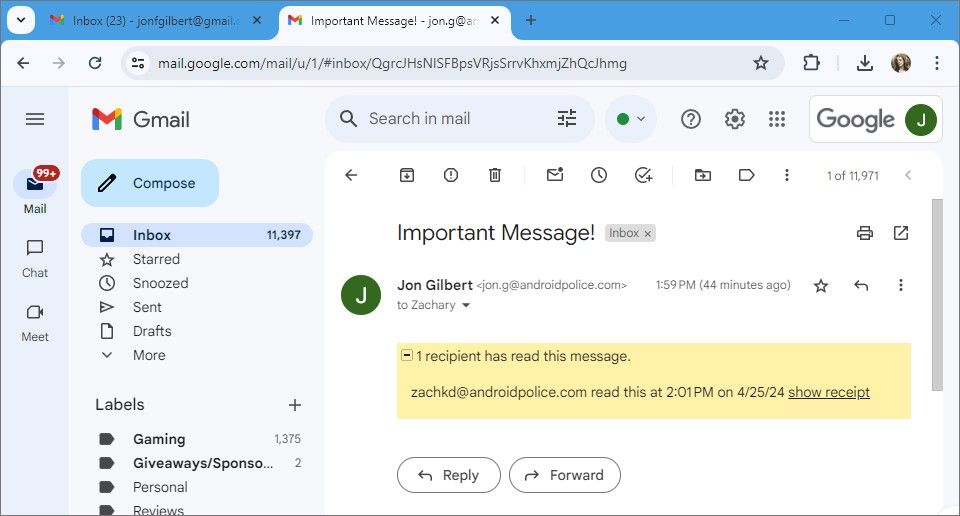
This brings us to the quiet dawn of the 1990s, the true birthplace of the asynchronous email, and the most profound shift in our relationship with the written word since Gutenberg. In the early corporate LANs (Local Area Networks), email was a utilitarian beast. It was a clunky, text-only missive that felt less like a letter and more like a note passed in class. But a peculiar innovation emerged almost immediately: the read receipt. A server-side script would send a small, unassuming pop-up message to the sender, stating, “Your message has been displayed to the recipient.” This was a seismic event, yet it was also a deceptive phantom. It did not mean the recipient understood, appreciated, or even looked at the screen for more than a microsecond. It simply meant the email client had loaded the bytes onto the screen. This early, clunky mechanism, however, laid the foundational brick for the modern obsession. It tempted us with a sliver of certainty, only to instantly reveal a new, deeper well of ambiguity. Was a three-second display a read? Was a one-minute display a careful reading? The metrics of engagement were born, and with them, a new breed of anxiety that our ancestors, waiting for the courier, could never have imagined—an anxiety born not of absence, but of a perverse digital presence.
Must Read
The Golden Age of Tracking: From Simple Receipts to the Pixelated Gaze
The real transformation, the leap from the clunky server receipt to the sophisticated stalker’s toolkit, began in the mid-2000s, when email moved from desktop clients like Outlook to web-based interfaces. The key here was the invisible tracking pixel. This is a tiny, 1x1 transparent image embedded within the HTML of an email. When the recipient opens the email, their email client sends a request to the sender’s server to fetch that image. That request is logged, timestamped, and assigned an IP address. Suddenly, you weren’t just knowing if an email was opened; you knew what time they opened it, what device they were on (an iPhone versus a desktop), and, frighteningly, their approximate physical location. The humble read receipt had evolved from a binary “yes/no” to a live surveillance feed. 2011 was a pivotal year, as platforms like Streak and Yesware emerged, bringing this kind of pixel-tracking to the masses, practically arming every freelance writer, salesperson, and nervous dater with a radar gun aimed at their recipients’ inboxes.
What is truly nostalgic in this era is the bizarre vernacular that developed around these tools. Terms like “ghosting,” “left on read,” and “double-tap” were not just internet slang; they were psychological diagnostic tools. The act of leaving an email “on read” became a weapon of passive aggression. In the 2010s, a new sub-genre of etiquette emerged, with entire blog posts dedicated to deciphering the meaning of “opened at 2:47 AM but no reply until Tuesday.” But the forgotten vintage fact is that email tracking was originally a defensive tool. In the early 2000s, customer service departments used read receipts to prove they had fulfilled a complaint, not to spy on clients. It was a bureaucratic CYA (Cover Your Ass) mechanism. The corporate mandate was: “Did we tell them? Yes. We have the receipt.” The psychology of the sender, however, was always the weak link. The system was never designed to satisfy the eager heart or the insecure soul; it was designed for legal irrefutability. And in that gap between legal proof and emotional truth, the modern paranoia was cultivated.
.jpg)
Another bizarre facet of this era was the rise of “email bankruptcy.” As tracked emails became the norm, a non-reply became deafening. In the late 2000s, a viral concept, popularized by tech gurus, encouraged overwhelmed professionals to declare “email bankruptcy,” deleting all past messages and starting fresh. This was a luddite’s retreat from the tyranny of the read receipt. But it was confession of a deeper truth: the constant gaze of the tracker was exhausting. We were not just reading emails; we were performing for the sender’s analytics. The recipient’s screen became a stage, and the sender was in the front row, watching their every scroll. This led to the bizarre practice of “preview panes” and the “privacy shield.” Tech-savvy users learned to disable the loading of remote images, effectively blinding the sender’s pixel. A digital arms race began, with trackers using more complex methods to bypass image blockers, only to be thwarted by paranoid users who enabled “text-only” mode. It was a war of perception, fought in the silent spaces of server logs.
Perhaps the most poignant and ancient principle was rediscovered during this period: the power of silence. In the days of handwritten letters, a long silence was often a sign of distance, or a slow postal service, not necessarily a rejection. In the digital age, we stripped away all those legitimate excuses. A read receipt at 2:00 PM that receives no reply by 5:00 PM is now interpreted as a conscious, deliberate snub. But modern psychology has begun to hack this principle. The “hack” is to understand that the read receipt is a lie. A study from the University of Michigan in 2018 found that people often open an email to “file it away” for later, fully intending to reply, but then forget. The act of reading has been decoupled from the act of responding. The modern, mature strategy, as espoused by productivity gurus like Cal Newport, is to manipulate the perceived read status. You can send an email, then immediately send a follow-up saying, “Ignore the previous, I’ve answered my own question,” which gives the sender a false sense of your engagement. Or, the more radical “hack” is to use a delay-send function to schedule your emails to arrive at 9:00 AM, ensuring a higher chance of an immediate open, artificially inflating your “read” metrics. We are no longer trying to read the recipient’s mind; we are trying to write their behavior, to orchestrate the moment of their gaze.
The New Alchemy: Automation and the Death of the Inbox
Today, in the 2020s, the question “did they read it?” is being answered not by pixels, but by sophisticated Artificial Intelligence and Machine Learning algorithms. Apps are no longer just telling us if it was opened, but how likely it was to be read completely. Tools like Superhuman and Mixmax use predictive analytics to guess when your recipient is most likely to be at their desk. They can even detect the “inbox zero” mindset, buzzing you when your email is opened, so you can pounce with a phone call. This is the new alchemy, turning the classic principle of “reading the room” into a data-driven process. It’s a modernization that feels less like communication and more like a chess match where every piece is tracked, every move is predicted, and the board is a server farm in Nevada.

But the deeper hack goes beyond the tool. The modern, enlightened approach rejects the tyranny of the read receipt entirely. The new philosophy, promoted by a wave of “slow business” advocates, argues that if you are obsessively tracking your email, you are sending emails that do not deserve to be tracked. You are writing fluff. The most powerful “read receipt” is a subject line so compelling that the recipient cannot help but reply immediately. The best way to know if someone read your email is to write an email that demands an action, not a reaction. The classic principles of storytelling—conflict, stakes, and urgency—are being applied to the subject line. It’s about crafting a message that is so valuable, the recipient feels a physical itch to respond. The obsession with if they read it is a distraction from the more pertinent question: why aren’t they replying? The answer to that, more often than not, is that your email was not important enough to warrant a reply, regardless of whether the pixels were rendered on their screen.
The Eternal Question: Three Modern Myths and Realities
1. Is the “Read Receipt” (the system-generated one) actually reliable?
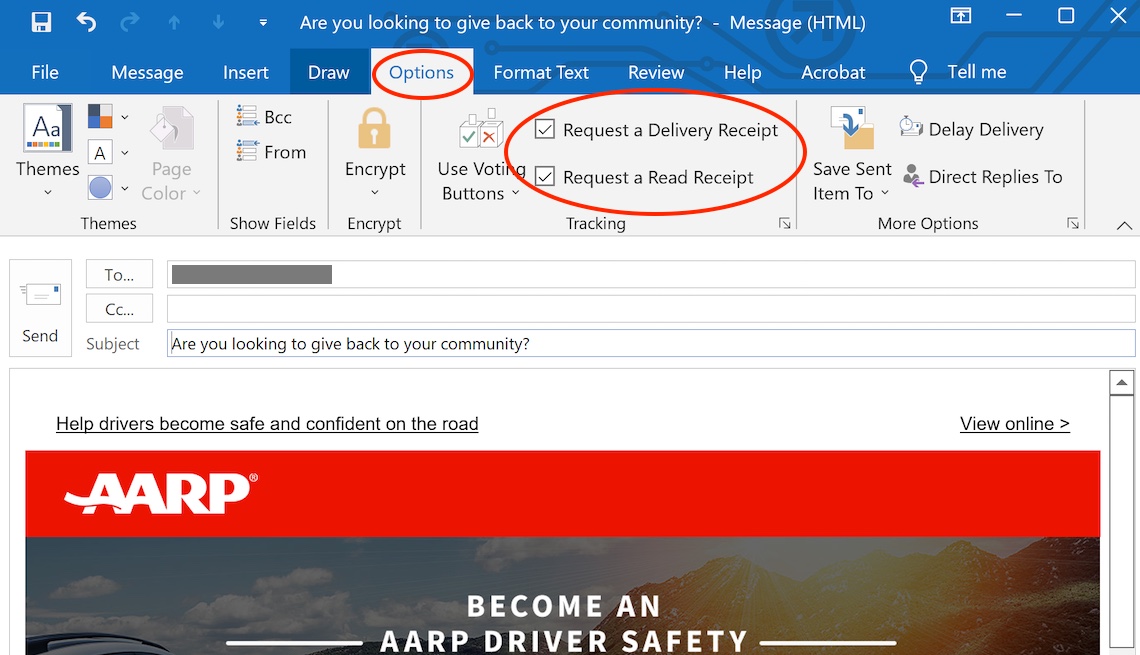
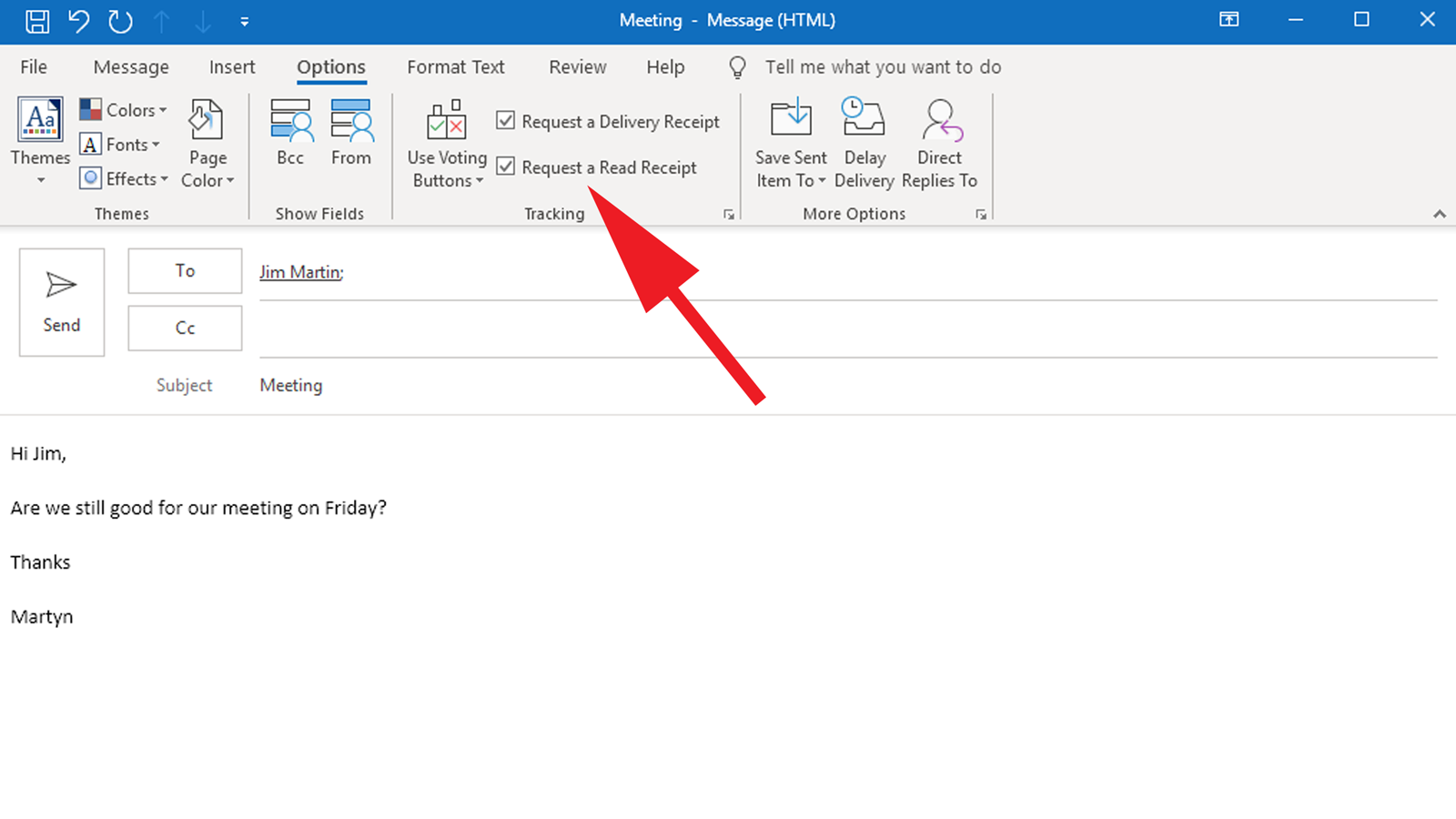
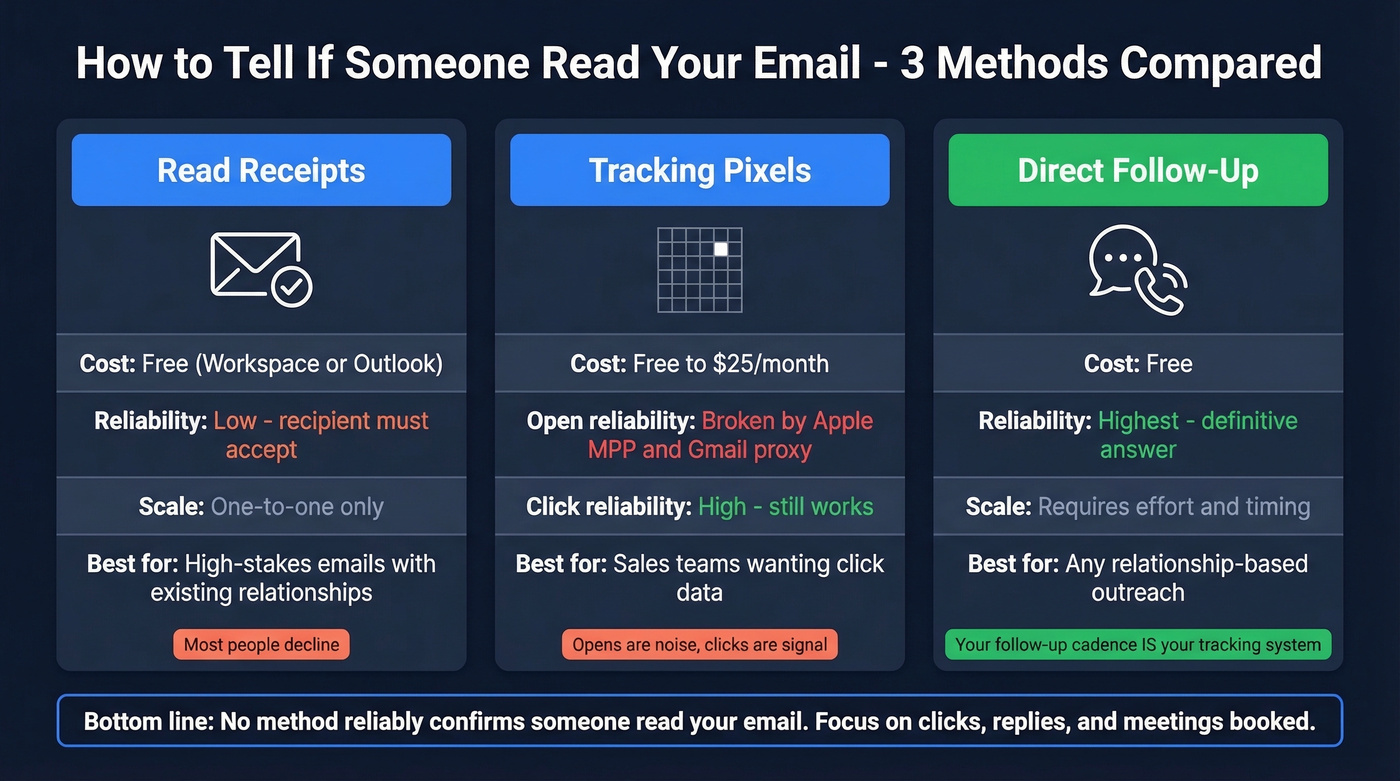
The system-generated read receipt, the one that pops up as a dialog box, is the 1990s relic. It relies on the recipient clicking “Yes” or “Send” to allow the notification. In the early days of Lotus Notes and Outlook, this was a common courtesy. However, by the mid-2000s, it was widely considered rude and intrusive. Most modern email clients, including Gmail and Apple Mail, do not send these receipts by default. They require the user to manually enable a “request read receipt” for each message, and even then, the recipient can simply click “No.” The only thing that receipt actually proves is that the recipient saw a pop-up window, not that they engaged with your words. It is a historical artifact, a digital fossil from a more trusting age. The modern reality is that the only reliable way to know is to ask a direct question in the email, such as “Does this make sense?” but even then, the reply is the only true receipt.
The myth persists because we desperately want a technological shortcut to emotional certainty. But the reality is that the system-based receipt was invented by engineers to solve a server-to-server communication problem, not a human-to-human one. It was a diagnostic tool for network failures, not a psychological indicator. So, if you see a “Read: Thursday, 3:15 PM” notification, treat it as a beautiful rumor, not a fact. It is unreliable, easily bypassed, and often ignored by recipients who find it invasive. The only truth is the content of the reply. If you get a reply, it was read. If you don’t, it was probably read but deemed unworthy, or it was deleted without a second thought. The receipt is a mirage in the desert of our insecurities.

2. Does using a tracking pixel make me a creep?
On the surface, yes. The act of embedding an invisible tracker feels inherently sinister, a throwback to the 1980s corporate espionage films where a mole plants a bug in a conference room. But the nuance is in the intent. In the 2000s, salespeople used tracking to know if a lead was “hot,” so they could time their follow-up calls. This is a utilitarian, albeit slightly stalkerish, application. However, using a pixel to monitor a personal email, a breakup note, or a job application rejection is a psychological crutch. The problem is that the pixel shows you the timestamp of the open, not the emotion behind it. It cannot tell you if they smiled, sighed, or rolled their eyes. The pixel is a blunt instrument in a delicate, nuanced psychological dance.
The modern counter-argument, however, is that the pixel is simply a data collection tool, no different from a doorbell camera. If you are transparent about your use of tracking in an email signature (saying “This email contains a tracking pixel for analytics”), you are being transparent, and it becomes less creepy. But the bigger issue is that the General Data Protection Regulation (GDPR) in 2018 began to clamp down on this behavior. Unconsented tracking is now technically illegal in many jurisdictions. The practicality is that most recipients are now aware of these trackers and have disabled remote image loading, making the pixel useless. The real creepiness, however, is not the technological invasion, but the emotional dependence it reveals. If you feel you need to know the exact second they opened your email, you are not sending an email; you are sending a cry for validation. The tracker is not a tool; it is an emotional prosthetic. And the most modern, evolved position is to discard the prosthetic and accept the discomfort of not knowing.
3. Will AI eventually know for sure if I’ve been read?
The futuristic promise of AI is that it will go beyond the open and into the comprehension. We are moving towards a world where your email client will use Natural Language Processing (NLP) to analyze the recipient’s reply pattern, their typing speed, and the sentiment of their response to infer if they absorbed the content. Imagine a future where your email app tells you, “Based on the recipient’s response time and the keywords used, they read your email fully, but they are conflicted about the proposal.” This is the “ambient intelligence” era. But the ancient myth here is the idea of a perfect read. In the 19th century, you could hire a “letter reader” to decipher the style and emotion of a correspondent’s handwriting. They claimed to know if the writer was angry or in love. But it was guesswork.
AI is a powerful modern-day letter reader, but it is still guessing. It measures behavior, not cognition. It can track eye movement on a screen, but it cannot feel the weight of your words in their mind. The human mind is the last unmapped territory. Even if AI predicts you’ve been read, it will never understand the why. It will not know that they read it while crying, or laughing, or that they printed it out and framed it. The next 20 years will likely see the death of the read receipt as a feature. Instead, emails will become voice notes or ephemeral holograms. Perhaps the most profound shift on the horizon is the return to the telephone principle: the expectation of synchronous communication. If we move towards “ambient messaging” where presence is known and always on, the concept of a “read” becomes obsolete. We will see the typing bubble, not the open receipt. We will see the live cursor, the hesitation, the deletion. We will return to the 1920s, but with a hyper-realistic digital overlay.
Looking forward, the next 20 years will likely dissolve the very concept of the inbox. We are already seeing a shift towards asynchronous collaboration tools like Slack and Notion, where “read” is implied by the shared workspace. The question will no longer be “Did you read my email?” but “Did you see my comment on the shared document?” The email format, with its agonizing waiting period, will be relegated to a nostalgic corner of the digital attic, a quaint artifact like the telegram. However, the underlying human anxiety will persist, merely shedding its skin. The anxiety will morph into questions about social media views, story replies, and podcast download counts. The medium changes, but the primal need to be acknowledged, to know that our voice has been heard and our thoughts have been processed, will remain a constant sun in the human sky. The future isn’t about knowing if it was read; it is about the seamless integration of thought and response, where the gap between sender and receiver shrinks to near-zero.
Perhaps the most beautiful lesson from the history of the read receipt is its ultimate futility. The goal was never really to know if the email was read. The goal was to know if we mattered. And no server log, no pixel, and no AI algorithm can ever answer that question with certainty. That answer is only found in the quality of the relationship itself, in the warmth of a reply that goes beyond a polite acknowledgment, in the substance of a conversation that continues long after the screen goes dark. We spend so much time trying to verify the receipt, that we often forget to write the letter. And in the end, the most effective way to know if someone read your email is to make it so compelling, so uniquely you, that the act of reading becomes a moment they want to share, not hide. That, and a simple, direct follow-up phone call, are the only real receipts we will ever need.