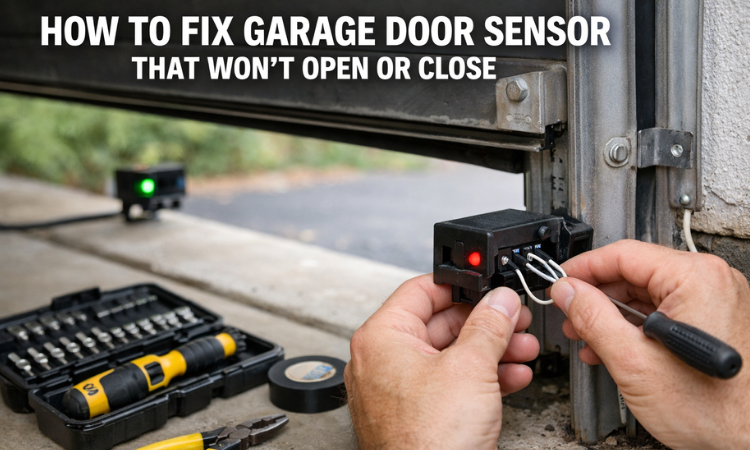
How To Fix My Garage Door Sensors

There is a peculiar moment, usually at dusk when the light is failing and the air holds the chill of evening, when you press the button on your garage door remote and nothing happens. The door sits there, a monolith of metal and inertia, stubbornly refusing to obey. Your first instinct is irritation, a quick jolt of annoyance. But if it happens again, and again, a deeper, more unsettling feeling creeps in. It’s not just about the door; it’s about the subtle erosion of trust in your own environment. We expect our homes to be sanctuaries of predictability, and when a simple mechanism like a garage door betrays that expectation, it rattles a primal part of our brain that craves order and safety. The modern garage is a threshold, a liminal space between the public world and your private one, and when that threshold becomes unreliable, we feel the vulnerability of being caught in between.
This is where the psychology of repair begins. We don’t just see two little sensors at the base of the door; we see a puzzle, a test of our competence. For many, the initial reaction is one of learned helplessness—a belief that we are not "handy" enough to fix it, that this is a job for a professional, that we are somehow intellectually unequipped. This fear is often more daunting than the actual mechanical issue. The blinking lights on the sensors, usually a red and a green, become a cryptic language that seems to mock our ignorance. But the journey to fixing these sensors is rarely just about wires and alignment. It’s a microcosm of how we approach problems in all areas of life: do we confront the issue with curiosity and patience, or do we retreat in frustration, hoping it will resolve itself? The choice we make, even with something as mundane as a garage door, reveals a great deal about our resilience and our relationship with our own agency.
The Hidden Emotional Triggers Behind a Stalled Door
Let’s be honest about the true source of the frustration. It’s rarely the physical labor of bending down to look at the sensors. The real trigger is the narrative we tell ourselves about the interruption. You were on a trajectory—coming home from work, carrying groceries, eager to step into your personal space—and this mechanical glitch has broken your flow. This disruption activates the brain's reticular activating system (RAS), which filters out unnecessary information but highlights anything that threatens our sense of normalcy. The door isn't just broken; it is a challenger to your autonomy. It’s a small, inanimate object that is dictating your schedule and your mood, and that perceived loss of control is a profound psychological stressor.
Must Read
Cognitive biases also play a significant role here. The first is the availability heuristic. You remember all the times in your life when repairs were expensive, complicated, or went wrong, and you apply that memory to this simple task. The second is catastrophizing. A misaligned sensor quickly becomes a fear of a broken spring, a ruined opener, or a thousand-dollar service call. We skip past the most logical, simple explanation—that the sensors are merely dirty or slightly crooked—and leap to the worst-case scenario. This anxiety makes our hands shake, narrows our focus, and prevents us from seeing the obvious solution. The physical act of kneeling down to investigate feels like an admission of defeat, a lowering of oneself, rather than an act of empowerment.
Furthermore, there is an emotional attachment to the idea of "home." The garage door is often the largest moving object attached to our house. It is a physical barrier against the elements and intruders. When it fails, it feels like our protective shell has a crack in it. This triggers a deep-seated insecurity related to safety and providing for our family. We might even project feelings of failure onto the door itself, thinking, "I just fixed this," or "This house is falling apart," which spirals into broader anxieties about home maintenance, finances, and our ability to keep our lives in order. The struggle is rarely with the sensor; it is with the echo of our own internal critics telling us we should have this figured out by now.
A Mindful, Step-by-Step Approach to Restoration
The first and most transformative step is to change your physical and mental posture. Instead of standing upright, looking down at the door with a sense of grievance, physically lower yourself to the ground. Sit on the floor or kneel on a piece of cardboard. This act of consciously getting to eye-level with the problem is a powerful psychological shift. It forces you out of the role of the frustrated observer and into the role of an investigator. Take a deep breath and tell yourself, "This is just a puzzle, and I am capable of solving it." Slowing down your breathing lowers your cortisol levels, allowing your prefrontal cortex—the logical part of your brain—to take over from the emotional amygdala. You are signaling to your body that you are in a state of curiosity, not danger.

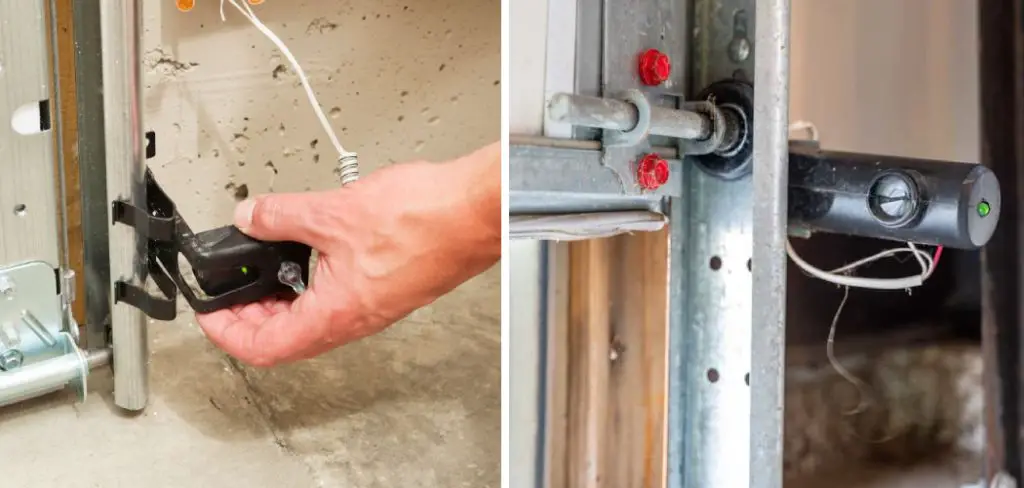
Next, focus on the external alignment. The most common culprit for sensor failure is simple misalignment. The sensors work by sending an invisible infrared beam to each other; if the beam is broken, the door reverses. Look at the two small units facing each other. They should be pointing directly at one another. I want you to do this slowly and deliberately. Loosen the wing nuts holding them in place, gently nudge one sensor until the light changes color or solidifies, and then tighten it back down. Move to the other side and do the same. This tiny, physical adjustment is a lesson in harmony. It reminds us that sometimes, things go awry simply because they have drifted out of sync, and a gentle, firm hand can restore balance without the need for drastic measures.
Now, address the environmental factors. Look at the lenses. They are small, usually a quarter of an inch in diameter. Have they become hazy with dust, dirt, or cobwebs? Our lives accumulate filth and grime in the same way. Taking a soft, slightly damp cloth and carefully wiping the lenses is an act of cleansing and mindfulness. It is a reminder that sometimes, our perception is clouded by the "dirt" of daily life—stress, fatigue, and negativity—and that a little bit of self-care and clearing can do wonders for our ability to "see" clearly. While you are down there, check that the sensors are not being blinded by direct sunlight (which can interfere with the beam) or obstructed by a stray box or debris. Clearing a physical path for the beam is very much like clearing a mental path for new, positive thoughts.
Finally, and this is the crucial emotional step: frame the repair as an act of self-reliance. As you tighten the last nut and stand up to press the button, shift your mental narrative. Do not see this as a tedious chore you have just survived. See it as a successful negotiation with your environment. When the door smoothly descends and touches the floor, you have not just fixed a sensor; you have re-established a dialogue with your home. You have proven to yourself that you have the agency to affect your surroundings. This small victory is a deposit into your "self-efficacy" bank account. It builds a reservoir of confidence that you can draw upon for larger, more daunting challenges in life. Press the button a few times. Watch the door go up and down. Meditate on the smooth, quiet reliability you have restored.
Frequently Asked Questions: The Psychology of the Fix
Why do I feel so much anxiety when the garage door won't close?
The anxiety stems from a violation of the "just-world hypothesis"—the cognitive assumption that our actions will consistently yield predictable results. You pressed the button (a stimulus), and you expected the door to close (a reward). When this cause-and-effect is broken, it triggers a mild state of cognitive dissonance. Your brain is trying to reconcile the expectation with the reality, and that mental friction creates anxiety. Furthermore, a garage door that won't close leaves you feeling exposed and vulnerable, specifically at night, which taps into our evolutionary fear of being unprotected and open to the elements or harm while we sleep.
On a deeper level, this anxiety is often a displacement for other, larger concerns in your life. If you are already feeling overwhelmed by work or relationships, a broken garage door provides a concrete, external target for your stress. It is easier to be angry at a mechanical object than to grapple with abstract feelings of inadequacy or worry. Recognizing this displacement is key. When you feel that rush of panic, ask yourself: "Is this really about the door, or is this about my need to feel in control of my world right now?" Often, fixing the door is the first step to calming the storm within because it gives you one tangible win to hold onto.
Is it "lazy" to call a professional, or should I fix it myself?
This is a conflict between your ego and your resource management. Calling a professional is not a sign of laziness; it is a sign of sound judgment and good boundaries. In a world obsessed with "hustle culture" and self-sufficiency, there is a toxic narrative that we must do everything ourselves to be considered competent. However, knowing when to outsource a task is a higher-order cognitive skill. It involves recognizing the opportunity cost of your time and energy. If you are frustrated, tired, or in a time crunch, forcing yourself to perform a repair can lead to careless mistakes and increased resentment.
However, the therapeutic benefit of a simple fix should not be underestimated. Successfully repairing the sensor yourself provides a profound sense of accomplishment that a check payment cannot buy. It connects you to the physical world in a way that digital life rarely allows. The best approach is to be honest with yourself. Give yourself a time limit—say, 30 minutes—to diagnose the issue without judgment. If you solve it, fantastic. If you don't, calling a professional is not a defeat; it is an intelligent strategy. The goal is not to "win" against the door, but to achieve a state of peace and functionality in your home. Both paths lead there, and both are valid.
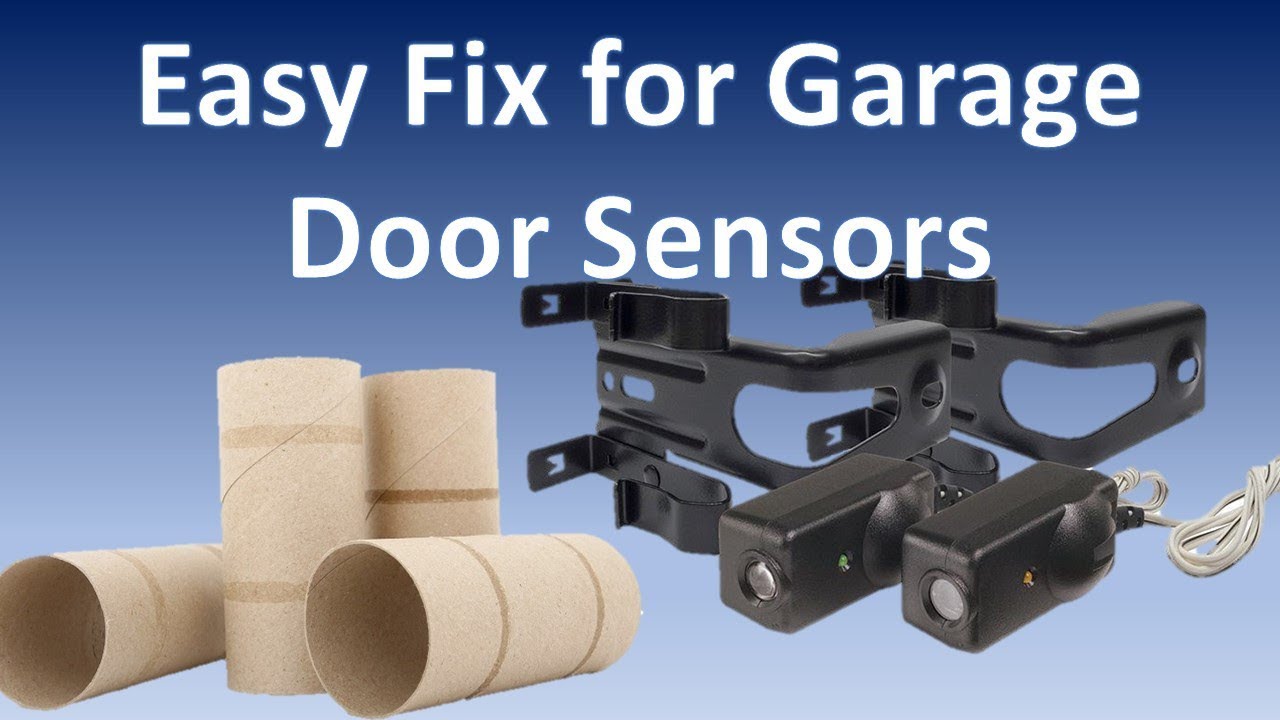
Why does the sensor light sometimes keep blinking even after I clean it?
A blinking light often signifies a state of searching or instability. In many ways, this mirrors our own mental states. The sensor is trying to establish a connection, but it is being interrupted by an unstable signal. If cleaning didn't work, the issue is likely with the physical wiring or the internal circuit board. From a psychological perspective, this is where patience is truly tested. This is the stage where we typically give up and fall into the "I knew I couldn't do it" trap. This is a cognitive distortion. Just because this specific attempt didn't work doesn't mean you are incapable; it means you have gathered new data.
Emotionally, this is the moment to practice resilience. You have two choices: you can view the blinking light as a personal affront, or you can view it as a server error that needs a different protocol. If you have tightened the alignment and cleaned the lenses, the next step is to check the wire connections at the back of the sensors and the main unit. If those are solid, then your task is complete; you have done everything within your reasonable power. The blinking light is not a judgment on your character; it is a specific piece of technical information. You can now decide to replace the sensor (a manageable task) or call an expert, armed with the knowledge of exactly what you have already tried. This is the art of problem-solving: knowing when to persist and when to pivot.
How can I stay calm while I am working on the wiring?
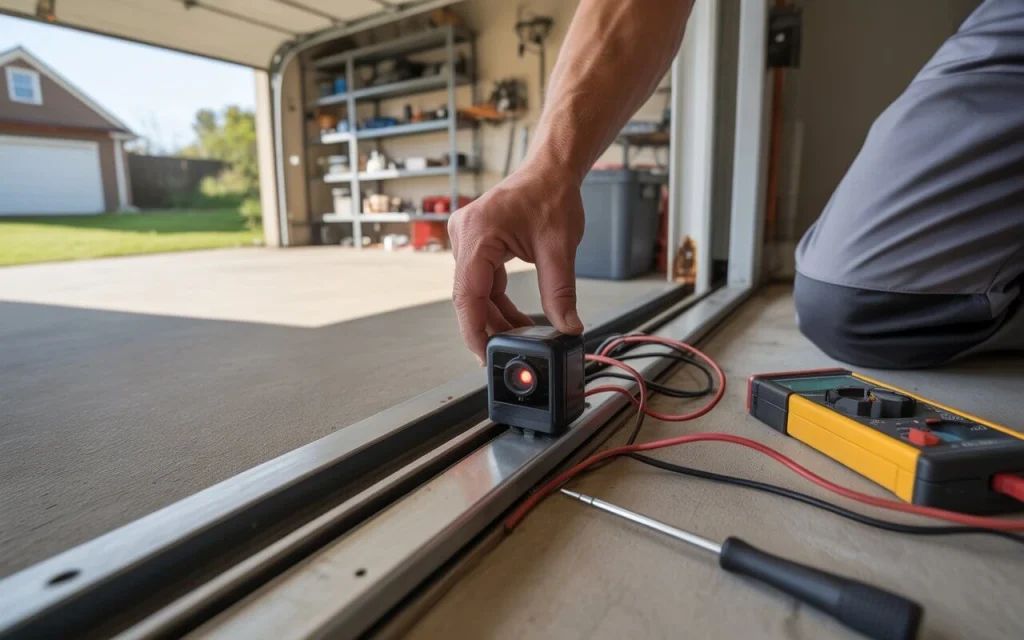
Wiring is where our primal fear of electrocution and "breaking something expensive" kicks in. The sight of exposed wires can trigger a fight-or-flight response because it feels dangerous and "unnatural." To stay calm, you must demystify the process. Before you touch anything, disconnect the power to the opener. This instantly removes the real, physical threat, allowing your mind to relax. Then, look at the wiring not as a chaotic nest of snakes, but as a simple flow chart. There is a red wire and a white wire, and they need to connect to matching terminals. It is a binary system—much simpler than the tangled web of thoughts in our heads.
Try to treat the physical task as a form of meditation. Focus only on the sensation of your own breathing and the tactile feel of the screwdriver in your hand. If you notice your mind drifting to "what if I zap myself" or "what if I mess up the main board," gently bring your attention back to the present moment and the specific screw you are turning. This is a practice in mindfulness. You are training your brain to focus on the step immediately in front of you, rather than projecting into a future of catastrophic failure. The wires are just pieces of metal; they have no power over your emotional state unless you give it to them. By staying present, you strip the task of its intimidation and turn it into a simple mechanical exercise.
Is it normal to feel a sense of accomplishment after fixing something this small?
Absolutely. In fact, it is essential. Our brains are wired to seek out completed tasks. This is known as the "Zeigarnik Effect," which states that our minds obsess over unfinished tasks but release that mental pressure once they are completed. Fixing the garage door sensor provides a clear, definitive end point. You don't have to wait for quarterly reviews or external validation to know you have succeeded; the door closes, and you have immediate, sensory feedback. This dopamine release is a natural reward that reinforces your sense of agency.
This feeling of accomplishment is vital for mental well-being because it counteracts the feelings of helplessness that can pervade modern life. We often work on projects that are long-term and abstract, where the finish line is unclear. A garage door repair is the antithesis of that. It is a micro-victory. It reminds you that you are a being capable of interacting with and improving your physical environment. Cherish that feeling. Let it wash over you. When you allow yourself to feel proud of this small win, you are strengthening a mental muscle that allows you to tackle bigger, more complex life challenges with a sense of hope and competence, rather than fear.
Mastering the fix of a garage door sensor is never really about the door. It is about reclaiming the narrative of your own life. Every time you confront a frustrating, mundane problem with a calm mind and a step-by-step approach, you are rewriting the internal script from "I am a victim of circumstance" to "I am an active participant in my reality." This simple act of repair teaches you that chaos can be tamed, that discord can be realigned, and that a little bit of dirt can be wiped away to restore clarity. These are not just mechanical skills; they are the foundational skills of resilience.
In the grand tapestry of life, the garage door is barely a thread. But the way you interact with that thread matters. Treating a malfunctioning sensor with patience and curiosity rather than anger and fear is a radical act of self-kindness. It is a promise to yourself that you will not be easily upset by the small stuff, and that you have the inner resources to navigate the unexpected. So, the next time your door hesitates, take a breath, grab a cloth, and kneel down. You aren't just fixing a sensor; you are quietly, gently, fixing your relationship with the world around you.