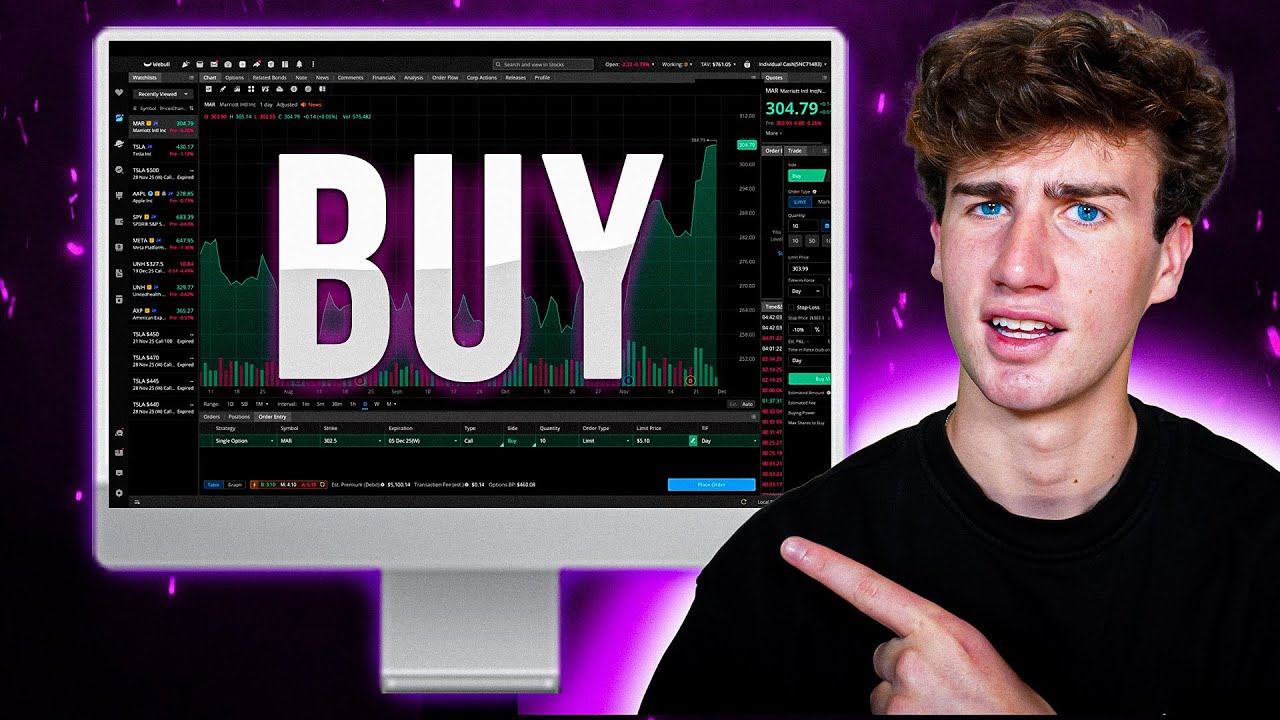
How To Buy A Call Option On Webull

There’s a peculiar alchemy to trading options. It’s not just about money; it’s about time, volatility, and the peculiar human desire to control a future that is, by definition, uncontrollable. Buying a call option, at its core, is a wager on momentum—a bet that a stock will not just go up, but that it will do so with enough vigor to outpace the ticking clock of its expiration date. In the digital age, platforms like Webull have democratized this once-rarefied corner of Wall Street, turning what was once the playground of institutional sharks into a gladiatorial arena for the retail masses. The interface is sleek, the data real-time, and the temptation to leverage your conviction into a 1,000% return is almost intoxicating.
But before you dive in, understand the history: options trading has existed in some form since the ancient Greeks, who used olive harvest contracts to hedge against poor yields. Yet, it wasn't until the Chicago Board Options Exchange (CBOE) standardized contracts in 1973 that it became a legitimate, mainstream financial tool. Today, with a few swipes on your smartphone, you can access this same legacy, but the stakes are higher because the speed is faster. This guide isn't just a manual; it's a psychological primer for navigating the pixelated depths of Webull to execute your first (or next) call option purchase with clarity and, hopefully, a modicum of grace under pressure.
The Art of the "YOLO" vs. The Science of the Spread
The dark fantasy of options trading is the "zero-to-hero" story—the tales of bartenders turning $500 into $50,000 on gamestop (GME) calls during the meme stock mania of 2021. These stories are real, but they are survivorship bias at its most seductive. For every viral screenshot of a massive gain, there are thousands of silent losses, hidden behind the guise of "learning experiences." The psychology here is critical: buying a call option on Webull is not gambling, but it feels like gambling. The dopamine hit from watching the Option Greeks—Delta, Gamma, Theta—move in your favor is chemically identical to a slot machine payout. You must recognize this physiological reaction before you place the trade, or the market will eat you alive, one theta decay at a time.
Must Read
Lesser-known fact: The "Greeks" are not just nerdy quant jargon; they are the weather system of your trade. Theta, the "decay," is your relentless enemy. Every second your call option sits idle, it loses value, even if the stock price stays flat. This is the hidden tax on optimism. To counter this, you need to understand why you are buying the option. Are you buying a lottery ticket (short-term, deep out-of-the-money) or are you buying a position of controlled leverage (longer-dated, slightly in-the-money)? The cultural impact of this dilemma is profound. It has created a generation of traders who check their portfolios more often than they check their Instagram feed, chasing a phantom green line on a candlestick chart while ignoring the slow bleed of time.
Webull, in particular, makes this both easier and harder. Easier because the UI is designed for speed, with options chains laid out in a visually intuitive color-coded grid. Harder because it feels too easy. The gap between the "checkout" experience of buying a shirt on Amazon and executing a complex multi-leg options strategy is dangerously thin. This seamlessness strips away the ceremony of risk, making a $2,000 position seem as trivial as a coffee purchase. It is a testament to our modern digital environment that financial instruments with unlimited downside potential can be transacted with the same nonchalance as a daily latte, a cultural shift that would terrify your grandfather's broker.
Step-by-Step: From Fiat to Derivatives (Without Losing Your Shirt)
Let’s get practical. The first step is ensuring your Webull account is funded and, more importantly, approved for options trading. This isn't automatic. You need to apply for "Options Trading" in the app's settings, and Webull will quiz you on your experience. Pro tip: answer honestly, but aim for a higher "Tier" if you're serious. Tier 1 usually allows covered calls, but you want Tier 2 or 3 for the ability to buy long calls (debit) without margin constraints. Without approval, you’re just staring at a ghost town in the options chain. Fund your account with money you are psychologically prepared to lose. This is not an investment; it is a speculative adventure.

Now, navigate to the main trading chart of a stock you love (or love to hate). Let’s use Tesla (TSLA) as our example. Tap "Trade" and then select "Options." You’ll see a matrix of expiration dates and strike prices. Here’s where the actionable takeaway kicks in: Do not buy the cheapest option. The cheapest ones are usually deep out-of-the-money with the shortest expiration. They are the lottery tickets, and they lose 90% of their value by Friday. Instead, look for a strike price that is near the current stock price (At-The-Money) or slightly in-the-money (ITM). The expiration date should be at least 30-45 days out to give the trade room to breathe. You are paying more upfront, but your probability of profit (PoP) skyrockets from 10% to 35% or 40%.
When you find your contract, you’ll see the "Ask" price, labeled as a premium. This is multiplied by 100 (the contract multiplier). So, if the Ask is $2.50, your cost is $250 per contract. Before you click "Buy to Open," look at the Open Interest (OI). If OI is low (under 100), the volume is illiquid. You can buy it, but you may struggle to sell it later, trapping you in a dying position. Also, check the Bid-Ask spread. If the spread is wider than 10% of the price, walk away. You want tight spreads (0.05 or 0.10 difference) for clean exits. Finally, set a Limit Order, not a Market Order. The market order will fill you at whatever price is available, often a catastrophic "slippage" that eats your potential profit before you even start.
Here’s a scenario for clarity: You buy a $100 Call on XYZ stock, expiring in 60 days. The stock is trading at $95. You pay $4.00 per share ($400 total). Thursday, the stock rips to $110 on an earnings surprise. Your call is now deep in the money. The option premium might be $10.00. You sell to close for $1,000, netting a $600 profit (150%). That’s the dream. But let’s rewind: if the stock goes to $90 and stays there for 59 days, your option is worth nearly $0. The hard takeaway is the Exit Plan. Before you enter, decide at what price you will cut losses (e.g., if the premium drops 40%) and at what price you will take profit (e.g., 50%). Write these numbers down on paper. Do not negotiate with yourself in the heat of the moment; your future self is an irrational animal.
Your 5 Most Urgent Questions, Answered
1. What exactly is "Theta Decay" and why does it speed up?
Theta is the silent assassin of option buyers. It measures how much value an option loses each day due to the passage of time. Think of it like a melting ice cube. An option with 90 days to expiration loses a small sprinkle of value daily. But as you get into the final 30 days, that sprinkle turns into a roaring waterfall. This acceleration is mathematical and merciless. The option market prices in a "probability distribution" of where the stock will be at expiration. When you have 60 days left, there is a wide cone of possibilities. With 7 days left, that cone is a narrow spike, and if the stock hasn't moved in your direction, the probability of it doing so collapses, and so does the premium.
Practically, this means your "cheap" weekly option is a toxic asset. The market makers know they will likely collect the full premium, so they price them with high Theta. To counter this, remember that buying time is buying opportunity. Paying $5 for a 90-day option versus $2 for a 7-day option is often the smarter play, even though it costs more capital. The longer duration gives the stock time to complete a messy, volatile rally. Trying to time a precise move to the exact week is akin to predicting the weather in London three weeks out—you’re going to get soaked.
2. Can I lose more money than I put into a call option?
No. This is the beautiful, paradoxical silver lining of buying calls (as opposed to selling them). When you buy a call, your maximum loss is the total premium you paid. If the stock drops to zero, your option expires worthless, and you lose the initial cost. You do not get a margin call, and you do not owe the broker more money. This "limited risk" is why it attracts casual traders. It embodies the phrase "cut your losses," because the market does it for you automatically at expiration.
However, do not be lulled into false security. While your monetary loss is capped, your psychological loss can be infinite. Watching a $500 premium decay to zero is a slow, grinding emotional torture. Moreover, if you are using a margin-enabled account and you sell options later (like naked calls), the risk is unlimited. But for the scope of this guide—simply buying a call—the liability is contained. The real danger is not blowing up your account on one trade, but repeatedly buying worthless contracts until your account is a ghost town for the wealthy.
3. Why does my option show "red" when the stock is "green"?
This is the most common source of confusion for new traders on Webull. You bought a call, the stock goes up $1, and yet your option is down $50. The culprit is "IV" (Implied Volatility). The price of an option is made up of intrinsic value (the amount the stock is above your strike price) and extrinsic value (time + volatility). The market charges more for options when it expects big swings. This is called High Implied Volatility. When a stock makes a sudden move, the market's expectation of future volatility often drops because the uncertainty partially resolved. This causes IV to crash, which crushes the extrinsic value of your option, even if the intrinsic value increased.

Imagine a date before an earnings report. Everyone is nervous, so options are expensive (IV is high). After earnings, if the stock jumps but doesn't explode, the market relaxes. The "fear premium" vanishes. Your option might lose value because the fear is gone, not because the trade was wrong. This phenomenon is known as "IV Crush." To mitigate this, avoid buying options strictly for earnings results unless you fully understand that a 10% stock move might not be enough to overcome the IV drop. It’s a cruel cheat code that the house (market makers) always wins.
4. When is the best time of day to buy a call option?
The opening bell (9:30 AM EST) is a war zone. Spreads are wide, volatility is chaotic, and the bid-ask spreads can be greedy. If you buy within the first 15 minutes, you are paying a "liquidity premium" for the privilege of acting fast. Similarly, the last 15 minutes before close (3:45-4:00 PM) can be messy, but it's often better for selling not buying. The sweet spot is generally between 10:00 AM and 11:30 AM. By then, the initial panic has subsided, the market has established a direction, and the spreads tighten considerably.
Another trick is to watch the "Premarket/After-hours" data but execute your trade during regular hours. Webull offers extensive pre-market data, but the options chain liquidity is often phantom-thin before the open. You might see a beautiful price that disappears instantly when you hit send. Patience is a weapon. Wait for the first 30 minutes of the session to pass. Watch the Volume Profile. If the stock is holding a level and drifting up on low volume, it’s a safer entry. If it’s spiking on high volume, beware of the reversal. The best traders are often not the ones who are early, but the ones who are calibrated.
5. Should I use "Stop Loss" orders on my options in Webull?
Yes, and no. A standard stop-loss on an option is a dangerous tool because options are volatile derivatives to the second. A stop-loss triggers a market order, and in a fast-moving options market, the slippage can be brutal. If your option is $3.00 and you set a stop at $2.50, a quick dip might gap down to $2.00, and your stop-loss executes at $1.90, far worse than your intended exit. However, in Webull, you can use a Stop Limit order. This triggers a limit order when the stop price is hit. This ensures you don't get filled at a terrible price, but it also risks not being filled at all if the stock crashes through your limit.

The better alternative for systematic exits is to manually monitor the Delta. Use a mental stop. If your intention is to hold for a 50% gain, set a mental alert at a 25% loss. The "trailing stop" in Webull is also useful. It locks in profits as the price rises, but again, use a limit trail, not a market trail. The moral of the story is that options demand more attention than common stocks. You cannot "set it and forget it." The Greeks are continually shifting, and your stop-loss levels must adapt. The only true risk management tool is your own discipline and having the time to watch the position. If you can't watch it, don't own it.
We live in an age where information is instantaneous, but wisdom is still slow. The ability to buy a call option on Webull is a mirror held up to our own impatience. It reflects our desire for quick resolution, for certainty in an uncertain timeline. When you engage with this financial instrument, you are not just trading a ticker symbol; you are negotiating with time itself. The daily act of deciding whether to hold or sell is a meditation on greed and fear, two forces as old as humanity. In the modern world, we have traded the physical colosseum for the digital trading pit, but the gladiators are still the same—our emotions fighting against the cold, logical math of the market.
Ultimately, mastering the call option is less about cracking a code and more about understanding your own limitations. It teaches you that you cannot control the market, only your response to it. The screen is a brutal teacher; it shows no mercy for sentimental attachments. Yet, this harshness is a gift. It forces you to define your risk, to plan your exit, and to accept that being wrong is part of the process. The stock market is a story of collective human behavior, and buying a call is your chance to write a tiny footnote in that story.
So, as you close this article and open the Webull app, do so with reverence, not recklessness. Treat every premium paid as a tuition fee for a lesson in financial self-awareness. The charts will fluctuate, the news will blare, but the fundamental truth remains: the market rewards the calm, the prepared, and the humble. Go trade, but more importantly, go think. The future is always uncertain, but your strategy doesn't have to be.