How Long Should I Study For Fe Exam

Okay, let’s be real. You’re staring at the FE Exam prep books, and your brain is screaming one question: “How long should I study for FE Exam?” It’s the ultimate engineering paradox—you need a plan, but you’d rather plan a nap. Take a deep breath, because I’m about to give you the straight talk, minus the robotic career-counselor vibe.
First, the boring but crucial truth: there’s no magic number. Anyone who tells you “exactly 300 hours” is selling something (probably a very expensive prep course). However, the sweet spot for most people is 8 to 12 weeks of consistent, focused study. Think of it like training for a 5K—you wouldn’t run 20 miles the day before, and you also wouldn’t wing it with zero practice.
It’s Not the Hours, It’s the Quality Hours
You can sit at your desk for 100 hours while scrolling your phone, but that counts for nothing. What matters is active studying—meaning you’re doing practice problems, getting them wrong, and then crying a little before understanding why. A solid 10-15 hours per week of real focus beats a 40-hour panic marathon every single time.
Must Read
Here’s the kicker: your brain needs rest to actually retain formulas. If you try to study for six hours straight on a Sunday, you’ll end up dreaming about Bernoulli’s equation and not in a fun way. Break it into 45-60 minute chunks with real breaks, and you’ll be shocked at how much sticks.
Are You a “Fresh Grad” or a “Help, I’ve Forgotten Everything” Grad?
If you’re still in school or just graduated, your momentum is your superpower. You can probably get away with 6-8 weeks of light-to-moderate review because you just saw this stuff in class. You’re basically a walking textbook, so don’t overthink it—just sharpen the rusty edges.

But if you’ve been working for a few years and the last time you saw a shear diagram was in a dusty folder, plan for the full 12 weeks. Your brain has replaced those formulas with “how to fix the office printer,” and that’s okay. Be honest with yourself, and give yourself the runway.
The “Two-Pass” Strategy: A Lifesaver
Here’s a fun little trick: do a “broad pass” first. Go through every topic—math, statics, dynamics, thermodynamics—just to see what you know and what makes you want to hide. Don’t solve everything; just get a map of the disaster zone. This takes about 3-4 weeks and is great for your ego (you’ll remember more than you think).

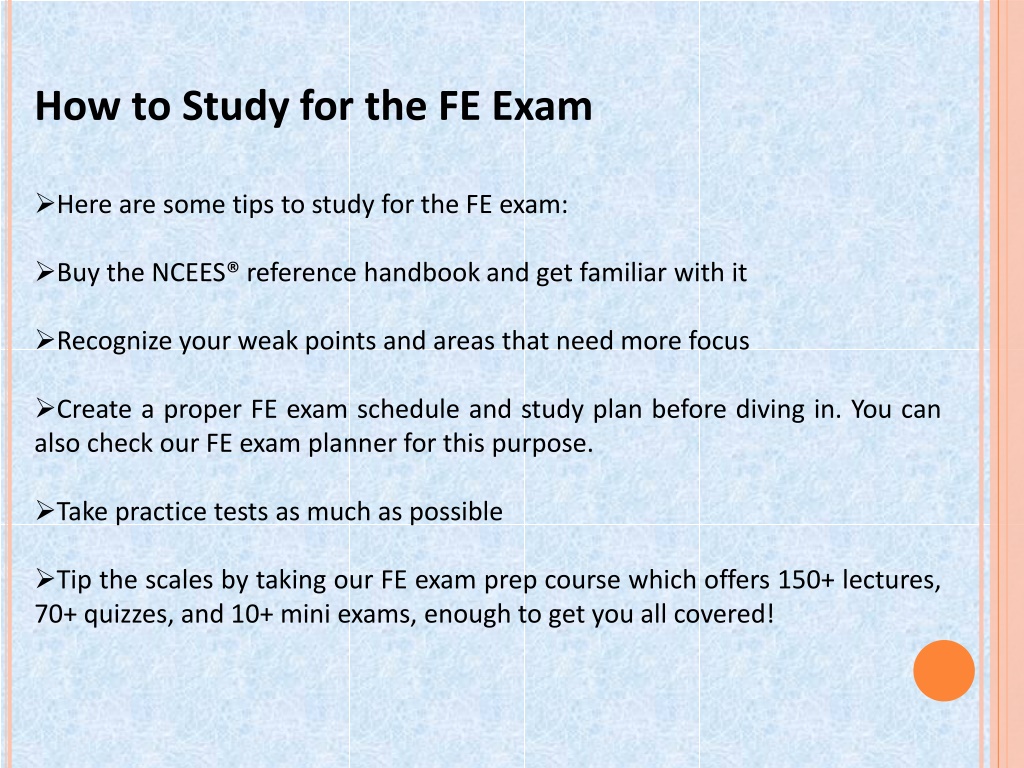
Then, do a “deep dive” on your problem areas. Spend the next 4-8 weeks hammering those weak spots with practice problems from the NCEES reference manual and old exams. This is where the real learning happens, and yes, it’s where you’ll hate your life a little. But that’s normal—it means you’re growing.
Watch Out for the “Crammer’s Curse”
Some people think they can study for two weeks and pass because they’re “smart.” Listen, you are smart, but the FE is a breadth exam—it covers 14 subjects. Cramming is like trying to eat a 12-course meal in five minutes; you’ll just end up with a stomach ache and a failed result. Don’t do that to yourself or your bank account (retake fees are not cheap).
Also, don’t fall into the trap of studying too long. Six months of prep? That’s how you burn out and start hallucinating unit conversions. The exam is a snapshot of your knowledge, not an endurance test. Two to three months is the Goldilocks zone—not too hot, not too cold, just right.

Listen to Your Gut (and Your Practice Scores)
Every week, take a timed practice quiz—even a short 20-question one. If you’re scoring above 60% on your weak areas, you’re on track. If you’re scoring below 30%, you might need an extra week or two. Your practice scores are your honest friends; they won’t lie to you just to make you feel better.
And here’s a secret: the FE Exam is a pass/fail test, not a competition. You don’t need a 95% to impress anyone. You just need a passing score, which is often around 50-60% raw. That means you can guess on a bunch of questions and still win. Think of it as the “D is for Diploma” rule, but for engineers.
The Bottom Line (With a Wink)
So, how long should you study? Honestly, until you feel bored by the material. That’s the weird sign you’re ready—when you see a beam problem and think, “Oh, this again,” instead of “Oh no.” That’s your cue to schedule the exam and stop freaking out.
You’ve survived statics, fluids, and that one professor who mumbled through every lecture. You can absolutely conquer this. Start slow, be consistent, laugh at your silly mistakes, and eat some good snacks during breaks. The FE is just a hurdle, not a wall—and you’ve already jumped higher ones in your engineering journey.
So grab your calculator, set a 10-week calendar, and go get it. And when you pass, treat yourself to something wonderful—you’ve earned it, you beautiful, formula-wrangling genius. You’ve got this, and future-you is already high-fiving you. Go crush it!