How Can I Open A Facebook Account

Let’s be real for a second: asking “How do I open a Facebook account” in 2025 feels almost archaeological, like asking how to chisel a rune or fire up a MySpace profile. Yet, here we are, and the internet is suddenly flooded with Gen Z users crawling back to the platform they swore was for their parents, only to find it’s a glorified retirement home for MLM hun bots and “Live, Laugh, Log Off” quote graphics. The trend has officially circled the drain and come back around as a form of ironic digital tourism. Everyone is talking about it because Facebook has evolved from a social network into a bizarre, hyper-specific utility—a place where you can buy a used nightstand, find out your second cousin’s dog died, and watch a 60-year-old argue about geopolitics in a comment section, all before your coffee gets cold.
The current status of Facebook in pop culture is nothing short of a villain-origin story redemption arc. It’s no longer the “cool” hangout; it’s the infrastructure of the internet. It’s the creepy uncle of social platforms who still has the Wi-Fi password. But here’s the twist: the algorithm has become so unhinged and so aggressively tailored to niche interests that it’s actually more entertaining than the contrived perfection of Instagram or the anxiety-inducing speed of TikTok. Opening an account now isn’t about staying in touch; it’s about accessing the secret layers of the web that are locked behind a login wall. It’s where the boomerang of internet culture finally lands, and trust me, you want a seat for the ride—even if it’s just to lurk.
So, why the sudden surge in “how-to” queries? Because the barrier to entry feels higher than it is. People are terrified of being doxxed, of their grandma seeing their burner meme account, or of falling into the algorithmic abyss of political rage-bait. But fear not, fellow digital voyeur. This isn’t your high school friend’s Facebook anymore. This is a black-box theater where you can curate a digital ghost. Let’s get you set up with the grace of a spy and the chaos of a shitposter.
Must Read
The Digital Paradox: Why Facebook is the New Underground
Here’s the tea: the subcultures thriving on Facebook right now are unhinged in the best way. While TikTok trends die in 48 hours, Facebook groups are permanent, self-sustaining ecosystems that operate on a level of nostalgia and obsession that makes the rest of the internet look superficial. We’re talking about the “Cooking with Margaret” groups where a 70-year-old accidentally posts a photo of her burnt casserole and gets 4,000 comments from strangers analyzing the Maillard reaction. We’re talking about the “Trauma Bonding over Lawn Care” communities where people post pictures of their dandelions and receive intense emotional support. This is not a social network; it’s a psychological experiment run by a giant blue server farm.
The toxicity is also part of the allure, unfortunately. The Marketplace is a lawless wasteland where you can negotiate a couch price like you’re in a hostage situation. The “Memories” feature is a digital ghost that reminds you of your cringe 2012 statuses, forcing you to confront your past self. And the comments sections on local news pages? That’s where the wild things are. It’s the last bastion of unmoderated, anonymous-turned-named chaos where people use their real photos and share their real, terrible opinions. Opening an account is essentially buying a ticket to a circus where the clowns are your neighbors, and the ringmaster is an algorithm designed to maximize your blood pressure. It’s fascinating, terrifying, and utterly unmissable if you study internet sociology.

Your Step-by-Step Survival Guide to the Blue Void
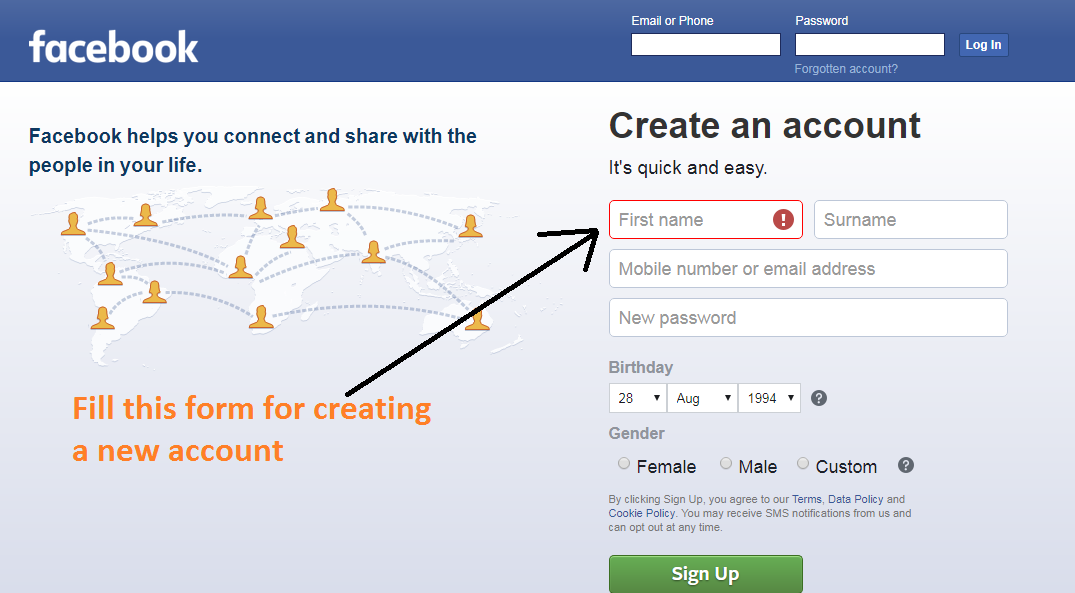
Listen, you don’t need a tech degree to do this, but you do need a strategy. Jumping into Facebook without a plan is like walking into a war zone wearing a “Kick Me” sign. First, armor up. Open your browser in incognito mode. Seriously. You do not want to be tracked by Facebook’s pixel before you even have an account; it’s like giving a stalker your address before you’ve even opened the door. Go to facebook.com and click “Create New Account.” Use a burner email—not your primary one. You will get spam. You will get notifications about “People You May Know.” You will be haunted. Protect your main inbox at all costs.
Next, the name game. You can use your real name, but where’s the fun in that? To navigate this trend without losing your sanity, consider a pseudonym that is technically compliant but spiritually unhinged. Something like “Ryan Gosling Fan Account” or “Slartibartfast III.” Facebook’s AI will try to catch you, but if you use a realistic-sounding variant, you’ll slip through the cracks. The goal is to be an observer, not a participant in your own life. Set your birthdate to something innocuous, but avoid being under 18 because that blocks you from Groups and Marketplace—the two killer features. You want to be a legal adult in the eyes of the machine.
Now, the privacy settings. This is where you save your soul. Once the account is technically live, go straight to “Settings & Privacy” > “Privacy Shortcuts” and do the following: (1) Set “Who can see your future posts” to Only Me. (2) Turn off “Do you want search engines outside Facebook to link to your profile?”—yes, that’s a checkbox. (3) Go to “Face Recognition” and disable it. Facebook wants to see you. They want to measure the distance between your eyes. Don’t let them. Finally, scroll to “Timeline and Tagging” and set “Who can post on your profile” to “Only Me.” You are now a digital phantom, a ghost in the machine.

Don’t upload a profile picture immediately. A blank avatar is your cloak of invisibility. If you absolutely must have a photo, use a picture of a landscape or a cartoon. Using a real photo of yourself makes you a target for scammers and, worse, your actual family. For the first week, just lurk. Join three groups: “Cats that Look Like Ron Swanson,” “Buy Nothing” for your zip code, and “Local Weird History.” This will calibrate your algorithm to be perfectly chaotic but harmless. Never, ever post a status update in the first 48 hours. You need to establish a baseline of zero energy before you can safely engage. And for the love of god, do not connect your Instagram. That is how they get you.
FAQ: The Internet’s Most Pestering Questions
Is Facebook still relevant in the age of TikTok and BeReal?
Relevance is a sliding scale. On one hand, no—it doesn’t have the pulse of youth culture. It doesn’t set dance trends or dictate fashion cycles. But on the other hand, it is the operating system of real-world connections. If you want to know what’s actually happening in your town—car wrecks, new restaurant openings, suspicious individuals in the neighborhood—TikTok won’t tell you. Facebook Groups’ local focus is unmatched. It’s relevant in the way plumbing is relevant: not glamorous, but essential for functioning in society. You don’t go to Facebook to be entertained in a curated way; you go to be informed in a messy, human way.
Culturally, it’s the only platform where your parents are more active than you, which creates an interesting power dynamic. There’s a certain irony in joining a platform specifically to watch your uncle misquote a movie, but that’s the point. It’s relevant as a sociological artifact that is still very much alive. If you want to participate in the larger digital ecosystem, you need a presence here, or you’re just a tourist on the internet without a passport.
Will I get hacked if I don't use my real name?
Paradoxically, using a pseudonym makes you less likely to be targeted for social engineering attacks. Hackers and scammers mine Facebook for real names, phone numbers, and location data to build profiles for phishing attempts. If you’re a ghost, you’re just a random IP address to them. However, your risk of being flagged by Facebook’s automated moderation increases. They will occasionally demand you verify your identity via a government-issued ID (which I promise you, they will then store). If you want to bypass this, make sure your account looks alive—fill out the bio, add an occasional photo of a cat, and maintain a realistic friend count (even if they are all bots or random people you’ve added). A fully fleshed-out persona is much harder to flag than a zero-posting husk.
The real threat isn’t hackers; it’s the tagging. If a friend tags you in a photo and the AI matches your facial geometry to your real-self, the algorithm will link the accounts. To prevent this, you need to lock down your privacy settings (as mentioned before). The danger of getting hacked comes from clicking on suspicious links in Marketplace or accepting friend requests from hot singles in your area. Use common sense, use a unique password, and enable 2FA via an authenticator app, not SMS (SIM swapping is a nightmare). You’ll be fine.
Do I actually have to engage with people?
Absolutely not. And this is the beauty of the modern Facebook. The era of “tag your friends” and “share this” guilt-tripping is dead. The platform has transitioned to a consumption-based model. You can use Facebook purely as an RSS feed. Follow meme pages, follow sports teams, follow local news outlets, and never interact with a human being except with a “Haha” react on a funny meme. The algorithm will eventually stop showing you people’s baby photos if you ignore them long enough, and it will pivot entirely to content from interests you haven’t even realized you have yet. It’s like having a personalized cable channel that broadcasts from the deep cuts of the internet.

Engagement is a currency you should choose to spend, not something you owe. The social pressure to like your aunt’s hospital selfie is a glitch in the matrix; ignore it. You should only engage with things that bring you genuine, chaotic joy. For me, that’s laughing at the “Shitposting in the Year 2025” group. For you, it might be auto-drafting in a fantasy football league. The point is, you are the consumer here, not the product. Well, you are the product, but you don’t have to act like it. Use the platform to harvest data for your own amusement and get out.
The burning question remains: is this a fad or a permanent lifestyle shift? I’d argue it’s a permanent shift in how we view the old guard of the internet. We aren’t going to delete our Facebook accounts in a grand, theatrical gesture—that’s so 2018. Instead, we are quietly re-subbing to it, but on our terms. We’ve stopped trying to make Facebook the cool kid and have accepted it as the reliable, slightly embarrassing utility room. It’s where the water heater of the internet lives, and sometimes, you just need hot water.
So go on, create the account. Embrace the cringe. Lurk in the shadows of the Marketplace. Post a comment on a local news article about traffic lights. You’ll hate it, you’ll love it, and you’ll absolutely never admit to it out loud. But I promise you, the digital anthropology you’ll witness is worth the price of admission—which, conveniently, is still absolutely zero dollars and all of your personal data.