Cae Oxford Aviation Academy Phoenix

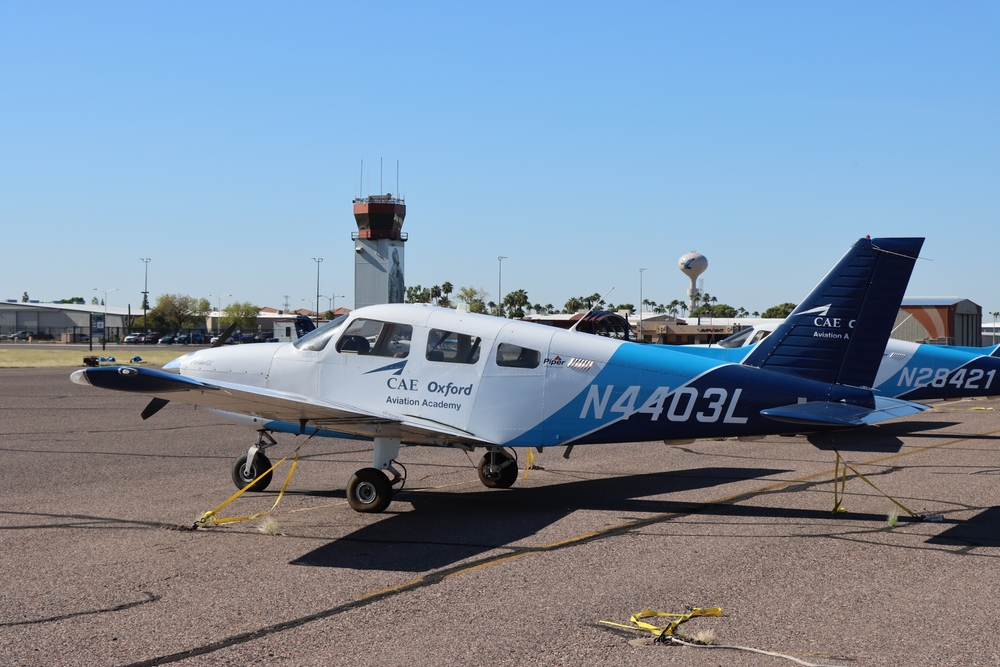
In the vast, sun-scorched expanses of the Arizona desert, where the heat shimmers off the tarmac like a mirage and the sky is an almost impossibly deep shade of blue, there exists a crucible for the future of global aviation. This is the CAE Oxford Aviation Academy Phoenix, a name that carries the weight of a thousand flight plans and the whispered anxieties of every cadet who has ever walked through its doors. It’s not merely a flight school; it’s a high-stakes finishing school for the skies, a place where the theoretical poetry of aerodynamics collides with the gritty, sweaty reality of touch-and-go landings at two in the morning. The campus, a sprawling complex of hangars, classrooms, and dormitories, feels less like a university and more like a monastic order dedicated to the cult of the cockpit, where the discipline is rigid, the standards are merciless, and the reward is a set of silver wings that signifies you are among the world’s elite.
Why Phoenix? The answer is as much about meteorology as it is about logistics. With over 300 days of sunshine a year, the region offers a rare commodity in the flight training world: uninterrupted flying time. In places like the UK or Northern Europe, weather delays can stretch a training program from eighteen months into a frustrating three-year odyssey. Here, the persistent high-pressure systems create a predictable environment for student pilots to log hours, master instrument approaches, and build the muscle memory required for a career in commercial aviation. But there’s a darker, more intriguing side to this desert location. The same brutal heat that guarantees clear skies also creates treacherous updrafts and gusty, unpredictable crosswinds that funnel through the mountain passes. This isn't a bug; it's a feature. The academy uses the desert's temperamental personality as a passive instructor, forcing cadets to respect the environment, teaching them that complacency is the true enemy long before they ever fly a passenger jet full of real people.
The Psychology of the Tarmac: More Than Just Stick and Rudder
Stepping onto the CAE Oxford ramp in Phoenix is an exercise in sensory overload. The smell of aviation fuel mixed with hot concrete, the deafening roar of a Diamond DA40’s engine spooling up, and the sight of dozens of students in crisp white shirts, epaulettes glinting in the harsh sun—it’s a scene that feels almost militaristic. But the most critical training happens between the ears, not in the hands. The academy is a pioneer in Evidence-Based Training (EBT), a methodology that shifts the focus from purely technical maneuvers to the psychological resilience of the pilot. Cadets are drilled in "threat and error management," learning to identify subtle pitfalls—from personal fatigue to ambiguous air traffic control instructions—before they escalate into critical incidents. This is where the "dark fun" begins; you realize that the greatest threat to a modern flight is rarely a mechanical failure, but rather the human brain’s tendency to take mental shortcuts when it feels safe.
Must Read
There’s a notorious corridor of airspace near the academy known colloquially as "the Sandbox." It’s a vast, featureless area of desert where visual references dissolve into an endless sea of beige. For a student pilot, flying over this terrain on a hazy day is a profound lesson in spatial disorientation—a terrifying phenomenon where your inner ear lies to you, telling you that you’re turning when you’re straight and level, or that you're climbing when you're descending. The academy doesn't shy away from this; they embrace it. Instructors will deliberately have you don "foggles" (limiting vision to the instruments only) and spin you through a series of maneuvers until your stomach drops and your brain screams. It’s a controlled dose of psychological horror designed to build an unbreakable trust in the instrument panel over your own instincts. Surviving those moments in the desert sky builds a level of self-confidence that you simply cannot replicate in a classroom in Ohio or a flight club in Kent.
Culturally, CAE Oxford Phoenix represents a global melting pot that mirrors the modern airline industry. Walk into the student lounge, and you’ll hear a symphony of accents: the clipped tones of a British cadet on a self-funded course, the rapid-fire Spanish of a Latam Airlines sponsored pilot, the reserved efficiency of a Scandinavian trainee, and the determined optimism of an Indian or Chinese cadet who has beaten thousands of applicants for a coveted airline placement. This cultural density is a hidden curriculum. You learn to communicate with non-native English speakers in high-stress, low-visibility situations—a skill that is arguably more valuable than a perfect ILS approach. The academy is a pressure cooker of social dynamics, forcing you to navigate egos, cultural taboos, and differing leadership styles, all while sharing a cramped cockpit for six hours a day. It’s a crash course in human ecology that pays dividends for decades.
From Zero to 737: The Grind and the Glory
Let’s get one thing straight: this is not a hobby. This is a boot camp for a profession that demands near-surgical precision. The typical Integrated ATPL (Airline Transport Pilot License) program here is a 14-month marathon that typically costs a staggering sum—often north of a hundred thousand dollars. The financial weight alone acts as a psychological catalyst; you are acutely aware that every "go-around" you execute on a bad landing is literally burning dollar bills. The schedule is brutal. You might have a 5:00 AM briefing, followed by a four-hour flight sequence, followed by a three-hour ground school on meteorology, and then a two-hour self-study session. It is not unusual to see cadets sleepwalking through the cafeteria, clutching energy drinks like lifelines. The academy's instructors, many of whom are retired airline captains with tens of thousands of hours, are notoriously strict. They don't shout, but their calm, deadpan critiques are often more devastating than any outburst. "That approach was so unstable that if this were a real airline, we'd be dead," an instructor might casually remark after a particularly shaky landing. It’s dark humor, but it’s effective—it creates a zero-tolerance culture for mediocrity.
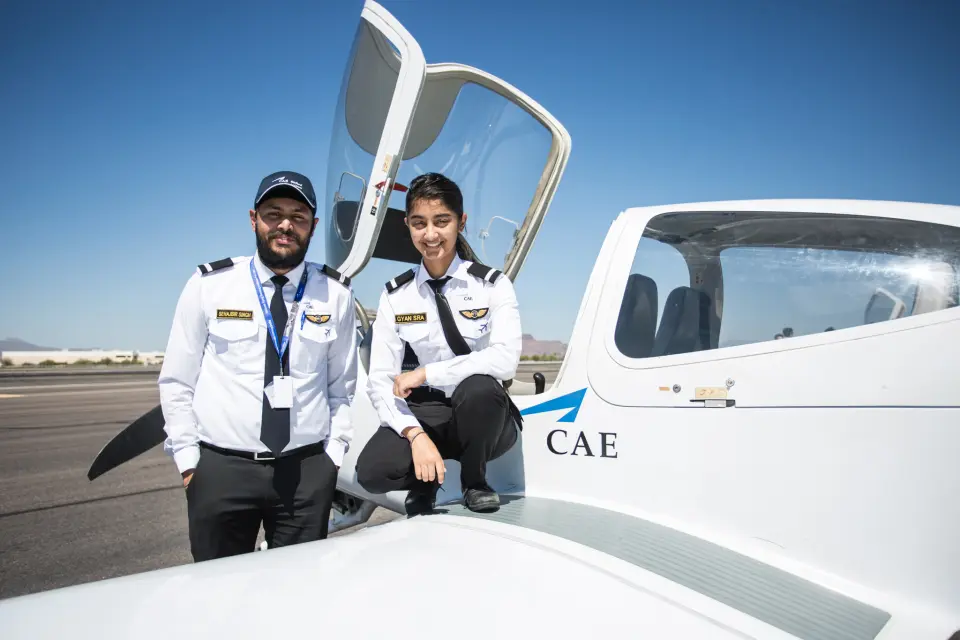
Consider the case of a recent graduate, a 24-year-old from Manchester named James. He breezed through the academic phases, acing his theoretical exams with 97% averages. But in the flight phase, he hit a wall. He developed "landing phobia" after a series of bounced landings during gusty Phoenix afternoons. The flight data monitoring (FDM) systems, which record every control input on the aircraft, showed he was overcorrecting, tensing up, and fighting the aircraft rather than flying it. Instead of letting him fail, his instructor pulled his FDM data and projected it on a screen, showing James exactly where his anxiety was manifesting in stick movements. They then switched to a "positive transfer" exercise, flying a glider—not the motorized Diamond aircraft—to relearn the feel of the energy management. James had to reset his muscle memory. This kind of tailored, data-driven intervention is what separates CAE Phoenix from a "hours-building" flight club. They don't just teach you to fly; they teach you how to learn how to fly, and how to recognize when your own psychology is sabotaging your performance.
For airline cadets, the final hurdle is the Airline Pilot Standards (APS) MCC (Multi-Crew Cooperation) course. This is where the real fun begins. You are no longer a solo pilot manipulating controls; you are a "First Officer" and your "Captain" is a peer you might not like. You are thrown into full-motion simulators that look and feel exactly like the flight deck of an Airbus A320. The scenarios are deliberately designed to fail. You’ll have an engine fire on takeoff, combined with a hydraulic leak, and a passenger medical emergency—all within the span of ninety seconds. The pressure is immense, but the goal is to test your decision-making under duress. Do you become indecisive? Do you delegate poorly? Do you let your ego block a suggestion from your co-pilot? These simulations are where CAE's commercial experience shines. They use real airline data and real accident reports to craft scenarios that are grimly realistic. It’s a stark reminder that while the desert skies are beautiful, they are a training ground for a world that is frequently unforgiving and rarely fair.
For the self-funded student who isn't sponsored by an airline, the path after graduation is different but equally daunting. They leave Phoenix with a frozen ATPL—meaning they have the theory but need to build practical flight hours. They might find themselves flying cargo at night in a tiny turboprop, or instructing new students back in the UK, paying off their massive loan. However, the CAE network provides a distinct advantage. The academy has direct recruitment pipelines with major carriers like Delta, Emirates, and easyJet. A high score at CAE Phoenix doesn't just get you a license; it gets you an interview. The modern airline industry is desperate for pilots—global demand is predicted to require 2.4 million new pilots by 2032—so the "cadet bubble" of the past has burst. Graduates are walking into first-officer roles at an unprecedented rate, but the standards remain elitist. The desert might be forgiving, but the check rides are not.
Frequently Asked Questions: The Unvarnished Truth
1. What are the actual physical and medical requirements to get in?
The pharmaceutical side of aviation is unforgiving. You will require an EASA Class 1 Medical Certificate (or FAA First Class, depending on your pathway) before you even sit in an aircraft. This is not a simple checkup; it’s an intense examination of your cardiovascular health, neurological function, vision (correctable to 20/20 but with strict limits on severe myopia), hearing, and even your psychological history. They will perform an ECG, an audiometry test, and a detailed blood test. The hidden 'gotcha' is often color vision—you must have perfect red/green distinction, as that dictates your ability to read runway lights and navigational beacons. Furthermore, they assess your mental health history scrupulously. A history of certain anxiety disorders or depression is not an automatic disqualification, but you will need to prove stability with long drug-free periods. For those with uncorrected refractive surgery (LASIK/PRK), you will need to provide extensive pre-and post-operative records to prove stability. The bottom line: you must be in peak physical shape, as the body ages quickly in the cockpit, and the medical board is looking for long-term viability.

Beyond the physical, there’s a "hidden" psychological screening—the COMPASS test. This is a computer-based aptitude assessment that measures your multitasking ability, spatial awareness, and reaction time under stress. You are given a series of increasingly complex tasks involving gauges, directions, and auditory cues. The test is designed to trick you; you might be asked to focus on a rapidly changing numerical display while simultaneously using a joystick to track a target on a moving map. The pass rate is notoriously low—roughly 30-40% on the first attempt. Many candidates with stellar grades in physics and math fail this test because it’s less about intelligence and more about cognitive bandwidth. The academy is not looking for geniuses; it’s looking for people who can maintain situational awareness while the world is collapsing around them. If you freeze when processing multiple inputs, the test will ruthlessly expose you.
2. Is the weather in Phoenix really as good as they claim for flying?
The marketing says 300+ days of clear flying weather, and that is largely true, but it comes with a severe caveat: the summer heat is a beast that affects performance. From June through August, temperatures regularly exceed 40°C (104°F). This extreme heat reduces air density, which directly impacts engine performance. You will find that your aircraft’s climb rate diminishes significantly, and take-off distance increases. As a student, this is a blessing in disguise because you learn "density altitude" not as an abstract formula but as a lived experience. You will perform takeoffs where the runway looks impossibly long and the aircraft feels sluggish, teaching you to calculate performance charts meticulously before every departure. The "dry heat" is also deceptive; it dehydrates you rapidly, leading to fatigue and reduced concentration. Cadets routinely chug two liters of water before a flight, and the academy mandates strict sun protection protocols for the flight deck windows.
Then there's the "monsoon season," which runs from roughly July to September. The clear blue skies evaporate into towering cumulonimbus clouds that build in the afternoon with terrifying speed, bringing sudden microbursts, lightning, and torrential rain. These are not light showers; they are dust storms rolling in like a brown wall, followed by massive downdrafts. The academy temporarily suspends VFR (Visual Flight Rules) training during these events, but IFR (Instrument Flight Rules) training often continues, providing a spectacular (and terrifying) live demonstration of thunderstorm avoidance. Withered old captains will tell you that Phoenix weather is either "squeeze or release," meaning the heat is either crushing you or the storms are trying to kill you. But for flight training, the variety is gold. You learn to read cloud formations better than any meteorologist because you are literally gambling your life on those readings every day.

3. What are the aircraft used at the Phoenix campus, and are they modern?
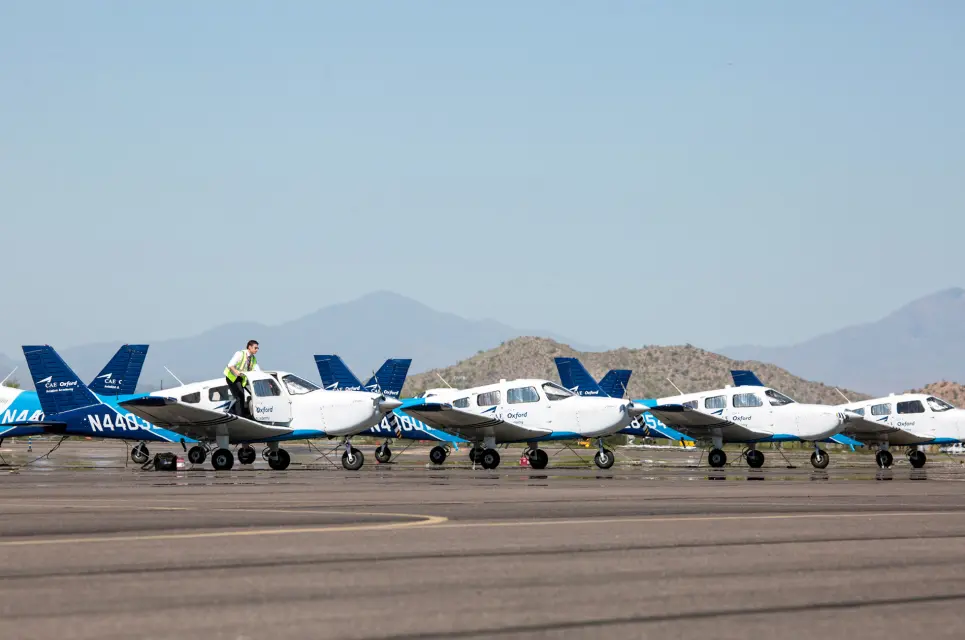
The mainstay of the CAE Phoenix fleet is the Diamond DA40 NG single-engine aircraft, and the Diamond DA42-VI twin-engine. This is not old-school retro aviation; these are state-of-the-art carbon-fiber machines. The DA40 is a low-wing, four-seat aircraft that is notoriously forgiving and has excellent visibility due to its bubble canopy design. It features the Garmin G1000 glass cockpit—the same avionics system found in many modern airliners. This is crucial because you don't learn on steam gauges (old analog dials); you learn on the exact screens you’ll see in an A320. The DA42 is the twin-engine version, used for the commercial and multi-engine ratings. It’s a fascinating aircraft—it uses Austro Engine AE300 turbo-diesel engines, which are more fuel-efficient and reliable than traditional avgas engines. This reduces operational costs (which theoretically reduces your flight training fees) and teaches you about diesel vs. avgas fundamentals—a rare skill.
But the crown jewel is the simulator suite. CAE has invested heavily in their own simulation technology. The classroom simulators are "fixed-base" (they don't move), but they replicate the G1000 suite exactly. The full-motion simulators, used for the MCC course, are massive, hydraulic-actuated cockpits that can bank, pitch, and vibrate. They offer 180+ degree visuals, and the fidelity is jaw-dropping. During a simulated severe crosswind landing, you will feel the aircraft bucking beneath you, see the runway lights racing toward you, and hear the wind howling. The instructional staff can programme a single wheel brake failure, a nosewheel steering malfunction, and a wind shear all at once. The aircraft are kept pristine—CAE’s maintenance team is obsessive, partly for safety and partly for brand image. A student who mishandles the throttle is not just graded on the landing; they are forced to watch a video replay of their own hand movements to see if they were smooth and deliberate.
4. What is the actual living situation and social life like on campus?
Forget the glamorous "Top Gun" lifestyle. The accommodation at CAE Phoenix is functional, clean, and spartan—think military barracks meets a modern university dormitory. You have shared apartments or single rooms in blocks located close to the training center. There is a gym, a small café, and a swimming pool, but the reality is that you will be too exhausted and financially stretched to enjoy them lavishly. The social life is intense but insular. You are surrounded by people who share your exact obsession, which is either amazing (instant camaraderie) or suffocating (you can't escape talking about stalls and spins at dinner). The academy organizes occasional barbeques and sports leagues, but they are often subdued because the next morning’s flight schedule looms large. The biggest social activity is studying—students form "study cells" in the library, quizzing each other on air law and navigation, often until midnight.
Phoenix itself is a sprawling, car-centric metropolis, and most cadets don't have cars. This can lead to a sense of isolation. You are located near the Luke Air Force Base, so the sound of F-16s screaming overhead is constant background noise. The nearest "civilization" is a short shuttle ride away, but it’s mostly strip malls. To counter the isolation, the academy has a strong "welfare" system—a dedicated team of mental health advisors and "pastoral" staff who check on students showing signs of burnout. They know that a cadet who is crying in the lobby after a failed check ride needs immediate intervention, not a lecture. It’s a paradox: the curriculum is brutally competitive, but the support network is genuinely caring. You will form lifelong friendships here, bonded by the shared trauma of a crosswind landing that you somehow survived and the pure elation of your first solo flight.

5. What separates a CAE Oxford graduate from a generic flight school graduate?
The primary differentiator is the network and the reputation of pedigree. When an airline recruiter sees "CAE Oxford Aviation Academy Phoenix" on a CV, they immediately understand the level of rigor the candidate endured. It’s a brand that says, "This person has been pushed to the breaking point and didn't snap." Graduates from smaller flight schools might have the same hours, but they often lack the standardized, data-driven feedback cycle that CAE provides. CAE graduates are trained on specific SOPs (Standard Operating Procedures) that mirror the airlines. They learn to use checklists verbally in a specific cadence, to use "callouts" during critical phases of flight, and to manage the automation with specific "PF/PM" (Pilot Flying/Pilot Monitoring) duties. This scripting means they transition to a type rating (e.g., on a Boeing 737) much faster, saving the airline significant training capital.
Moreover, the culture of "professionalism" is drilled into you. You are constantly monitored, and your performance metrics are tracked. A CAE graduate is accustomed to critique; they don't get defensive when a check pilot criticizes their approach—they nod, say "yes, sir," and correct it immediately. This emotional maturity is the most significant intangible asset. The school also fosters a "just culture" where errors are reported and analyzed rather than punished. Students are encouraged to admit they "broke the sterile cockpit rule" or "mis-squawked the transponder" so the instructors can debrief the entire class. This ability to be transparent about one's own fallibility is a massive asset in a modern airline safety system. You are not just a stick-and-rudder pilot; you are a standardized, culturally aware, and emotionally intelligent team member. That, in essence, is the premium you pay for.
The story of CAE Oxford Aviation Academy Phoenix is ultimately a mirror reflecting our own relationship with risk and mastery. We all have our own personal "deserts"—environments that are hostile, unforgiving, and seemingly indifferent to our struggles. For the cadet, the desert is literal; for the rest of us, it’s metaphorical—a demanding career, a complicated relationship, or a daunting creative project. The lessons learned on the tarmac in Phoenix are universal: you do not control the weather, but you control your preparation; you cannot eliminate turbulence, but you can adjust your course and speed to minimize its impact. The academy teaches a brutal form of optimism—acknowledging the severity of a problem without succumbing to fear, which is a skill that translates directly to waking up on a Monday morning and facing a difficult week.
And finally, Phoenix touches on the deep human craving for transformation. The cadets arrive as civilians, filled with doubt and excitement, and leave as pilots—a title that carries an almost mythological weight in our culture. We see them as modern knights, guardians of the thin blue line between the earth and the void. This transformation is not magical; it is the result of hundreds of hours of repetitive, mundane practice, of fixing your mistakes, and of pushing through exhaustion. It’s a testament to the human spirit’s ability to conquer our innate fear of falling. When you watch a newly graduated pilot walk across the apron with a confident swagger, you are witnessing the culmination of a process that has stripped away their ego, rebuilt their confidence, and instilled a permanent sense of humility in the face of the sky. It is a timely reminder that our greatest strengths are often forged in the most unforgiving environments.
_webp_40cd750bba9870f18aada2478b24840a.webp)