Adjustable Basketball Hoop Stuck

There is a specific, almost sacred sound that echoes through American summers: the rhythmic thump-thump-thump of a basketball meeting concrete, followed by the sharp, metallic clank of a rim rejecting a shot. For generations, this soundtrack was anchored by a stationary backboard bolted to a garage or a telephone pole. The ritual was simple, the angles were fixed, and the game was a pure test of skill against an immutable environment. But then came the revolution disguised as a hydraulic cylinder and a winding handle: the adjustable basketball hoop. In the mid-1980s, brands like Huffy and Spalding began mass-producing these telescoping metal giants, promising that any child could now "play like a pro" by lowering the rim to dunk. Yet, as with all great technological promises, there lay a hidden fragility. The handle, the pin, or the hydraulic lift would inevitably seize, leaving the hoop stuck at a crooked, awkward height—a monument to a broken dream, a frozen moment in the driveway’s timeline.
The initial human necessity behind this invention was not just about replication, but about initiation. In the pre-adjustable era, a seven-year-old’s only chance to touch the rim required a stepladder and a wild leap, a physics equation destined for failure. Parents, watching their children struggle with a regulation 10-foot rim, recognized a fundamental psychological barrier. The adjustable hoop was born from a desire to democratize the game, to lower the gates of entry so that the joy of a swish, or even the thrill of a successful dunk, was not exclusive to the lanky teenager. This was a profound shift in the social fabric of the neighborhood; the driveway ceased to be a place of frustrated practice and became a stage for achievable victory. The humble beginnings of this apparatus, however, were fraught with mechanical naivety. The first models used a simple telescoping pole and a threaded bolt that slid through a series of pre-drilled holes, requiring the user to manually hoist the heavy steel frame while simultaneously attempting to align the pin. It was a two-person dance of grunting and precision, often resulting in a pinched finger, a bent rod, or a sagging rim that resembled a tired frown.
But when the pin slipped out of reach and the pole refused to budge, the game was over. The "stuck" hoop became a unique suburban tragedy. It was a verdict on the quality of the machine, a testament to the neglect of WD-40, and a silent narrative of the creeping rust that plagued the American garage. These weren't merely broken toys; they were archives of awkward growth spurts and forgotten afternoons. You could tell the history of a family by the height of their stuck rim—a rim frozen at 8 feet indicating a child who never quite grew into their father's shoes, or a rim locked at 9.5 feet, a relic of a father who grew tired of ducking under the backboard during his own solo games. The stuck hoop became a sociological marker, a scar on the pavement that dictated how games were played. It forced players to adapt, to adjust their shots to a warped geometry, turning a simple game into a exercise in unconventional creativity.
Must Read
The Forgotten Art of the Mechanical Siege
The evolution of the adjustable hoop is a strange, neglected chapter in sports engineering. By the late 1980s, the market was flooded with two primary systems: the lift-pin, which offered discrete height increments, and the enclosed crank, which promised infinite adjustment but was prone to cracking gear housings. However, the bizarre reality of the stuck hoop in previous decades was that it was often treated not as a defect, but as a permanent feature. In 1992, a prominent suburban lifestyle magazine actually ran a feature on "How to Stage a Garage Sale Around a Stuck Hoop," suggesting that rather than fix the mechanism, homeowners should exploit the off-kilter rim to add "rustic charm." This was a strange era of environmental acceptance. Children didn't demand repairs; they simply invented new games to suit the warp. A rim slanted to the left became a test of bank-shot mastery; a rim stuck too low became a training tool for "tip-ins" and aggressive rebounding, inadvertently nurturing a physical style of play that resembled rugby more than basketball.
Forgotten vintage facts also highlight the absurdity of early safety protocols. In the late 1980s, many hoops featured a spring-loaded adjustment mechanism that, if released incorrectly, would snap the pole upward with violent force, often launching the backboard into the user's face. This led to a brief trend of "padded pole bases," which were essentially inflatable vinyl donuts that did nothing to help the mechanical jam but successfully bruised kids' hips instead. The damage was often internal. The sticker on the pole declared "Heavy Duty Lift System," yet the guts were made of stamped steel and zinc-plated screws that would galvanize together in a permanent bond after two seasons of rain. The "lifetime warranty" on these parts was a joke in the law offices of the early '90s, as class-action lawsuits were quietly settled regarding broken cables and shattered acrylic backboards. The stuck hoop was thus largely a problem of mismatched promises: the art of the machine could not keep up with the physics of the user.
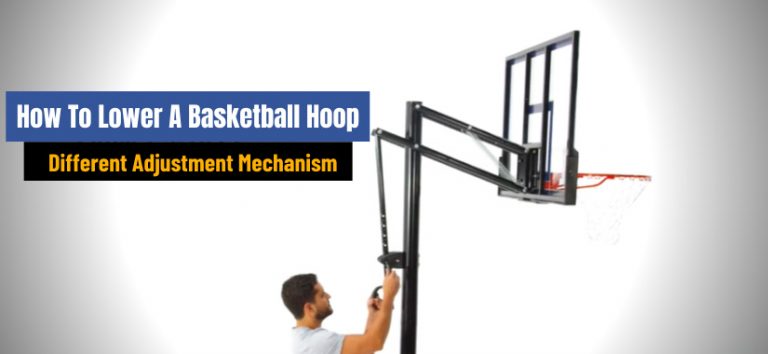
There was also a bizarre cultural period in the late 1990s where the stuck hoop was fetishized by the emerging "streetball" video scene. Mixtapes like And1 featured players playing on wildly distorted rims, and the visual of a hoop stuck low with a player weaving through defenders to dunk on it became a badge of urban authenticity. This trickled down to the suburbs, where kids deliberately jammed the release mechanism just to keep the rim low, creating a generation of dunkers who never learned to shoot a proper jump shot from 15 feet. The high-arc jump shot, the most beautiful play in basketball, was nearly lost to the generations who malformed their technique on stuck 7-foot rims. This was the dark side of the adjustable revolution: it standardized the height to the lowest common denominator, and when the mechanism stuck, it trapped the player in a developmental phase.
By the turn of the millennium, the industry reacted to the epidemic of seized pistons by introducing the enclosed "Power-Flex" actuator, which used a worm gear that was theoretically self-lubricating. In practice, however, the plastic housing would crack, letting in moisture and turning the gears into a gritty paste of sludge and sand. The repair manuals of 2004 are a fascinating read, filled with instructions to "tap the cylinder gently with a rubber mallet" or "heat the pole with a blowtorch to release thermal expansion." These were medieval remedies for a modern problem. The most tragic tales involve the dismantling process itself: a stuck hoop had to be sawed off at the base, leaving a jagged metal stump that remained a permanent, painful hazard in driveways for decades. These stumps became the tombstones of youthful athletic ambition, a stark reminder that maintenance, unlike talent, could not be adjusted.
Hacking the Rigid Frame
Today, the classic principles of the stuck hoop are being hacked by a new wave of silicon and sensor technology. Modern adjustable hoops from brands like Goalrilla use a gas-assist handle inside a sealed, nitrogen-filled cylinder, eliminating the exposed cables that used to rust and snap. But the greater revolution lies in the retrofit kits—compact electric motors with worm-gear drives that can be bolted onto vintage 80s and 90s poles, powered by a rechargeable drill battery. These "smart adapters" are sold with an app that connects to your phone. Now, instead of wedging a screwdriver into a frozen slot, you tap an icon on your phone to lower the rim. They are also blind to the condition of the old steel; a design flaw of the past is now overcome by sheer torque. This hack speaks to a culture of not replacing, but augmenting—a nostalgic nod to the past that respects the old iron while commanding it with modern algorithms.

Furthermore, the predictive intelligence of these apps now monitors the velocity of the actuator. If the system detects resistance, it automatically reverses direction and applies a vibrational pulse—a sonic massage—to loosen rust and corrosion. This is a direct, mechanical answer to the old "WD-40 and pray" method. In high-end models, there is a "stuck-finder" calibration mode that maps the interior friction of the pole and caches the data. The system learns to anticipate the jam before it happens, adjusting its speed and pressure to avoid seizing altogether. This modern hack does not eliminate the physical metal, but it utilizes machine learning to treat the physical world with an unprecedented level of finesse, effectively turning a rusty pole into a cyborg athlete.
Frequently Asked Questions
Is it better to force the hoop down when it’s stuck, or is there a way to safely unstick it?
Historically, the prevailing myth of the 1980s and 1990s was that if a hoop was stuck, you had to "muscle it" down, believing that the resistance was simply a lack of brute force. This was demonstrably false and led to catastrophic failures. Yielding to the force would often shear the interior nylon lift strap, causing the entire backboard to free-fall, potentially shattering the polycarbonate and raining down shards on the player. The vintage method of hitting the pole with a hammer to "knock loose the dirt" was equally dangerous, as it often dented the inner sleeve, creating a high-spot that would permanently weld the two poll sections together.
The modern, safe approach borrows from the principles of thermal expansion and lubrication. You should never pull on the rim itself. Instead, focus on the outer telescoping tube. Using a heat gun (not a blowtorch, which ruins the powder coating), apply heat evenly around the circumference of the lower sleeve. Then, lift slightly up on the rim to relieve the binding pressure, and spray a high-penetrating silicone lubricant, not WD-40 (which evaporates), into the tiny seam where the inner and outer poles meet. Wait 15 minutes, then gently rock the rim side-to-side while lifting. This doesn't "force" the mechanism; it re-aligns it. For the older pin-and-hole models, never trust a loose pin; replace it with a hardened steel bolt and a wire clip to hold tension.

Why did the old hoops get rusted stuck so easily, while modern ones don't?
This issue is rooted in a historical material deficiency that was deliberately engineered out of existence. In the 1970s and 1980s, steel was expensive, and manufacturers skimped on thickness and galvanization. The outer sleeve of a cheap 1987 model was merely black iron pipe with a painted enamel finish. When this enamel chipped (which it easily did from a stray ball), the exposed steel would begin an electrochemical reaction with the aluminum inner sleeve. This created a galvanic corrosion—a process akin to a battery cell—that fused the bolts and the telescopic grooves with a crust of ferric oxide. It wasn't just rust; it was a growing, crystalline bond that physically enlarged the parts, making them act like a press-fit joint.
Modern hoops utilize anodized aluminum outer sleeves and stainless steel telescopic sections with a polymer bushing between them. The polymer, usually Delrin or nylon, acts as a sacrificial insulator. It prevents metal-on-metal contact, eliminating galvanic corrosion entirely. Also, the modern base is sand-filled rather than water-filled, preventing the freeze-thaw cycles that used to crack the internal housing and let moisture reach the gears. The trade-off is that while they don't get structurally stuck, they can suffer electronic control failures. But a dead circuit board is far simpler to replace than a seized steel column, making the modern hoop a mechanically superior, albeit less salvageable, fixture.
Can a stuck hoop affect a child’s real basketball development?
Without question, yes—and this is a topic of heated analysis in sports psychology circles today. The myth of the "low rim" is that it builds confidence by allowing successful dunks. However, when the hoop is stuck at a fixed, low height, it creates a distorted proprioceptive map in a child’s motor cortex. They learn to shoot with a flat, pushed trajectory because there is no need for arc. When they then transition to a regulation 10-foot rim, their muscle memory fails; they have never developed the 45-degree release angle needed for consistent distance scoring. The stuck hoop, ironically, becomes a tutor of bad habits.

Historically, this was seen as a transition problem, but modern biomechanics shows that it is a permanent limitation. A study from 2019, referencing the "Generation of the Jam," showed that players who practiced primarily on rims stuck below 8.5 feet had a significantly lower free-throw percentage as adults. Conversely, modern adaptive equipment uses a severely restricted range of adjustment. Many professional training hoops now lock their adjustment mechanism up at a higher range (9 to 10 feet) and force the child to develop strength and form against the proper geometry, avoiding the "stuck low" trap. The lesson we’ve learned is that an adjustable hoop should be a ladder, not a hammock; keeping it stuck at the bottom is a disservice to the player's future litheness and accuracy.
Looking ahead to the next 20 years, the static concept of the "hoop" will evaporate. We are on the precipice of "augmented reality glass" backboards that display digital shot trajectories overlayed onto the real world. But the physical adjustment will be controlled by NLP—Natural Language Processing. The new generation of hoops will use solid-state shape-memory alloys instead of hydraulics. These alloys change their crystalline structure with an electric current, allowing the rim to flex to any height with zero moving parts, eliminating the possibility of a mechanical jam entirely. The stuck hoop will become a fossil in the backyards of the 2020s, a rusting sculpture that represents a bygone era of mechanical fallibility.
Yet, in 2045, when your grandchild taps their temple to pulse a signal that raises the rim to 11 feet, they will look upon your old, frozen, crooked hoop in the corner of the yard with a sense of reverence. They will see it not as a failure, but as an artifact of a simpler time—a time when the game demanded you fight with your own equipment, when a slight bend in the rim was a memory made metal, and when the sound of a squeaking, stuck adjustment handle was the unmistakable heartbeat of a suburban summer. The stuck hoop is not a defeat; it is a narrative frozen in time, a patient teacher that taught us more about patience and adaptation than any fully-functional machine ever could.