
2019 F250 6.2 Oil Change Interval
The 6.2-liter gasoline V8 in the 2019 Ford F-250 is a marvel of thermodynamic compromise. It’s a pushrod, iron-block behemoth designed to produce substantial torque at low RPMs while enduring the brutal shear forces of heavy towing. But beneath the valve covers, a silent war is waged every time you turn the key. The engine’s internal combustion process is essentially controlled explosions, generating not just rotational energy but also a cascade of chemical byproducts—soot, unburnt fuel, and nitric acid precursors—that contaminate the lubricating oil. The 6.2’s oil change interval is not a suggestion; it is a calculated lifespan for a complex colloidal suspension of base oils and additive packages that must neutralize acids and suspend particulates until your next service.
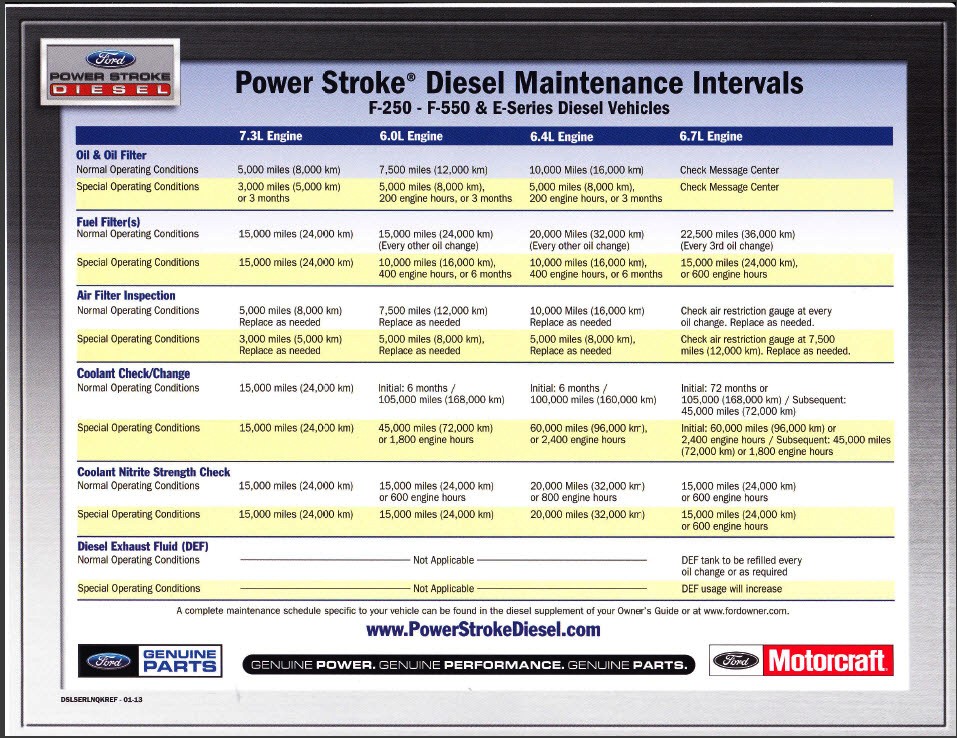
For most owners, the phrase "oil change interval" conjures a simple odometer reading. Yet the reality is a dynamic equation involving time, temperature, and duty cycle. The 2019 F-250’s Intelligent Oil-Life Monitor (IOLM) doesn’t just track miles; it calculates a percentage based on engine revolutions, coolant temperature, and the number of cold starts. This is your first biological analogy: your engine’s oil is like blood plasma, carrying heat away from pistons and delivering detergents to scour metal surfaces. When you neglect the interval, the plasma becomes sludge—a viscous, abrasive clot that starves hydraulic lifters and scores cylinder walls. The OEM recommends an interval of 7,500 miles under normal conditions, but that number is a statistical average, not a law of physics.
Here’s the pragmatic rub: most F-250 owners don't drive "normally." If you use your truck for what it was built for—hauling a 14,000-pound fifth-wheel or plowing snow—the oil’s viscosity index improvers (long-chain polymers) are mechanically chopped into shorter, less effective molecules. This process, called shear degradation, happens faster under high load. The IOLM will often trigger a change at 5,000 miles or less under severe conditions, but a savvy owner should understand the why behind that number. We are not simply changing dirty oil; we are replenishing a sacrificial chemical barrier that prevents metal-on-metal contact. The science dictates that waiting until the oil is visibly black is like waiting for a fever before treating an infection—the damage is already systemic.
Must Read
The Chemical Clock: Oxidation, Nitration, and the Hidden Viscosity Curve
Let’s dissect the actual chemistry occurring inside your 6.2-liter crankcase. Base oil, whether synthetic or conventional, is a hydrocarbon. When exposed to oxygen at 212°F (100°C) and above, it undergoes oxidation. This reaction forms organic acids and insoluble gums that increase the oil's viscosity. A 5W-30 synthetic that starts at 10.5 centistokes at 100°C can thicken to 14 centistokes after 6,000 miles of high-load operation. The IOLM has no viscometer on board; it uses an algorithm. So, while the dash may read 30% life remaining, the physical chemistry might suggest the oil is already past its useful protective window, especially if you frequently perform short trips where the oil never reaches full operating temperature to boil off condensation and fuel dilution.
Biological systems offer a profound parallel. Your liver detoxifies blood; your oil filter detoxicates lubricant. But the filter is only a physical barrier—it captures particles above 20 microns. The chemical additives—zinc dialkyldithiophosphate (ZDDP) for anti-wear and calcium sulfonate for detergency—are consumed sacrificially. When ZDDP depletes, the camshaft lobes and lifters face direct boundary lubrication contact. Data from used-oil analysis (UOA) labs like Blackstone show that the 6.2’s oil typically shows elevated iron wear particles after 5,000 miles of severe towing, signaling piston ring and cylinder wear. More critically, nitration occurs when rich air-fuel mixtures (common during heavy throttle) interact with NOx gases, creating highly corrosive nitrates. These nitrates literally eat bearing material.
The 2019 model year is particularly notable because Ford updated the IOLM algorithm to be more conservative than earlier versions. This is a rare case of manufacturer transparency admitting that petroleum engineering is not static. The algorithm now accounts for fuel dilution, a condition where unburnt gasoline seeps past piston rings into the oil pan, lowering the oil's flashpoint and thinning its film strength. If you live in a cold climate and make repeated 5-minute trips, your oil can become 5% to 8% fuel by volume. The system will shorten the interval to as low as 3,000 miles. ignoring this is akin to ignoring a doctor's note about your cholesterol—you feel fine until the catastrophic arterial blockage. The pragmatic takeaway is that the dash percentage is a starting point, not a final verdict.
Hacking the Interval: Data-Driven Strategies for Extended Wear Protection
To master the 6.2’s oil change protocol, you must abandon the "one-size-fits-all" manual recommendation and adopt a multi-variable monitoring approach. First, invest in a high-quality synthetic oil that exceeds API SN Plus or SP specifications. A full synthetic (like Mobil 1 or Valvoline) has a higher oxidation resistance due to ester and PAO base stocks. These molecules are more uniform, meaning they resist shear degradation better. This simple choice can extend the safe operation window by 20% compared to conventional oil under identical conditions. However, do not assume synthetic allows you to bypass the IOLM—it only buys you a more robust safety margin for your specific driving style.

Second, master the "temperature delta" hack. The IOLM does not measure oil temperature directly; it infers it from coolant temperature. But the oil pan in the F-250 reaches equilibrium much slower than the block. When towing up a 6% grade, oil temps can hit 250°F while coolant stays at 210°F. At that temperature, oxidation doubles for every 18°F rise. My recommendation: install a real-time oil temperature gauge (via the OBD-II port using a Bluetooth dongle and an app like Torque Pro). If you see oil temps above 230°F for more than 30 minutes, immediately reduce your service interval by 20% (e.g., from 5,500 to 4,400 miles). This is evidence-based, not paranoia. You are optimizing the thermodynamics of your engine's blood.
Third, implement the "two-filter" rule. Always change the oil filter with every oil change, but use a high-efficiency filter (like Motorcraft FL-820S or Wix XP) that has a bypass valve rated at 14-16 psi. The filter's efficiency is measured by its beta ratio (e.g., beta 2/20 = 98.7% efficiency at 20 microns). A cheap filter might have a beta ratio of 2/10, allowing more particles through. The 6.2’s variable valve timing system relies on precise hydraulic pressure. Even 0.5% more particulate contamination can cause phaser clatter. Consider changing the filter at 3,000 miles and the oil at 6,000 miles if you are a high-mileage driver—this gives you a "mid-cycle blood transfusion" without throwing away the whole plasma.
Fourth, perform a used oil analysis at least twice a year. For $35, a lab will tell you the exact ppm of iron, copper, aluminum, and silicon. If you see iron rising above 45 ppm in a 5,000-mile sample, you are experiencing abnormal wear—likely due to a cold-running thermostat or a clogged PCV valve. Fix that issue before your next interval. This data transforms oil changes from superstition into precision medicine. Finally, record your actual oil life reset date and odometer in a spreadsheet. Cross-reference it with your towing mileage and ambient temperature. Do not rely on memory; your brain is not a pH meter. The data will reveal patterns—e.g., "winter months shorten interval by 800 miles"—that allow you to preemptively schedule changes before the IOLM drops below 15%.
Fifth and most critically, adopt the "hot drain" protocol. Never change oil on a cold engine. The science is simple: warm oil has a lower viscosity (around 20-30 cSt), which allows suspended contaminants to flow out with the drain, whereas cold oil (< 60°F) leaves nearly 15% of old sludge in the pan, immediately contaminating new oil. Drive the truck for 15 minutes to bring the oil to 190°F, then drain. Wait 15 minutes after the stream becomes a drip to allow the oil pan sump—which is baffled in the F-250—to fully evacuate the last quart. This one habit yields more measurable benefit than switching synthetic brands. It’s the difference between rinsing a wound with water versus antibacterial solution before bandaging.

Frequently Asked Questions
1. Can I trust the Ford IOLM to 7,500 miles even if I tow every weekend?
No. The IOLM is calibrated for a general driver, but Ford states that severe service (towing > 8,500 lbs, extreme dust, or frequent idling) requires a 50% reduction in the oil change interval, regardless of what the monitor says. The algorithm cannot measure torque directly; it estimates load based on RPM and throttle position. Under sustained high-RPM highway driving with a trailer, the IOLM may still show 40% life at 5,000 miles, but a UOA will show elevated oxidation (total acid number above 4.0 mg KOH/g). In this case, change at 4,000–4,500 miles. Your truck’s engine bearings will thank you with extended life.
Furthermore, towing increases the crankcase pressure, which forces blow-by gases (and their corrosive acids) past the rings more aggressively. The oil also carries abrasive carbon particles from diesel-like combustion in a gasoline engine. The IOLM’s algorithm for 2019 F-250 did not account for trailer brake controllers or hitch weight sensors. It sees throttle position, but a 0-60 mph sprint with an empty bed and a 0-60 sprint with 12,000 lbs behind you produce different combustion cylinder pressures. The latter creates exponentially more soot. As a rule, if you tow more than 20% of the time, halve the IOLM’s remaining percentage before scheduling a change.
2. Is it safe to use 5W-30 synthetic if Ford recommends 5W-20?
Yes, with a caveat. The 6.2 is a robust engine designed for 5W-20 primarily for fuel economy (Corporate Average Fuel Economy standards). Using 5W-30 at high ambient temperatures (above 90°F) provides a thicker hydrodynamic film at bearing loads, reducing wear during towing. However, you must ensure the 5W-30 meets the Ford WSS-M2C946-A specification or API SN Plus. The risk is not engine damage but a slight fuel economy penalty (roughly 1–2%) and slightly higher oil pressure, which the variable displacement oil pump (if equipped) will compensate for. Data from F-250 forums with UOA results show that 5W-30 reduces iron wear by 15% under heavy towing.
Conversely, do not use 5W-40 or 0W-40 heavy-duty diesel oil. Those have additives (higher TBN, different ZDDP levels) that can clog the 6.2’s hydraulic valve lifters and variable cam timing solenoids, which are designed for lower-viscosity oils. The engine’s oil galleries are narrow; overly thick oil causes delayed oil pressure build-up on cold starts, leading to camshaft wear in the first 30 seconds. Stick to 5W-30 maximum. If you live in sub-zero climates, 0W-30 is the optimal choice—it flows 20% faster at -10°F than 5W-20, providing immediate lubrication to the overhead valve gear without sacrificing high-temperature film strength.

3. What does it mean if my oil level drops between changes on the 6.2?
The 6.2 is not an engine known for excessive oil consumption—normal consumption is 1 quart per 3,000 miles under severe duty. If you are losing more than that, it is not a "normal" variation; it’s a biometric warning. First, check the PCV valve (positive crankcase ventilation). A stuck-closed PCV valve creates crankcase pressure that forces oil past the rear main seal or valve stem seals. Second, inspect the motor oil dipstick for a fuel smell. If the oil thins due to fuel dilution, the level may appear to rise, not fall—this is cause for immediate action, as it destroys viscosity. Third, check for external leaks at the oil filter adapter and the pressure sensor switch.
Pragmatic troubleshooting: perform a "compression test" on all eight cylinders. If you see a 15% variance between cylinders, you have piston ring wear, which allows oil to burn in the combustion chamber. This is often a result of past extended intervals. If all compression is fine, the culprit is likely a leaking timing cover gasket, which drips oil down the front of the engine—often mistaken for an oil pan leak. Do not attempt to "top off" with a thicker viscosity to mask the issue; that is like treating low blood pressure with a bandage. Measure the exact consumption over 1,000 miles using a dipstick marking method, then diagnose accordingly.
4. Is the oil life percentage based on the 2019's solenoid-driven oil pump, or is it just a timer?
It is neither a pure timer nor a real-time sensor. The IOLM in the 2019 F-250 uses a proprietary algorithm that considers cumulative engine revolutions, time since last reset, and engine temperature profile. It does not use an optical sensor to check oil clarity. For instance, if you idle for 4 hours at a job site, the system counts those revolutions as load, but the engine is only at 700 RPM—so it adds fewer "wear points" than if you were cruising at 2,500 RPM for the same duration. This is a flawed proxy, because idling causes fuel dilution and moisture accumulation, which are chemical, not mechanical, wear factors. The algorithm also never reads the oil's pH level, which becomes acidic around 25,000 miles of driving.
The practical implication is that you can "game" the IOLM by driving long highway miles—it will show high life remaining, but your oil may still be degraded from time alone. Oil degrades over time, even if the engine is not running. Oxygen slowly saturates the base oil, and coolant heat cycling causes condensation. The IOLM has a maximum time limit of 12 months; after a year, it will force a change message. Respect that. The system is a probabilistic model, not a deterministic lab test. For peak accuracy, compare the IOLM percentage to a manual urine test strip—if the color is dark, the nitrates are high, regardless of what the machine says.

5. Can I extend the interval to 10,000 miles if I use a bypass filtration system?
Technically, yes—but only if you install a dual-stage bypass oil filter (e.g., Amsoil or Frantz) that filters down to 2 microns and holds 2+ quarts. Such a system removes almost all particulate soot and operates continuously. However, it does not replace depleted additives. You will need to perform $100 used-oil analysis every 2,500 miles to monitor the Total Base Number (TBN). Once TBN drops below 5.0 mg KOH/g, the oil’s acid-neutralizing capacity is exhausted, and it can no longer protect the bearings, regardless of how clean it looks. The bypass filter is a "life hack" for oil filtration, not oil chemistry.
Moreover, the 6.2’s turbocharger (if you have the gas engine—it does not have a turbo, but the point stands for future torque loads) or its variable timing phasers rely on specific additive packages. The detergents in fresh oil keep the phaser solenoid screens clear. With extended intervals, these screens clog with lacquer, causing timing rattle on cold starts. My recommendation: if you insist on bypass filtration, still change your full-flow oil filter and add 1 quart of fresh oil at 7,500 miles to replenish additives, but never exceed 9,000 miles on any single oil fill in this engine. The cost of a long-block replacement ($8,000) far outweighs the savings of skipping $60 worth of oil changes.
Respecting the science of oil degradation is an exercise in deferred gratification. The immediate reward of skipping an oil change is saving 45 minutes and $70. The long-term reward of adhering to a data-driven interval is a truck that still produces factory-rated compression at 200,000 miles. We live in a culture of disposable technology, but a 6.2-liter V8 is a precision instrument with tolerances measured in microns. By treating your oil change interval as a dynamic biological threshold—rather than a static calendar date—you align your actions with the chemical reality of oxidation, shear, and acid buildup. You become a steward of metallurgy, not just a consumer of fuel.
Empowerment comes from understanding that the engine doesn't care about your schedule; it cares about pressure and viscosity. The moment you accept that the lifecycle of your oil is a nonlinear curve dependent on heat, load, and time, you unlock the ability to predict failures before they occur. Every quart of synthetic you pour is a small investment in entropy reversal. The 2019 F-250 is a tool designed to outlast its owner’s financial depreciation curve—but only if you honor the lubricant that makes its physics possible. So, reset that IOLM with confidence, log your data, and drive knowing your oil is not a burnt offering, but a living, active shield against the relentless arrow of time.


